


Underdogs, upsets, politics: The story of a World Cup that comes down to Argentina vs Spain – Sport


There is a version of this tournament that exists only in press releases: 104 games, three countries, a halftime show with more headline acts than most music festivals manage in a weekend, a Peace Prize nobody quite understands, hydration breaks timed to the minute.
FIFA built something enormous this summer, then spent five weeks discovering that a football tournament, however large you make it, still insists on being decided by 22 people and a ball.
Tonight, at the MetLife Stadium, Madonna, Shakira and BTS will perform to a crowd that mostly just wants them to hurry up so Argentina and Spain can get on with it. That, in miniature, has been the story of the last month: spectacle straining against substance and mostly, gloriously, losing.
Noise before a ball was kicked
Start with the noise, because there was so much of it before a ball was even kicked. The draw itself happened under a cloud, staged at a Kennedy Centre now reshaped in Donald Trump’s image, with enough absent artists to make the guest list feel like a boycott by omission.

Gianni Infantino stood up and cited half a billion ticket requests as though the number alone settled the argument about prices that had, by some counts, multiplied several times over since the last World Cup.

Scientists wrote an open letter, warning that fourteen of the sixteen stadiums risked dangerous heat.
FIFA’s answer was a three-minute cooling break, inserted into every half of every match whether the thermometer demanded it or not — a fix so blunt that Marcelo Bielsa, never a man to let a philosophical objection go unspoken, complained it had quietly turned two halves of football into four.
Ramon Vega, former Tottenham Hotspur defender, put it more bluntly still, accusing the sport of “selling its own soul”.
Whether that had more to do with player welfare or with broadcasters needing a reliable window to sell advertising around depends entirely on who you ask, and Infantino, asked directly, insisted it was the former.
Draw your own conclusions from the fact he needed to say so at all.
Travel restrictions
Then there was Somalia’s Omar Artan, a well-regarded referee turned away at the American border on a valid visa, on the strength of an anonymous official’s unevidenced suggestion about who he might know.
Iran, Haiti, Senegal and Ivory Coast arrived as qualified nations still shadowed by the same travel restrictions.
None of this was subtext. It was the text, printed above the fold, before a single group game had been played. Football, the actual sport, was meant to be the thing that got squeezed out.
It wasn’t. It never quite is.
The 48-team format was supposed to be the great diluting agent — more mismatches, more one-sided processions, the sporting equivalent of watering down good wine to make it stretch further.
Goalkeepers and underdogs
Instead it produced Cape Verde, a nation of less than 600,000 people, holding the reigning continental champions Spain scoreless despite facing 27 shots and then coming from behind to draw with Uruguay, football’s oldest World Cup winners, through a late strike from Helio Varela that had commentators reaching for a thesaurus they didn’t need, and a 40-year-old goalkeeper named Vozinha who would soon have the world following his every move.
Another goalkeeper who took the spotlight was Eloy Room of Curacao, who made save after save to deny Ecuador, days after his side had shipped seven to Germany, as if the tournament itself couldn’t decide what kind of story it wanted to tell about the island nation.
There was Qatar, hosts four years ago and strangers to their own competition ever since, picking up the first World Cup point in their history against Switzerland, of all the modest ambitions to finally achieve.
There was Australia doing to the fashionable, star-laden Turkiye exactly what unfashionable sides have always done to sides that read their own headlines too closely — outworking them into submission, 2-0, Connor Metcalfe’s low finish sealing it.
Norway’s first-ever knockout win
Norway’s contribution to all this ran longer and cut deeper than any of it. This was their first World Cup appearance since 1998, and it produced, in short order, the country’s first-ever win at a World Cup knockout stage — a last-32 tie against Ivory Coast settled by a late Haaland goal that his own coach, Stale Solbakken, would later say he wouldn’t trade for any player alive.
What followed made that look like a warm-up. In the round-of-16, Norway met a Brazil side chasing its first title in a generation, and for most of an hour it was Brazil doing the chasing — Vinicius Junior twice denied, Bruno Guimaraes seeing a first-half penalty saved by goalkeeper Orjan Nyland — before Haaland decided, with ten minutes left, that the game needed deciding.
A header in the 79th minute and a low drive from the edge of the box in the 90th, both teed up by Andreas Schjelderup, put him level with Messi’s tournament tally, a number he would finish on too.
Neymar’s stoppage-time penalty made it 2-1 and changed nothing. Brazil went out to European opposition for the sixth straight tournament; Norway, a country that had spent 28 years watching this event from the outside, celebrated as if it had won the thing outright, chants rolling from the stands in New Jersey back to the streets of Oslo.
It bought them a first-ever quarter-final, against England in Miami, which they lost 2-1 after extra time — Schjelderup’s early opener eventually answered twice by Jude Bellingham, the second goal arriving with barely three minutes of extra time gone. It was, by every measure except the scoreline, a team with nothing left to prove.
Paraguay’s shock
Yes, there were routs too — Germany put seven past Curacao, Canada put six past Qatar, Argentina brushed Algeria aside 3-0 — and it would be dishonest to pretend the gap between football’s aristocracy and its newer arrivals has closed altogether. But the anecdotal sense that an expanded World Cup would be worse, thinner, less competitive than its predecessor mostly didn’t survive contact with the actual football.
Mexico coach Javier Aguirre, hardly given to sentiment, remarked publicly on how tight most of the games had been beneath the handful of outliers.
Saudi Arabia sacked Herve Renard, the man who once beat Argentina at a World Cup, 59 days before this one began, replaced him with Georgios Donis, and went out anyway, which tells you rather less about the format than it does about the limits of throwing money at a problem that was never really about money.
Then Paraguay happened. Thrashed by the United States in their own opener, written off, mocked gently as the sort of side the bigger nations would swat aside come the knockouts, they instead met four-time champions Germany in the round-of-32 and beat them on penalties — 4-3, the biggest shock the World Cup’s knockout stage has produced in its history, a sentence that will look absurd in print for years and was nonetheless true.
Ronaldo’s final bow
Cristiano Ronaldo’s ending arrived with all the grace he’d have wanted and none of the outcome. Spain beat Portugal 1-0 in the last 16, a stoppage-time Mikel Merino strike doing the damage, Ronaldo reduced to 19 touches across 90 minutes by a defence that simply refused to let a 41-year-old rewrite the script one final time.
The five-time Ballon d’or winner had scored twice against Uzbekistan and once against Croatia earlier in the competition, enough to remind everyone why he was there, not enough to change how it ended. Afterwards, he confirmed what had already been quietly understood: “This was my last World Cup.”
Roberto Martinez resigned as coach within hours, calling time on a cycle rather than a career. Whether Ronaldo plays for Portugal again is a question he’s chosen, characteristically, not to answer on anyone’s schedule but his own.
Spain, for what it’s worth, made a habit of finishing teams late — Merino alone provided stoppage-time or near-stoppage-time winners against both Portugal and, later, Belgium — while conceding precisely once in seven matches, a defensive record that looks less like good fortune and more like a plan executed with unusual patience.
When they met France in the semi-final, a team that had scored 16 goals in six matches up to that point, they simply didn’t let them score at all, winning 2-0 and confirming that this Spanish side’s story was control, not chaos.
Argentina grind past England
Argentina’s semi-final against England offered the opposite temperament entirely — 30 minutes without a single shot from either team, the sort of dead, airless start that statisticians had to go back to 1966 to find a precedent for, before England broke the deadlock through Anthony Gordon and then, fatally, decided to defend a one-goal lead with 40-odd minutes still on the clock.
Argentina made them pay for that caution with brutal efficiency: two goals in seven minutes, Enzo Fernandez and Lautaro Martinez both teed up by the same 38-year-old at the base of the move. Messi has now made a habit, in what’s understood to be his last World Cup, of doing the thing everyone expects and somehow making it feel like a surprise anyway.
If the football occasionally rose above the noise, the noise had a way of finding its way back onto the pitch regardless. Egypt’s exit to Argentina in the last 16 turned on a disallowed goal — Mostafa Zico’s effort chalked off by VAR for a foul in the build-up — and the sense, voiced by coach Hossam Hassan and plenty of others watching, that the same standard hadn’t been applied evenly across the 90 minutes.
It’s the kind of grievance football always produces and rarely resolves, and it will be argued over for longer than anyone remembers the score.
The Balogun affair
The Balogun affair was stranger, and more openly political than most World Cup controversies bother to be. A red card for treading on an opponent’s ankle should have meant one match out for Folarin Balogun of the US.
Instead, US President Donald Trump rang Gianni Infantino personally to ask for a review — “I asked for a review because I didn’t think it was a foul,” he told reporters afterwards, as though a head of state calling a sporting body’s president about a red card were an unremarkable Tuesday — and FIFA duly suspended the ban under a rule so rarely invoked that most of football had to look it up.
UEFA called it a red line crossed. Belgium’s appeal was thrown out on a technicality before the match even kicked off. Balogun played, barely troubled the game, and the US lost 4-1 anyway, eliminated as co-hosts from their own tournament in a defeat that made the entire episode feel, in retrospect, almost beside the point — proof that political muscle can bend a disciplinary process considerably more easily than it can bend a football match.
The Balogun affair was, in the end, a footnote to a tournament that had already moved on, which leaves the numbers and the two men still chasing them as the sun goes down on this whole overstuffed enterprise.
Messi arrived at his sixth and, by his own account, final World Cup already the game’s most decorated living player, missing only the individual distinction of a Golden Boot.
Somewhere between Austria and Jordan and a laboured win over Cape Verde he became the tournament’s all-time leading scorer outright, a record that had stood in various forms for the better part of a century.
He held it for less than a fortnight.
Mbappe reclaims the record
In Saturday’s bronze-medal match — itself a riot of a game, 6-4, England racing four goals clear before the interval through Declan Rice, Ezri Konsa and a rampant Bukayo Saka double — Kylian Mbappe scored twice, took the all-time scoring record back off Messi with his second and in doing so moved two goals clear of him in this tournament’s Golden Boot race, ten to eight, with games now run out for everyone except the two men left standing in New Jersey tonight.
Saka completed his hat-trick from the spot. Bellingham added a stoppage-time goal of his own, the seventh of his tournament, more than any England player has scored at a single World Cup before him. England leave with bronze, their best finish since they won the whole thing in 1966, and the peculiar consolation of having played the most entertaining match nobody will remember as the final.
Setting up the final
So it comes down to this: Messi needs goals he may not get, against a Spanish defence that has conceded exactly once in seven matches, in a final billed, not at all subtly, as a handover between a 38-year-old who has already won everything and a 19-year-old, Lamine Yamal, who was not yet three years old the last time Spain lifted this trophy.
Argentina are chasing something no side has managed since Brazil in 1962 — back-to-back World Cups. Spain are chasing their first title since 2010, and the closest thing this bloated, briefly ridiculous, occasionally brilliant tournament has to a clean story: control triumphing over chaos, at the end of a month that spent most of its energy trying to prove chaos was in charge all along.
It wasn’t, quite. Not on the pitch, anyway. Whether that still holds by full-time tonight is the last thing this World Cup has left to decide.
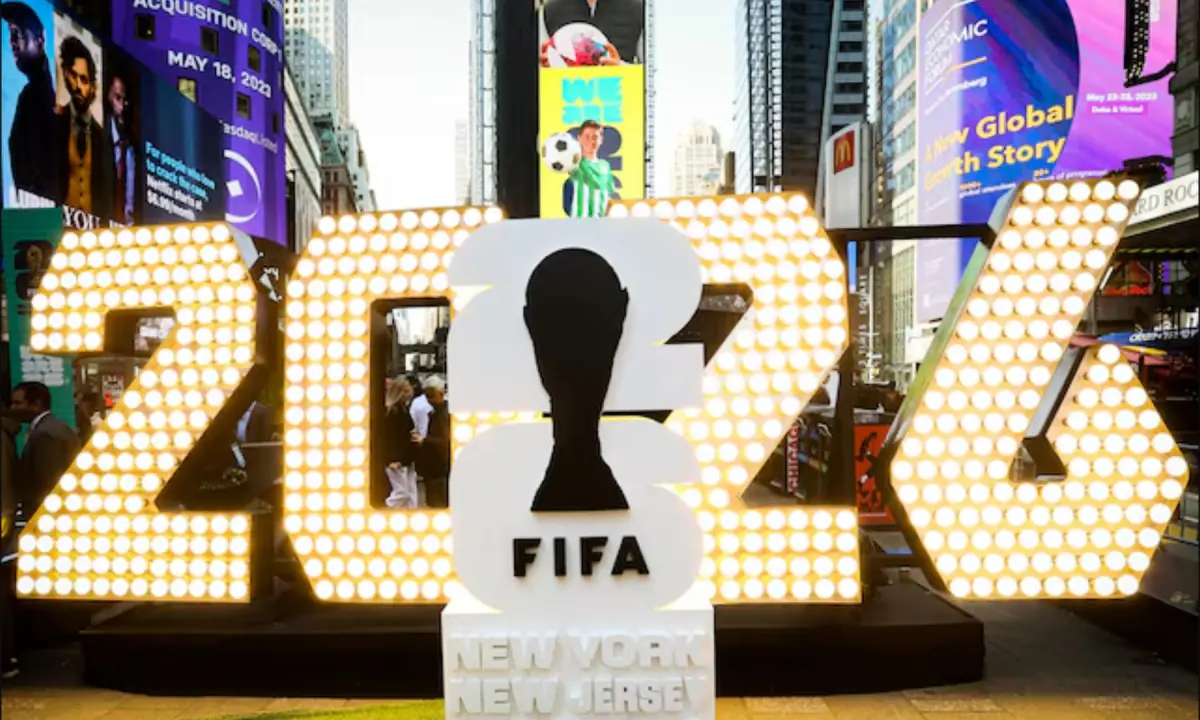
Header image: The FIFA World Cup 2026 logo is revealed during the kickoff event in Times Square in New York City, US on May 18, 2023. — Reuters/ File

