



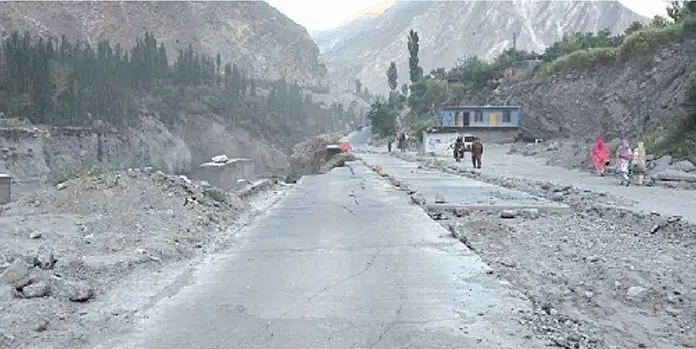

The Pakistan Meteorological Department (PMD) on Saturday issued an alert for glacial lake outburst floods (Glofs) in the upper regions of the country, including Gilgit-Baltistan and Khyber Pakhtunkhwa, due to a fresh westerly wave expected during the coming week.
A Glof refers to the sudden release of water and debris from a glacial lake, leading to the loss of lives, property, and livelihoods in mountain communities. Over 7.1 million people in GB and KP are vulnerable to the phenomenon, according to the Ministry of Climate Change.
In an alert issued on Saturday, the department said partly cloudy to cloudy weather accompanied by moderate to heavy rain and thunderstorms was expected to affect the glaciated valleys of GB and KP.
It highlighted that daytime temperatures were already “running above normal” in glaciated valleys.

“The combination of substantial warming and precipitation is likely to substantially accelerate snow and ice melt in the glaciated valleys of these regions,” it said.

It said that water levels in rivers were likely to remain high, existing glacial lakes may expand and new glacial lakes may form due to the large volume of melted water.
It warned that vulnerable downstream settlements and low-lying areas along riverbanks could face sudden inundation, while flash flooding remained a significant threat in susceptible locations.
It added that the rapid expansion of glacial lakes could destabilise natural ice or moraine dams, potentially triggering Glof incidents.
“The thawing of permafrost, combined with excess surface water, can trigger heavy mud and debris flows down mountain slopes,” it said.
The PMD advised residents and visitors in snow-bound and glaciated valleys to stay away from riverbanks, stream beds and local nullahs, and to closely monitor water bodies for sudden or gradual changes in water levels.
The advisory also urged people to avoid camping, trekking or staying near rivers, streams, glacial lakes and narrow mountain valleys during the forecast period, and to steer clear of unstable slopes where melting snow could trigger landslides or debris flows.
Residents were further advised to continuously monitor official weather forecasts and alerts issued by the PMD.
It also directed disaster management authorities and relevant departments to maintain round-the-clock alertness and take all necessary precautionary measures.
Pakistan is home to over 13,032 glaciers, the largest reservoir of glaciers outside of the polar regions. However, experts have warned that about 10,000 glaciers in Chitral and GB have been reported to be receding due to climate change–induced temperature rise.
In February, the National Emergencies Operation Centre (NEOC) issued an advisory regarding potential Glof risks from March to September 2026, citing anticipated rising temperatures, changing weather patterns, and possible early heatwave conditions in northern Pakistan.

