




Says Pakistan is making all-out efforts to bring the two parties to the negotiating table
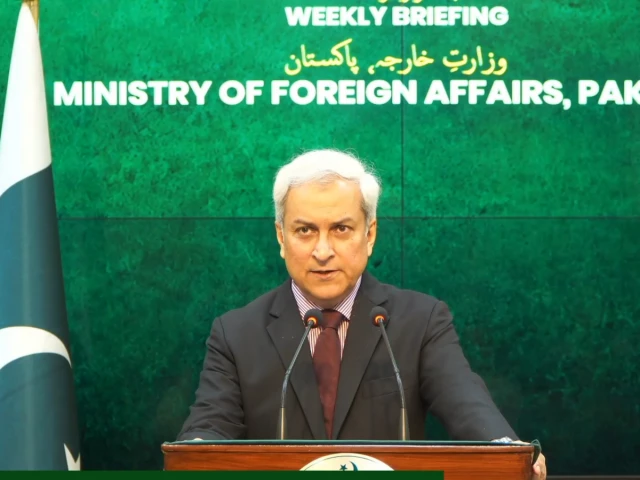
Foreign Office Spokesperson Tahir Hussain Andrabi speaking at the FO weekly press briefing in Islamabad. SCREENGRAB
Interior Minister Mohsin Naqvi’s visit to Tehran was focused on promoting “peace, stability and constructive engagement” among the parties in the region, Foreign Office (FO) spokesperson Tahir Andrabi said on Wednesday.
Naqvi landed in Tehran on Tuesday as part of Pakistan’s latest diplomatic push to help end the conflict between Iran and the United States and revive stalled negotiations between the two sides. His visit came as Islamabad sought to use its longstanding ties with Tehran, alongside its relations with Washington, to encourage a diplomatic resolution to the conflict.

Speaking at the weekly press briefing, Andrabi said the visit provided an opportunity to discuss bilateral relations, security-related matters and regional developments, with particular emphasis on efforts to promote peace and stability.

“His visit provides an opportunity to discuss bilateral relations, security-related matters, and regional developments, with a particular focus on efforts to promote peace, stability and constructive engagement amongst the parties in the region,” Andrabi said.
“Pakistan is making all-out efforts to bring the two parties to the negotiating table,” Andrabi said, adding that Islamabad sought to “pave the way for peace and stability in the region”.
“Pakistan will continue to offset spoilers using direct and indirect channels and enable continuation of constructive dialogue to resolve all outstanding issues,” he said.
Andrabi said Pakistan remained engaged alongside its “brotherly states” in sincere efforts to resolve the crisis in the Middle East and the Gulf.
The visit also came amid growing hopes of a possible breakthrough, with Defence Minister Khawaja Asif saying Washington and Tehran could be moving towards an agreement. “Things are shaping up again in favour of a peace arrangement or a deal,” Asif told Bloomberg News, adding that “the signals in the last two three days are that we are close to some sort of an arrangement.”
🔴LIVE: Spokesperson’s Weekly Press Briefing 12-08-2026 at Ministry of Foreign Affairs, Islamabad https://t.co/MMRHzhUaWE
— Ministry of Foreign Affairs – Pakistan (@ForeignOfficePk) August 12, 2026
Andrabi, speaking on the newly signed Makkah Joint Agreement, said that the pact was “purely defensive in nature” and would enable the three countries to make “unified efforts” to confront security threats and challenges.
The Makkah Joint Defence Agreement was signed by Pakistan, Saudi Arabia and Turkiye on Friday, establishing a framework for collective security and defence cooperation under which an armed attack on any one of the three countries would be considered an attack on all. The pact was built on a Strategic Mutual Defence Agreement signed by Pakistan and Saudi Arabia in September 2025, which contained a similar mutual-defence commitment.
Andrabi said the Makkah Joint Defence Agreement, signed at the August 7 summit in Makkah Al-Mukarramah, reflected the three countries’ resolve to “share the burden of regional peace and security” and strengthen “collective security”, Andrabi said at the Foreign Office’s weekly briefing.
Describing the summit as the “highlight of this week”, the spokesperson said the agreement represented a “natural step” in the long-standing brotherly relations between Pakistan, Saudi Arabia and Turkiye.
“The agreement is purely defensive in nature and allows unified efforts to confront threats and security challenges to the member states,” he said. Andrabi said the pact reflected the three countries’ commitment to promoting “peace, security and stability in the region and beyond”.
Read: US-Iran deal back in sight amid fresh diplomatic push
He said Pakistan had played a “pivotal role” in bringing the Makkah Accord to fruition, referring to Deputy Prime Minister and Foreign Minister Ishaq Dar’s description of the agreement as a “historic milestone”.
Dar had underscored that under the leadership of Prime Minister Shehbaz Sharif, Chief of Defence Forces Field Marshal Asim Munir and the Foreign Office, Pakistan had played a key role in finalising the accord, Andrabi said.
Dar had also commended the leadership for “safeguarding Pakistan’s national interest” and “strengthening strategic partnership with Saudi Arabia and Turkiye”.
Recounting the foreign minister’s activities this week, Andrabi said that FM Dar held three telephone conversations on August 10 with the foreign ministers of Saudi Arabia, Iran and Kuwait.
During his call with Saudi Foreign Minister Prince Faisal bin Farhan, Dar discussed bilateral and multilateral cooperation, regional developments and “the importance of close coordination”.
With Iranian Foreign Minister Abbas Araqchi, Dar exchanged views on regional and international developments, efforts to promote “peace and stability” and the Makkah Joint Defence Agreement, Andrabi said.
Read More: Iran downplays concerns over Makkah pact
Dar also spoke with Kuwaiti Foreign Minister Sheikh Abdullah Al-Sabah, with discussions focusing on the Makkah agreement, regional developments, Pakistan-Kuwait relations and follow-up to the Kuwaiti foreign minister’s visit to Pakistan, particularly regarding enhanced bilateral cooperation and investment.
On August 11, Dar spoke with Bahrain’s Foreign Minister Dr Abdullatif bin Rashid Al Zayani, who congratulated him on the signing of the Makkah defence agreement and expressed his intention to visit Pakistan. Dar welcomed the proposed visit and “reaffirmed Pakistan’s commitment to dialogue and diplomacy for regional peace and stability”, Andrabi said.
Dar also spoke with Canadian Foreign Minister Anita Anand on August 9, with the two sides discussing regional developments, including the Makkah agreement and the evolving US-Iran situation.
“The situation in Palestine, particularly East Jerusalem, was also discussed,” Andrabi said, adding that the two ministers agreed to “remain actively engaged” in their bilateral interactions.
Dar also spoke with Senegalese Foreign Minister Cheikh Niang, with the two ministers expressing their commitment to strengthening Pakistan-Senegal relations and cooperation on matters of mutual interest. They agreed to enhance “ongoing cooperation and coordination” at multilateral forums, particularly the United Nations, he said.
Andrabi said Dar also held telephone conversations with Democratic Republic of Congo President Félix Tshisekedi and former Guinea-Bissau president Sissoco Embaló on August 10.
He briefed them on the “contours and significance” of the Makkah agreement and its role in strengthening regional peace and security, while discussing further advancement of Pakistan-DRC relations through high-level exchanges.
Pakistan and New Zealand also held bilateral political consultations and a joint trade committee meeting, Andrabi said.
Also Read: Trump claims US controls Iranian money
The two sides discussed cooperation in economic development, science and technology, education, counterterrorism and people-to-people contacts and agreed to enhance cooperation at multilateral forums, particularly the United Nations.
The joint trade committee discussed bilateral trade and investment in agriculture, livestock, information technology, education and services, as well as cooperation in “sustainable agriculture, wool production, and plant protection”.
A key outcome was the signing of an education cooperation arrangement aimed at “deepening collaboration in the education sector” and strengthening ties between students and educational institutions.

