




• Only Rs1.13tr allocated to PSDP against Rs4.1tr requirement; minister terms shortfall ‘new circular debt crisis’
• Record Rs4.715tr development plan unveiled
• APCC resolves to divert resources to ongoing projects
ISLAMABAD: Under tight International Monetary Fund (IMF) oversight, the government has trimmed allocations for most sectors in the next federal development programme to create additional fiscal space for the PML-N’s trademark national highways, a new Rs87 billion share for coalition partners and a Rs70bn allocation for ruling party lawmakers’ schemes.
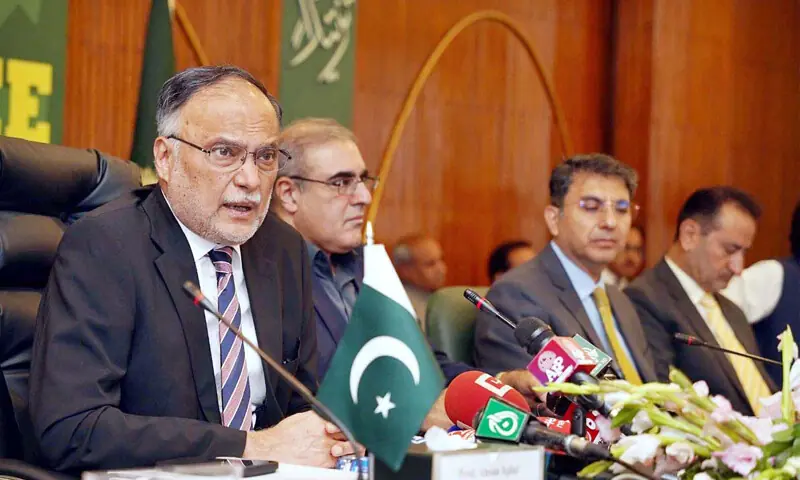
Yet, the Annual Plan Coordination Committee, led by Planning and Development Minister Ahsan Iqbal, on Monday unveiled a record national development programme of Rs4.715 trillion, made possible by an unprecedented 27pc hike in development allocations by state-owned entities and a 10pc rise in provincial allocations to an all-time high of Rs3.138tr.
The overall Rs4.715tr development portfolio comprises the largest share of provincial annual development plans (ADPs) at Rs3.138tr (up 9.6pc), followed by the federal Public Sector Development Programme (PSDP) of Rs1.126tr, up 12.6pc from the current year, and Rs451bn from SOEs, up 27pc from Rs355bn in the current fiscal year.

However, the federal PSDP allocation of Rs1.126tr for next year disappointed the planning minister, who described it as “a new circular debt crisis”, with almost Rs11tr in throw-forward liabilities from around 800 ongoing projects that would be impossible to complete over the next decade.

He said he had requested the prime minister for a minimum allocation of Rs2.9tr for development next year against actual requirements of Rs4.1tr, but the Ministry of Finance could spare only Rs1.126tr owing to IMF restrictions.
Mr Iqbal said development projects had come to a standstill over the past eight years after record development investments between 2013 and 2018. He said it should be a matter of shame that the country continued to celebrate raising foreign debt and issuing bonds to service liabilities instead of supporting export growth to finance national development and social welfare needs.
Even within the constrained PSDP allocation of Rs1.126tr, which includes Rs267bn in foreign assistance, about Rs125bn pertains to the N-25 highway in Balochistan, for which the prime minister had separately imposed an additional Rs10 per litre levy on petroleum products. This effectively leaves the PSDP size at Rs1.001tr — almost unchanged from the current year’s Rs1tr allocation, which was later reduced to Rs836bn to partially finance the impact of the closure of the Strait of Hormuz.
The government has allocated Rs264bn for national highways next year, up 18.4pc from Rs223bn in the current fiscal year, while the power sector has been earmarked Rs91bn, almost unchanged from this year’s Rs90.8bn.
The planning minister told the APCC that after allocating Rs87bn for coalition partners, Rs70bn for the Sustainable Development Goals (SDGs) Achievement Programme, Rs100bn for Balochistan projects excluding the N-25, and Rs153bn for AJK, GB and the newly-merged districts of KP, the actual PSDP allocation drops to a “disgraceful” Rs591bn. After meeting the Rs426bn rupee-cover requirement for foreign-funded projects, only Rs165bn remains available for other ongoing schemes.
The Rs3.138tr provincial development outlay is led by Punjab, which has allocated Rs1.450tr (46pc) for next year, up 17pc.
Sindh follows with a relatively restrained development allocation of Rs816bn compared to Rs887bn in the current fiscal year, a decline of 8pc.
KP has proposed a development envelope of Rs564bn for next year, up almost 24pc from Rs455bn in the current year.
In addition to substantial federal allocations, Balochistan has increased its ADP size to Rs308bn, up 10pc from Rs279bn this year.
Based on these financial envelopes, the government has set next year’s economic growth target at 4pc, supported by projected growth of 3.8pc in agriculture, 4pc in industry and 4.2pc in services. Inflation is targeted at 8.2pc.
Given the tight fiscal position, the APCC decided to make limited allocations, focusing on strategic and high-impact projects, ensuring adequate rupee cover for foreign-funded schemes to honour international obligations, prioritising projects with more than 70pc completion for early execution, avoiding token allocations, restricting new projects except those aimed at enhancing productivity, and discouraging projects of a provincial nature except in less-developed areas.
The sector-wise breakdown shows that the largest share — Rs729.9bn, or 65pc — has been earmarked for infrastructure projects, compared to Rs615bn budgeted in the current fiscal year, an increase of 19pc. Within infrastructure, transport and communications receive the highest allocation at Rs409bn (36pc), compared to Rs326bn in the current year, up 25pc. This is followed by water resources at Rs140bn (12.5pc), energy at Rs136bn (12pc), and physical planning and housing at Rs45bn (4pc).
The social sector has been allocated Rs187.2bn (16.6pc), including education (7pc), health (2.2pc), the SDGs Achievement Programme (6.2pc) and other social sectors (1.3pc). To help less-developed regions catch up with the rest of the country, Rs54.1bn (4.8pc) has been earmarked for AJK, GB and the newly merged districts of KP. The science, technology and information technology sector has been allocated Rs45bn (4pc), while governance and production sectors have been allocated Rs10.2bn and 0.8pc of the PSDP, respectively.
Iqbal lamented that the country was operating with an extremely reduced PSDP at a time when development needs were rising sharply. He said development space had been squeezed by mounting debt-servicing pressures, prolonged macroeconomic stress and worsening global headwinds. PSDP allocations, he noted, stood at 19.6pc of the national budget and 2.5pc of GDP in FY18, but had fallen to just 4pc of the budget and 0.6pc of GDP by 2025-26.
“The PSDP is not merely a budget line — it is a statement of national intent,” the minister said, stressing that development funding was directly linked to economic growth, national productivity and public welfare.
He warned that Pakistan was still struggling to recover from the post-2018 economic shock, with debt servicing burdens and recurring external vulnerabilities limiting the country’s ability to invest in transformative projects.
Given the limited fiscal space, the APCC decided that more than 98pc of available resources would be directed towards ongoing projects, with priority accorded to high-impact and near-completion schemes, particularly in water, energy, transport and other core infrastructure sectors.
Published in Dawn, June 2nd, 2026

