



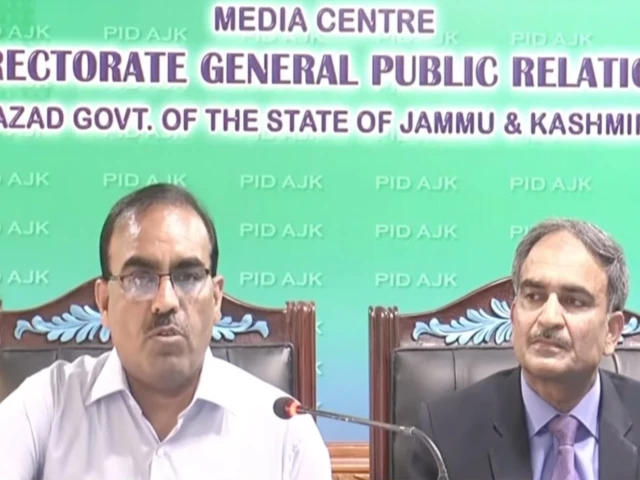

AJK Home Secretary Chaudhry Guftar Hussain addresses a press conference alongside Elementary and Secondary Education Secretary Qazi Inayat in Mirpur on Tuesday. SCREENGRAB
The Azad Jammu and Kashmir (AJK) government insisted on Tuesday that an operation against the banned Jammu and Kashmir Awami Action Committee (JAAC) had become unavoidable after an attack on security forces and civilians in Rawalakot left a Rangers official martyred and another injured.
Sources said armed groups affiliated with the banned JAAC opened fire in a civilian area near the Matial Maira Bus Terminal in Rawalakot on Tuesday morning. The attackers also fired automatic weapons at police officers when they moved in to control the law and order situation following the attack.
The sources said Rangers personnel reached the spot to assist the police in restoring law and order. However, the armed assailants not only opened direct fire on them but also used improvised explosive devices (IEDs). As a result, Ranger Naik Imtiyaz Ali was martyred, while another official was injured.

Read: Rangers personnel martyred in Rawalakot attack by banned JAAC armed groups

Later, addressing a joint press conference alongside the education secretary, AJK Home Secretary Chaudhry Guftar Hussain, said authorities had launched a clearance operation after the attack, adding that a full-fledged operation against the armed groups had become unavoidable to restore peace in AJK.
The home secretary said the banned JAAC had disrupted peace and normal life across the region for the past 38 days under the guise of a rights movement, while using intimidation and blackmail to advance an anti-Pakistan agenda aimed at maligning the Pakistan Armed Forces.
He alleged that traders had been threatened into shutting their markets, while students, women, and children were being used as human shields and young people were being pushed out of classrooms and into protest politics.
Hussain said normal life had been restored in most areas, educational institutions had resumed operations, and government institutions were fully mobilised to respond to all forms of intimidation and disorder in accordance with the law.
The home secretary told the media that Khawaja Mehran, identified as the leader of the banned organisation, had issued a 48-hour deadline to block all entry points into AJK. He added that similar threats had failed in the past, as people had distanced themselves from the banned outfit.
“The use of sophisticated automatic weapons and improvised explosive devices contradicts the banned committee’s claim of pursuing peaceful protests,” he said. “It makes a decisive operation unavoidable to free the public from armed miscreants.”
Hussain said law enforcement personnel were conducting a clearance operation at Baloch Bazaar to reopen the Kotli-Tarar Khal Road and other major highways. The operation would continue until all roads were secured, public safety restored, and the supply of essential commodities fully ensured.
Also Read: Former JAAC member urges leadership to withdraw Rawalakot long march, sit-in
Speaking at the same press conference, the elementary and secondary education secretary, Qazi Inayat, said that, after losing public support and seeing its own leaders distance themselves, the banned JAAC had adopted a new strategy of placing women, children, and students at the forefront of demonstrations as human shields.
“Involving children and students in protests endangers their lives and amounts to sacrificing the future of the younger generation for political purposes,” he said.
Inayat added that the department had directed all educational institutions in Rawalakot to keep students away from all protest activities.
He warned there was a serious risk that students in school uniforms could be used as human shields during demonstrations. He added that educational institutions had been instructed to closely monitor students’ attendance and movement and immediately inform parents if any such situation arose.
The home secretary warned that legal action would be taken against any institution or administration found violating official directives or allowing students to participate in protests.
“Schools and colleges, not protest camps, are the rightful place for students,” he added.
Both officials stressed that public and private institutions were functioning as usual and that medical and other colleges had reopened in Muzaffarabad, Mirpur, Kotli, and other areas. They added that summer camps for board classes had also commenced in Muzaffarabad, Mirpur, Kotli, Leepa, and Kel.
They urged the people of Rawalakot to reject disruptive elements and cooperate with the state so that businesses, transport services and educational institutions could return to normal.

