



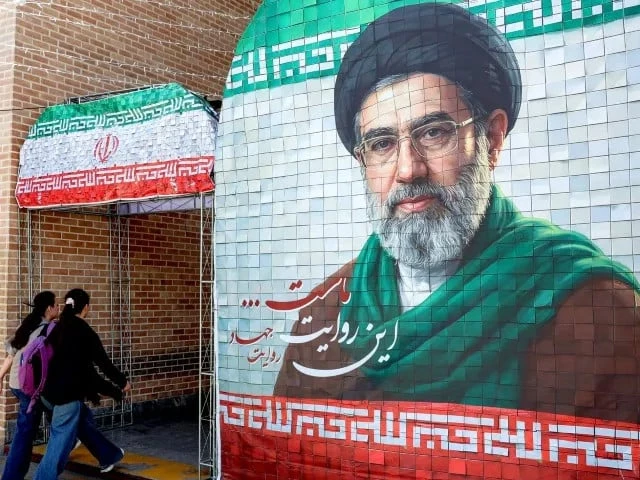

Iran accused the United States of violating a ceasefire by targeting two ships at the Strait of Hormuz
WASHINGTON/TEHRAN:
World capitals and markets were waiting on Thursday for Tehran to respond to Washington’s latest proposed deal to end the war in the Middle East and to reopen the key shipping lane out of the Gulf.

Iran accused the United States of violating a ceasefire by targeting two ships at the Strait of Hormuz and attacking civilian areas, the country’s top joint military command said early on Friday.

US military naval units operating in the area of the Strait of Hormuz came under Iranian missile fire following an attack by the US military on an Iranian oil tanker, Iranian state media, citing an unnamed military official, said on Thursday.
US military vessels were forced to retreat after sustaining damage from Iranian missile strikes, it added. It was unclear when the incident happened.
Iran’s semi-official news agency Tasnim reported that three US destroyers near the Strait of Hormuz were targeted in an attack by the Iranian navy.
The US military on Thursday carried out strikes on Iran’s Qeshm port and Bandar Abbas, a Fox News reporter said in a post on X, citing a senior US official.
The official said the strikes do not mean a restarting of the war or an end to the ceasefire announced on April 7, according to the post.
Asian stocks soared and oil prices fell after US President Donald Trump said once again that an agreement could be near after positive talks, and Iran said it would pass on its latest position to mediator Pakistan.
Any agreement to prolong the ceasefire between the United States and Iran could also lower tensions in Lebanon, where an already fragile truce with Israel was under renewed strain after a strike on southern Beirut killed a Hezbollah commander.
The war, launched by the United States and Israel in late February, has seen Iran respond with attacks across the Middle East and impose a chokehold on the Strait of Hormuz, the gateway to the Gulf oil and gas industries and a strategic trade route.
Trump had this week briefly launched a naval operation to escort commercial vessels and force open the strait, only to stand it down within hours, citing progress on negotiations with Iran, which have been mediated by Pakistan and supported by Washington’s Gulf Arab allies.
“We’ve had very good talks over the last 24 hours, and it’s very possible that we’ll make a deal,” Trump told reporters on Wednesday, adding his now habitual threat to return to bombing if Tehran refuses to back down to US demands.
Iran’s foreign ministry spokesman Esmaeil Baqaei said the US proposal remained “under review” and Tehran would communicate its position to mediator Pakistan “after finalising its views”.
According to a report from US network NBC News, Trump’s U-turn came after Saudi Arabiawhose Crown Prince Mohammed bin Salman reportedly talked directly to Trumprefused to allow US forces to use its airspace and bases for the operation to force passage through Hormuz.
US news outlet Axios, citing two officials, reported that both Tehran and Washington were close to agreement on a one-page memorandum of understanding to end the war and set a framework for negotiations on Iran’s nuclear programme.
The wider Middle East war, launched by the US and Israel in late February, has seen Iran respond with attacks across the Middle East and impose a chokehold on the Strait of Hormuz, the gateway to the Gulf oil and gas industries and a strategic trade route.
Around 1,500 ships and 20,000 international crew are now trapped in the Gulf region because of the conflict, the secretary general of the UN’s International Maritime Organization, Arsenio Dominguez, told a Maritime Convention of the Americas meeting in Panama.
Trump had this week briefly launched a naval operation to force open the strait to commercial vessels, only to stand it down within hours, citing progress on negotiations with Iran.
“We’ve had very good talks over the last 24 hours, and it’s very possible that we’ll make a deal,” Trump said on Wednesday, adding his now habitual threat to return to bombing if Tehran refuses to meet US demands.
Iran’s foreign ministry spokesman Esmaeil Baqaei has said Tehran will communicate its position to mediator Pakistan “after finalising its views”.
But, inside Iran, many civilians were cynical about the talks.
“Neither side in these negotiations is really capable of reaching an agreement,” 42-year-old photographer Shervin told AFP reporters in Paris, messaging from Tehran.
“This is another one of Trump’s games; otherwise, why are so many warships and military forces being sent toward Iran?”
According to a report from US network NBC News, Trump’s U-turn came after Saudi Arabiawhose Crown Prince Mohammed bin Salman reportedly talked directly to Trumprefused to allow US forces to use its airspace and bases for the Hormuz operation.
Asked by AFP, a Saudi source close to the government denied the report.
US news outlet Axios, citing two officials, reported that both Tehran and Washington were close to agreement on a one-page memorandum of understanding to end the war and set a framework for negotiations on Iran’s nuclear programme.
Trump has claimed that Iran’s leadership is divided in the wake of the deaths of many senior figures in US and Israeli strikes.
But President Masoud Pezeshkian said Thursday he had met with the country’s new supreme leader Mojtaba Khamenei, who has not been seen in public since his appointment in early March.
“What struck me most during this meeting was the vision and the humble and sincere approach of the supreme leader of the Islamic revolution,” Pezeshkian said, in a video broadcast by state television.
Meanwhile, oil prices fell again on optimism for a peace deal, tumbling by five percent on Thursdayafter having fallen around 10 percent over the previous two days.
International benchmark Brent North Sea crude and the main US contract, West Texas Intermediate, were still higher than before the war, but below the symbolic $100 level.
Markets have been thrown into turmoil by the closure of the Strait of Hormuz, which in peacetime carries a fifth of the world’s oil and LNG trade as well as much of its fertiliser.

