




Says Doha talks ‘going well’, but warns of shift in calculus if Tehran rebuilds nuclear programme
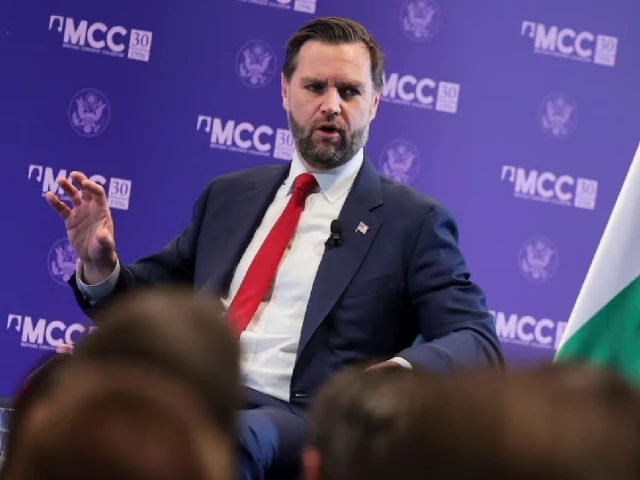
Vice President JD Vance. Photo: Reuters
United States Vice President JD Vance said on Wednesday that US President Donald Trump did not intend to restart military operations in Iran without a “clearly defined purpose”.
“What I can commit to is the president’s not going to send our military back in unless he has to,” Vance told reporters.

He warned that any Iranian attempt to rebuild its nuclear programme or target commercial vessels would change Washington’s strategy.

Vance confirmed that ongoing discussions in Doha were “going well”, noting that the administration remained focused on negotiating in “good faith”.
“We’re obviously going to give the negotiations as much of a chance to succeed as possible,” he said.
The vice president also addressed internal Iranian politics, claiming that many in Tehran now recognised previous decades of governance as a “mistake”. “We think we see a lot of momentum for the people who are trying to turn over a new leaf,” Vance said, but acknowledged that some remain attached to “old ways”.
Meanwhile, Bloomberg reported that US negotiators Steve Witkoff and Jared Kushner held “positive” discussions in Qatar this week as Washington and Tehran work toward a permanent resolution to their months-long war.
A senior administration official noted that progress was being made on technical talks intended to solidify the broad framework of the recently signed peace memorandum.
The current 60-day negotiating window, which began last month, aims to address critical issues including sanctions relief, nuclear verification, and the total reopening of the Strait of Hormuz.
Meanwhile, the Wall Street Journal reported that Trump recently discussed a potential return to all-out war with top military advisers, including Defence Secretary Pete Hegseth, but had decided to prioritise diplomacy for now.
Trump was said to have expressed concerns that another wave of full-scale attacks would “derail diplomacy” and hinder efforts to dismantle Iran’s nuclear programme.
Officials speaking to the Journal indicated that the US president was willing to allow negotiations to continue beyond the initial August 18 deadline for an agreement to ensure the process remained viable.
Despite the optimistic tone from the White House, Tehran officially denied that any direct meetings were scheduled with American representatives, insisting that all consultations occurred via intermediaries.
Iran says part of initial $6b in frozen assets to fund purchase of ‘needed goods’
Iran announced that part of the initial $6 billion in frozen assets would be used to purchase “needed goods” following talks in Doha.
According to the official IRNA news agency, Kazem Gharibabadi, Iran’s deputy foreign minister for legal and international affairs and chief negotiator, said discussions with Qatari officials included issues related to spending part of the funds.
“During meetings with Qatari officials, some issues related to spending part of the initial $6 billion were reviewed, and it was decided that, based on our country’s declared needs, the purchase of needed goods would be carried out and made available to Iran,” Gharibabadi said.
He made the remarks after concluding a round of talks in Doha, where an Iranian delegation held meetings with Qatari and Pakistani mediators to follow up on the implementation of the Islamabad memorandum of understanding with the US.
The Iranian official said the three sides decided to establish an “urgent communication channel” to formally document and review implementation of the memorandum.
Gharibabadi also reiterated that “no direct meeting” had taken place between the Iranian and US delegations in Doha.
Trump says denuclearisation ‘taking place’ after US negotiators held ‘very good meetings’ with Iran
Earlier, Trump said the US was getting along very well with Iran and that recent meetings in Qatar had gone well on the denuclearisation of Tehran.
“The denuclearisation of Iran is moving along well,” Trump told reporters. “They’ve had very good meetings, and we’ll see.”
The US and Iran held technical talks in the Qatari capital of Doha on Wednesday as they seek to agree on the flow of shipping through the Strait of Hormuz and secure a lasting ceasefire, a source with direct knowledge of the talks and an Iranian official said.
Trump’s son-in-law Jared Kushner and envoy Steve Witkoff met the prime minister of Qatar — a mediator in the talks alongside Pakistan — to lay the groundwork for the negotiations, but would not be attending the discussions themselves, the source with direct knowledge of the talks said.
“We’re getting along very well,” Trump said, adding Iran has “come a long way.”
“I think they’re fine,” the president added.
US-Iran indirect talks in Qatar focus on release of funds, Strait of Hormuz
Indirect talks between Tehran and Washington have been ongoing since Tuesday night in Doha, a senior Iranian official told Reuters on Wednesday, adding that discussions were focused on the release of Tehran’s funds and the Strait of Hormuz.
“Indirect negotiations began on Tuesday night. Iran held meetings with Qatari and Pakistani officials, who in turn met with the US side. The indirect talks continued on Wednesday, focusing on Iran’s frozen assets and the Strait of Hormuz,” the official said.
Araghchi warns Israel of powerful response over Katz’s remarks
Iran’s Foreign Minister, Abbas Araghchi has reacted strongly to a post in which Israeli Defence Minister Israel Katz said Iran’s supreme leader, Mojtaba Khamenei, was “marked for death.”
“The terms of the Islamabad MoU are crystal clear and public for all to see,” Araghchi said. “POTUS has committed the US to muzzling its pets in Tel Aviv. If they ignore their master, Iran will school them.”
In quotes shared by Israeli media on Monday, Katz described the Iranians as “good merchants” trying to extract concessions in negotiations and said Israel would not allow Iran to produce nuclear weapons.
In response, Araghchi said that “any threat against our People and Leadership will receive an immediate, powerful response.”
Israel could strike Iran ‘a third time’, defence minister says
Israeli Defence Minister Israel Katz says Israel could target Iran again “if it deems it necessary” despite ongoing US efforts to pursue diplomacy Al Jazeera.
Speaking at a memorial ceremony for those killed in the 2006 war in Lebanon, Katz said: “We have attacked twice with proactive, preemptive strikes in Iran and, if necessary, we will strike a third time as well.”
Israeli forces will remain indefinitely in what he called “security zones” in Lebanon, Syria and Gaza to protect Israeli communities, he added.
US will be in ‘great position’ even if Iran talks fail: Vance
US Vice President JD Vance told Fox News on Wednesday that the Trump administration was in a “great position” regardless of how the talks pan out.
The US “obviously” wanted the talks to succeed, Vance said, but added that his country was “still in a much stronger position” than Iran even if they fail. He insisted that Tehran’s nuclear programme and military had been “destroyed” and warned that Trump had made clear that any Iranian attacks on shipping in the Strait of Hormuz would prompt a US military response.
Vance again said Iran would be “permanently transformed” if negotiations aimed at securing a lasting settlement are successful.
Earlier, the vice president said oil traffic in the Strait of Hormuz has reached its pre-war height, and that technical talks with Iran continue, though Tehran denies holding peace talks with the US.
Ship runs aground in Hormuz after leaving Iran-designated route: Reports
A foreign vessel ran aground in the Strait of Hormuz on Wednesday after deviating from a navigation route designated by Iranian authorities, according to Iranian state broadcaster IRIB.
It reported that the ship left the assigned transit lane before running aground in the strategic waterway.
No immediate information was available on the vessel’s identity or flag.
The incident comes after Iran introduced new navigation procedures for commercial shipping through the Strait of Hormuz under the Islamabad Memorandum of Understanding between Washington and Tehran. The rules require vessels to follow designated routes and coordinate passage with Iranian authorities to ensure safe navigation.
Iran’s Islamic Revolutionary Guard Corps (IRGC) said early Thursday that safe passage through the strait is only possible via Tehran-approved routes, calling any uncoordinated navigation “unacceptable” and “completely dangerous.”
Under the memorandum’s fifth clause, Iran has committed to facilitating safe passage for commercial vessels through the strait for 60 days while carrying out mine-clearance operations.
China urges US, Iran to advance negotiations amid Doha talks
China on Wednesday urged the US and Iran to advance negotiations toward a comprehensive solution to the conflict.
Speaking to reporters in the Chinese capital, Foreign Ministry spokesman Guo Jiakun said Beijing “has always believed that unilateral sanctions on Iran should be lifted at an early date.”
“We hope the US and Iran will jointly implement the (Islamabad) Memorandum of Understanding, which has already been signed and move negotiations forward to promote a comprehensive solution… at an early date,” Guo said.
The statement came as Qatar was hosting US and Iranian delegations for separate talks on Tuesday and Wednesday.
The White House envoys travelled to Doha after US President Donald Trump announced on Monday that Iran had requested a meeting in the Qatari capital.
Iran, however, denied that any direct talks with Washington are scheduled, while saying consultations with intermediaries continue.
Deadly Minab school attack will not be forgotten: Iran’s UN envoy
Ambassador Ali Bahreini says Iran will not allow the world to forget the attack as he held a virtual meeting with survivors and witnesses, according to Al Jazeera.
The missile strike on February 28 – when the US and Israel launched their unprovoked attack on Iran – killed at least 168 children and teachers. The victims were mostly young girls and boys.
According to Iranian state media, Bahreini said: “The duty of justice demands that we ensure the victimisation … and crimes against civilians are not forgotten over time. Today, there is no country that does not recognise the criminal nature of this attack or is unfamiliar with the name of Minab school.”
Neither the United States nor Israel has owned up to the school strike. “Without any doubt, responsibility for this act lies with the United States and Israel as the aggressors,” said Bahreini.
‘Right to bear arms a Lebanese matter and a necessity’: Official
The head of Lebanon’s Finance and Budget Committee, Ibrahim Kanaan, met with President Joseph Aoun to discuss the ceasefire with Israel signed in Washington, DC, and the next course of action for the government, according to Al Jazeera.
“The state’s right to bear arms is a Lebanese matter and a necessity for the protection of Lebanon, particularly in the aftermath of the war,” the Lebanese Presidency quoted Kanaan as saying in a post on X.
“After the meeting, my conviction and commitment to the goals of the president of the republic grew even stronger, foremost among them the full liberation of the land in accordance with international borders, the return of the displaced, and then reconstruction.”
The post quoted him as adding: “National unity is the foundation – undermining it today will only reinforce division and occupation and bring about the destruction of the homeland.”
Iran says it won’t meet with US envoys
Iran said on Tuesday it would not meet with top US envoys who flew to the region following an outbreak of hostilities, clouding the prospects for a lasting peace between the two countries.
Iranian officials also said the two sides must still sort out the terms of a ceasefire they signed two weeks ago before they could tackle more difficult topics, such as possible limits to its nuclear program.
The developments indicated the two sides are far apart on key pillars of the initial framework, which calls for Iran to lift its chokehold on the Strait of Hormuz in exchange for financial incentives, and sets up 60 days of negotiations to work out a permanent peace deal.
US President Donald Trump’s son-in-law Jared Kushner and envoy Steve Witkoff arrived in Doha for what the White House described as “high-level” talks, but Iran and host Qatar said they would meet with mediators, rather than the Iranians themselves.
Qatar said Prime Minister Sheikh Mohammed bin Abdulrahman al-Thani was among those to meet with Witkoff and Kushner.
Read: Iran says officials to meet Qatari mediators in Doha tomorrow, rules out direct talks with US
“No meeting at any level with the American side has been scheduled for the coming days,” Iranian Foreign Ministry spokesperson Esmaeil Baghaei said.
The two countries were due to commence lower-level technical talks, according to Majed al-Ansari, spokesperson for Qatar’s foreign ministry.
Trump said to be contemplating strikes
Looking for ways to break the deadlock, Trump has weighed a return to all-out war, holding conversations with Defence Secretary Pete Hegseth and Chairman of the Joint Chiefs of Staff General Dan Caine on conducting more strikes, the Wall Street Journal reported, citing US sources familiar with the discussion. Reuters could not immediately confirm the report.
But for now Trump, who has publicly threatened Iran with more attacks, has decided to give diplomacy more time, the report said.
Shipping has partially resumed through the strait, which handled one-fifth of global oil and liquefied natural gas before the war broke out on February 28.
But Iranian officials said they had a right to manage traffic along with US ally Oman, which lies on the other side of the strategic waterway, and would impose tolls in mid-August when the 60-day period expires.
“The sovereignty of the Strait of Hormuz lies with Iran and Oman, and traffic in the Strait is subject to arrangements determined by Iran,” Iran’s top negotiator, Mohammed Baqer Qalibaf, said on state TV.
US Vice President JD Vance said Iran would be prevented from charging tolls through the international waterway, telling The Michael Knowles Show, “This is not going to end in a place where the Iranians are collecting tolls on ships going through the Strait of Hormuz.”
Vance also said in the interview recorded on Monday but released on Tuesday that oil flows through the Strait of Hormuz had returned to pre-war levels, even exceeding those on some days, without citing figures.
Despite the uncertainty, oil prices have fallen since the weekend, when the US bombed Iranian military facilities in response to drone strikes on commercial ships, and Iran attacked US military sites in Kuwait and Bahrain.
Vulnerable economies, however, could remain at risk from food and fuel price increases even after energy markets feel relief, the UN trade and development agency said on Tuesday.
The war pushed up global inflation and has put Trump under political pressure before the midterm elections in November that will determine control of the US Congress. Trump and Treasury Secretary Scott Bessent are both urging gasoline retailers to lower prices.
The interim deal between the US and Iran also provides for an end to the conflict between Israel and Iran-backed militant group Hezbollah in Lebanon.
But Lebanon’s powerful parliament speaker, Nabih Berri, an ally of Hezbollah, cast doubt on a separate, US-brokered framework deal between Lebanon and Israel to halt that war.
Analysts said the deal risks entrenching a stalemate by tying Israel’s withdrawal from southern Lebanon to Hezbollah’s disarmament.

