




New tariffs expected, but trade partners worldwide strongly dispute justification
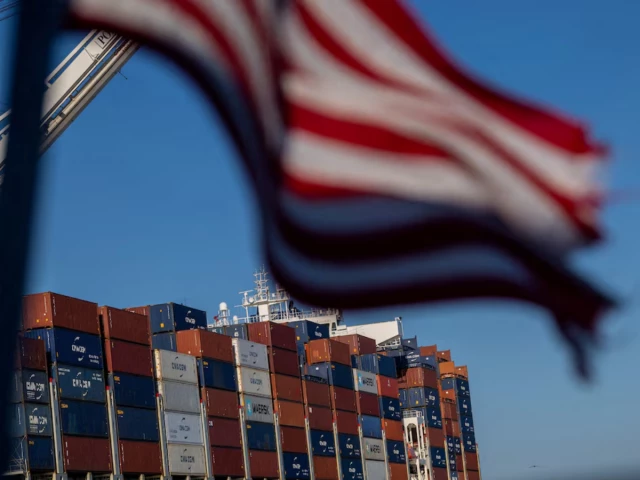
A cargo ship full of shipping containers is seen at the port of Oakland, California, US. Photo: Reuters
US President Donald Trump is moving ahead with sweeping new tariffs on dozens of America’s trading partners, escalating global trade tensions just as a temporary set of stopgap levies expires.
The Trump administration announced on Thursday it will impose tariffs ranging from 10 to 12.5 per cent on imports from 60 countries, covering roughly 99 per cent of US imports. The move comes after a legal setback earlier this year, when the US Supreme Court struck down some of Trump’s most ambitious tariff measures.

The new duties will take effect at 12:01 am Friday in Washington, DC (04:01 GMT), coinciding with the expiration of temporary 10 per cent tariffs that had been introduced as an interim measure following the court ruling.

Washington has justified the fresh tariffs by accusing trading partners of failing to adequately enforce bans on goods produced through forced labour. US Trade Representative Jamieson Greer defended the decision, saying the move was long overdue.
“The United States has had a forced labour import ban for nearly a century, and rigorously enforces it; it’s well past time for our trading partners to do the same,” Greer said in a statement on Thursday. “Today’s action will begin to correct what is both a human rights abuse and a distortive trade practice to improve the welfare of workers everywhere.”
However, the announcement has triggered sharp criticism from governments across the globe, with many rejecting both the legal and moral basis of the tariffs.
European officials were quick to challenge Washington’s justification. Kaja Kallas, Vice President of the European Commission, questioned the premise of the move, highlighting the bloc’s labour protections.
Read More: US imposes new 50% tariffs on $20 billion worth of Canadian products
“If you compare our labour laws to those of the United State, I mean we have paid vacations, we have very good labor conditions for our employees, so it is not really grounded,” she said.
Brazil also condemned the decision, accusing the Trump administration of disguising protectionism under the banner of human rights.
“Lacking a legal basis under domestic law to support its protectionist trade policy, the US Trade Representative chose to manipulate an issue of great importance to human rights and worker rights movements,” a Brazilian government spokesperson said.
China, the world’s second-largest economy, voiced strong opposition, warning against the broader implications of escalating trade barriers.
“We oppose all forms of unilateral tariff measures. Tariff wars and trade wars are not in the interests of any party,” Foreign Ministry spokesperson Lin Jian said.
Australia echoed similar concerns, rejecting the US stance and defending its own record on labour standards.
“We continue to maintain that these tariffs are unjustified. Australia is a country that deals with the issue of modern slavery seriously,” Minister of Trade and Tourism Don Farrell said.
France also warned that the move could deepen uncertainty in the global economy. “It [new tariffs] creates more uncertainty for world trade and clearly it’s not favourable for growth,” Bank of France Governor Emmanuel Moulin said.
The latest measures mark a renewed push by the Trump administration to reshape global trade flows, but analysts warn they could further strain relations with key allies and partners at a time when economic stability remains fragile. (With additional input from agencies)

