


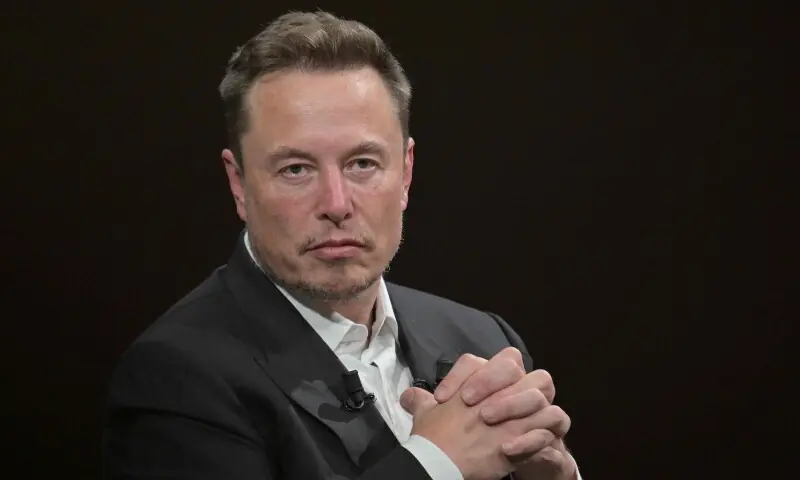

Few business leaders have been as deeply embedded in popular culture as Elon Musk, the ambitious entrepreneur who has become a central figure in internet culture and amassed a fortune that has made him the world’s first trillionaire.
At a time when concerns about inequality are high and public attitudes toward the ultra-wealthy have soured, Musk has managed to retain a loyal following despite his stratospheric net worth and without the folksy persona that endeared other tycoons such as Warren Buffett to the masses.
While admirers view Musk’s no-filter style as part of his appeal, critics have accused him of wielding oligarch-like power, raised concerns about governance at his companies and objected to his increasingly partisan political interventions.
Still, SpaceX, the sprawling rocket, satellite and AI company that, together with electric-car maker Tesla, forms the centre of Musk’s empire, raised a record $75 billion in its initial public offering (IPO) on Thursday, highlighting investor enthusiasm for his business ventures.

SpaceX IPO sale
SpaceX priced the biggest-ever US IPO at $135 per share, making Elon Musk’s rocket and spacecraft manufacturer one of the world’s most valuable companies.

The IPO raised a record $75bn on the sale of 555.56 million shares, valuing the space, satellite and AI provider at $1.77 trillion, a record for an initial offering.
Thursday’*s pricing caps off a months-long effort that realised Musk’s most ambitious project yet even as he stood a handful of financial traditions on their heads, and as some analysts question whether its lofty valuation is justified.
SpaceX will rank seventh among US-listed firms when its shares begin trading on the Nasdaq on Friday, though it lost money last year and other mega-caps far outpace its revenue.
Elon Musk’s net worth
Prior to the share sale, Forbes pegged his net worth at roughly $780bn, far ahead of the man next in line, Alphabet co-founder Larry Page.
“The second richest person has been hovering around $300bn, so about less than one-third of what Musk can potentially be worth tomorrow,” said Matt Durot, deputy editor at Forbes Wealth.
“And only one other person (Oracle founder) Larry Ellison has ever been worth $400bn.
Most of Musk’s wealth now rests with SpaceX, where he holds a stake worth roughly $866bn.
Along with Tesla and the rest of his properties, his net worth will exceed $1.1tr when the stock begins trading on Friday, according to Reuters calculations based on company filings.
The tally includes stock components that would vest over time.
Musk became a household name through Tesla and SpaceX before expanding his influence with the $44bn acquisition of social media platform Twitter (now X) in 2022.
The deal gave him a direct channel to hundreds of millions of users and made him a prominent voice on issues ranging from politics and immigration to government spending and free speech.
His move into politics, particularly his role in US President Donald Trump’s Department of Government Efficiency (DOGE) last year, has been among his most contentious ventures.
The political fallout coincided with weakening Tesla sales in several international markets in 2025 as protests and consumer boycotts targeted the electric vehicle maker.
The Elon premium
Musk, 54, was born in Pretoria, South Africa, to a Canadian mother and South African father. He attended the University of Pennsylvania, graduating in 1997.
He took over as Tesla’s CEO in 2008 with the conviction that electric vehicles could combine high performance with software-driven features, helping redefine the global automotive industry.
Some auto-industry watchers say Tesla’s success and its trillion-dollar-plus market cap helped prod traditional automakers to pivot to electric cars.
Many investors are betting he can repeat the feat in space and artificial intelligence. Yet SpaceX remains cash-hungry, and much of the company’s valuation rests on technologies that may take years or decades to become commercially viable.
Beyond Tesla and SpaceX, Musk has co-founded five other companies, including tunnelling startup The Boring Company and brain implant maker Neuralink.
As CEO of Tesla, Musk has courted controversy and praise in equal measure. He is credited with turning Tesla into the world’s most valuable automaker.
Executives at legacy automakers dismissed the threat for years, sceptical that a startup car company could figure out how to mass produce electric vehicles profitably.
He renewed the world’s respect for American ingenuity in automotive engineering, said Bob Lutz, a former General Motors vice chairman.
At the same time, Tesla has faced legal challenges and shareholder concerns tied to its storied CEO, particularly his 2018 pay package, once worth $56bn.
Musk’s influence has become so pervasive that market observers have dubbed the network of businesses around him the “Muskonomy.”
The phenomenon has given rise to what some investors call the “Elon premium,” a valuation boost driven as much by faith in Musk’s vision as by traditional financial metrics.
“Much like Tesla, SpaceX is a bet on Elon Musk,” said Matt Kennedy, senior strategist at Renaissance Capital, a provider of IPO-focused research and exchange-traded funds.
“A market cap of $1.5tr-$2tr would certainly throw all traditional valuation methodologies out the window, and is instead best characterised as the ‘Elon Musk premium’.”
Musk unfiltered
The concentration of influence around a single entrepreneur has amplified concerns about corporate governance, conflicts of interest and the risks of tying company fortunes too closely to one individual.
Over the years, Musk has turned clashes with regulators, billionaires, short sellers, journalists and media organisations, including Reuters, into recurring public battles that often unfolded on social media.
Musk’s alliance with Trump followed a familiar pattern. After helping bankroll Trump’s return to the White House and serving in a senior advisory role through the administration’s DOGE initiative, Musk became one of the president’s closest corporate allies.
The relationship later fractured amid disagreements over policy and spending, spilling into a public feud. Though the two have since struck a more conciliatory tone, their falling-out highlighted the increasingly blurred lines between Musk’s business empire and political ambitions.
Yet for many investors, concerns about Musk’s often unconventional behaviour are outweighed by his track record of turning ambitious ideas into some of the world’s most valuable companies.
“Elon is the Edison of our time,” JPMorgan Chase CEO Jamie Dimon said during a recent conversation with Musk.
The banker, a former adversary of Musk in a prolonged legal battle, has since become an admirer. Dimon told CNBC last year that the pair had “hugged it out,” and he hailed Musk as “our Einstein.”