



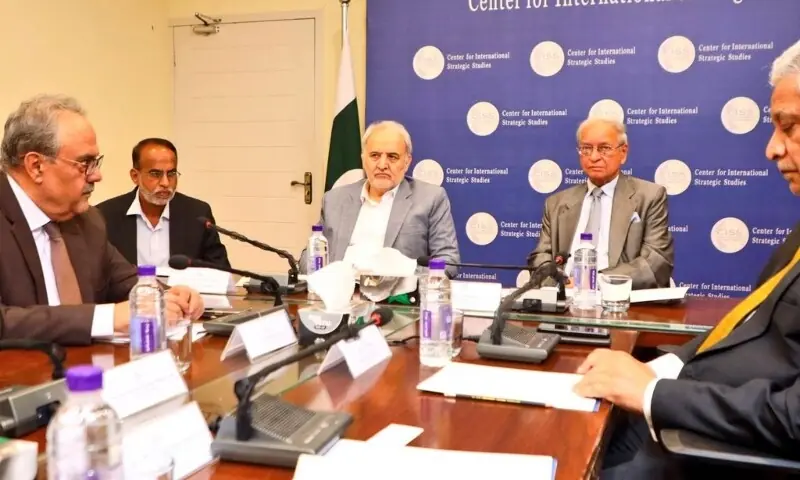

ISLAMABAD: Iran’s Ambassador to Pakistan Dr Reza Amiri Moghadam believes the region could witness new political alignments once the ongoing war involving the United States and Israel comes to an end.
He was speaking at a roundtable hosted by the Centre for International Strategic Studies (CISS), Islamabad, where diplomats, academics and policy practitioners discussed the future course of Pakistan-Iran ties and the evolving regional situation as the conflict continues under what participants described as a delicate ceasefire.
The Iranian envoy, reflecting the thinking in Tehran, said Iran considers its relationship with Pakistan a priority in the neighbourhood.

While noting that Iran maintains relations with other states, including India, he said Pakistan remained a key partner and the relationship was steadily growing stronger.
The envoy said Iran had consistently pursued friendly relations with neighbouring countries, but predicted that the recent war could significantly reshape regional order. He suggested the conflict could lead to a decline in US influence and further isolation of Israel.
Dr Moghadam said Pakistan-Iran ties had strengthened considerably and raised prospects for a broader regional alliance comprising Iran, Turkiye, Saudi Arabia, Egypt and Pakistan after the war ends.
Dr Moghadam thanked Pakistan for what he called steadfast support during difficult times and for facilitating contacts between Washington and Tehran.
He said the two countries shared strong brotherly relations and reaffirmed that Iran would never allow its territory to be used against Pakistan.
Former ambassador Asif Durrani said the Chabahar and Gwadar ports should be viewed as complementary rather than competing projects.
He said Gwadar could potentially serve as a mother port to support wider regional connectivity and trade integration.
Ambassador Durrani said Pakistan’s diplomatic approach reflected engagement with the United States while preserving brotherly ties with Iran.
He stressed that it was a carefully calibrated policy aimed at de-escalation, extending the ceasefire and working towards a durable settlement, while ensuring regional stability and economic security.
Prof Dr Nazir Hussain, former dean of the Faculty of Social Sciences at Quaid-i-Azam University, said Pakistan and Iran shared deep historical and cultural linkages and had made efforts in recent years to improve coordination, expand border trade and strengthen institutional engagement.
He said there remained significant untapped potential for economic cooperation, particularly in energy, trade and connectivity, with both sides increasingly viewing each other as important partners for regional stability and development.
Earlier, in his welcome remarks, Executive Director of CISS Ambassador Ali Sarwar Naqvi said Pakistan played a constructive role in facilitating a ceasefire between the United States and Iran on April 7, followed by direct bilateral talks on April 11 and 12 after decades of estrangement.
He said Pakistan’s mediation efforts were continuing after the extension of the ceasefire and Islamabad remained committed to supporting initiatives that promote peace and stability in the region.
Published in Dawn, May 9th, 2026


