



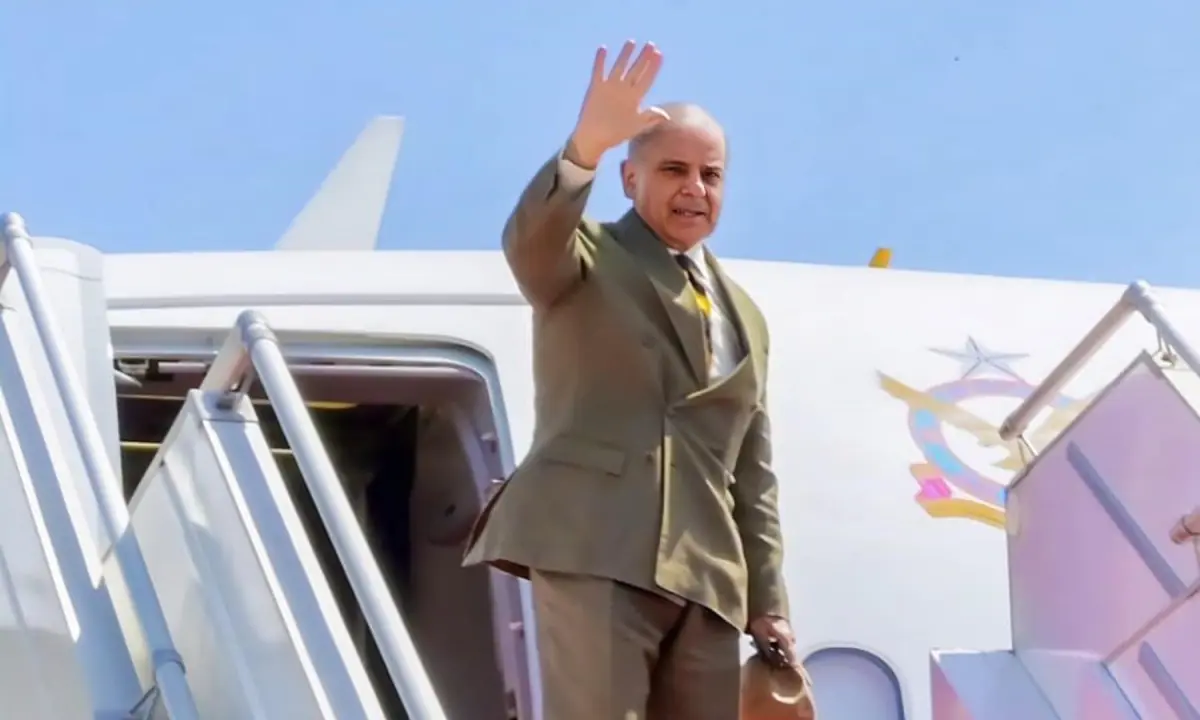

Prime Minister Shehbaz Sharif met with Saudi Crown Prince Mohammed bin Salman after he reached Jeddah on Wednesday alongside a high-level delegation on an official visit to the kingdom, the PM Office’s (PMO) said in a statement.
The statement added that Deputy Prime Minister and Foreign Minister Ishaq Dar was also present at the meeting.
Earlier, a post on the PMO’s X account said the premier was received by the Deputy Governor of the Makkah Region, Prince Saud bin Mushaal bin Abdulaziz, Saudi Arabia’s Ambassador to Pakistan, Nawaf bin Saeed Al-Malki and Pakistan’s Ambassador to Saudi Arabia, Ahmad Farooq upon his arrival in the kingdom.

It added that while in Jeddah, PM Shehbaz would meet with the kingdom’s top leadership.
“The meeting will involve discussions on further strengthening bilateral relations between Pakistan and Saudi Arabia and an exchange of views on the regional situation,” the PMO said.
According to the PMO, apart from DPM Dar, Information Minister Attaullah Tarar and Special Assistant to the Prime Minister (SAPM) Tariq Fatemi, as well as other senior officials, are also part of the delegation.
Earlier, the Foreign Office (FO) said the prime minister, accompanied by a high-level delegation, would be undertaking official visits to Saudi Arabia, Qatar and Turkiye from April 15 to 18.
In its statement, the FO said the visits to Saudi Arabia and Qatar were “in the bilateral context”. It added that the premier would meet the leadership there to “discuss ongoing bilateral cooperation as well as regional peace and security”.
In Turkiye, he will participate in the fifth Antalya Diplomacy Forum and present Pakistan’s position in the Leaders’ Panel along with other world leaders, the FO added.
“Pakistan’s participation in the forum reflects its continued commitment to constructive diplomacy, multilateral cooperation, and meaningful engagement with the international community on issues of global importance,” the FO statement said.
On the sidelines of the forum, PM Shehbaz was “expected to hold bilateral meetings with President Recep Tayyip Erdoğan and other key world leaders”.
Gulf countries — including Saudi Arabia — were facing Iranian attacks, which Tehran says were aimed at US and Israeli sites in response to the latter’s deadly large-scale strikes. Pakistan intensified efforts to act as a mediator between the United States and Iran to end the war that had engulfed the Middle East, leading to a fragile, temporary ceasefire and a first round of talks in Islamabad.
Last month, PM Shehbaz hailed Saudi Arabia for showing “remarkable restraint” during the ongoing hostilities and stressed the need for urgent de-escalation.
On March 9, PM Shehbaz held a “restricted meeting” with Crown Prince Mohammed bin Salman, according to a statement by the PM’s spokesperson.
During the meeting, the prime minister expressed Pakistan’s “full solidarity and support for the Kingdom of Saudi Arabia in these challenging times”, and both leaders agreed to work together for regional peace and stability.
Pakistan and Saudi Arabia have long shared a multifaceted relationship rooted in strategic military cooperation, mutual economic interests, and shared Islamic heritage. These ties have encompassed economic assistance and energy supplies, with Riyadh being a significant source of financial aid and oil for Islamabad.
Earlier today, the finance ministry announced that Saudi Arabia has pledged an additional $3 billion in deposits for Pakistan and has extended its existing $5bn facility for a further three years.
The ministry further stated that the existing $5bn Saudi deposit would no longer be subject to the previous annual rollover arrangement and would instead be extended for a longer term.
On April 11, the Saudi defence ministry confirmed that Pakistan has sent a military force and fighter jets to Saudi Arabia to boost security under a joint defence cooperation agreement between the two countries.
In September of last year, PM Shehbaz and Crown Prince Mohammed bin Salman signed a “Strategic Mutual Defence Agreement” in Riyadh, pledging that any attack on either nation would be treated as an act of aggression against both.


