




The government unveiled the Pakistan Economic Survey (PES) for FY2025-26 on Thursday, according to which GDP growth was recorded at 3.7pc in the outgoing fiscal year.
This is higher than last year’s growth of 3.18pc but falls short of its target of 4.2pc.
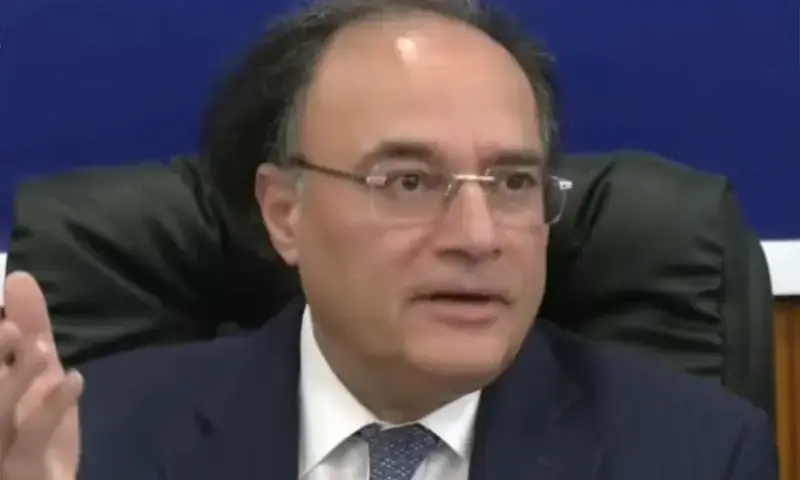
Addressing a press conference in Islamabad, Finance Minister Muhammad Aurangzeb presented the survey, which he said told a story of resilience and discipline shown during the previous year.
He said the country began the outgoing fiscal year with uncertainty due to tariffs. “Then, by the end of July, we reached a point where we could be in a competitive position with respect to our exports, especially to the US,” he added.

Then there were floods in August and September 2025, followed by a regional conflict in March this year.

“These challenges tested Pakistan’s resilience,” he said, adding that the government was able to deal with them and remained on the path of moving from stabilisation to growth.
GDP growth
He said GDP growth in FY26 was recorded at 3.7 per cent, against a target of 4.2pc.
However, the economic survey stated that the economy “accelerated its growth momentum in FY2026” compared to the previous year, when GDP growth was recorded at 3.18pc.
“The improvement owes to effective macroeconomic management, better fiscal account, growth in large scale manufacturing (LSM) sector, resilience of the agriculture sector to floods of 2025, exchange rate stability and reforms under the IMF Extended Fund Facility (EFF) Programme,” it stated.
For his part, Aurangzeb also pointed out that global growth had reduced to 3.1pc from 3.7pc due to the factors he elaborated on earlier in the press conference.
The finance minister said that Pakistan had recorded GDP growth of 3.7pc, which was the highest in the past four years. The finance minister recalled that GDP growth in FY2023 was -0.2pc, 2.6pc in FY2024 and 3.2pc in FY2025.
He said it was earlier estimated that GDP growth would exceed 4pc, but it did not happen due to the ongoing conflict in the Middle East.
“But having said that, we have still reached a historically high size of the economy at Rs126.9 trillion,” he said.
The minister said GDP per capita income had reached $1,901, which was $1,751.
Agriculture
Giving a sector-wise breakdown, he said growth in agriculture was recorded at 2.89pc, compared to 1.53pc in the last fiscal year. “This was despite floods,” he said, adding that the crop sub-sector showed positive growth. It was recorded at 1.44pc, the finance minister said.
He added the livestock sector also “continues to go from strength to strength”.
LSM
Aurangzeb said 6.1pc growth was recorded in large-scale manufacturing (LSM) in FY26, which was the highest in the last four years. He elaborated that positive growth was seen in 16 of LSM’s 22 sub-sectors.
“So it’s not one single sector that is leading or contributing to this 6.1pc turnaround in LSM. It is broadband [growth],” he said.
He further said that prominent year-on-year growth was witnessed in this sector. “To give you some examples, there was a 10pc increase in the demand for cement, 17pc for fertiliser, 5pc for petroleum, 31pc for automobiles and 9pc for mobile phones.”
Services
Noting that the services sector made up close to 58pc of Pakistan’s GDP, he said 4.9pc growth was recorded in this sector in the outgoing fiscal year.
“This, too, is the highest in the last four years,” he said.
He particularly mentioned communication and information services, which he said recorded a growth of 7.52pc. The growth in this sub-sector in FY26 was also the highest over the past four years.
Moreover, he continued, this sub-sector held significance for the digital economy.
Fiscal deficit
The survey document stated that the fiscal deficit “narrowed significantly” to 0.7pc of GDP (Rs 856.4bn) from 2.6pc of GDP (Rs 2,970bn) in the corresponding period last year.
Similarly, primary surplus also improved to 3.2pc from 3pc, the survey document said.
Aurangzeb said during his press conference that tax revenues had increased by 10.1pc and markup payments saw a decrease of 23pc, which he said increased fiscal space.
More to follow

