




Ancient maps are often labelled with a warning: “Hic Sunt Dracones”* (here be dragons), marking the point where civilisation ended, and the unknown began. Today, we have updated the legend for a colder, more administrative age: “Here be collateral damage.”
The modern cartography of power trades the dragon for the statistic. And human loss is codified as a necessary friction of a global machine.
This logic does not remain confined to maps or language; it settles into terrain.
The geographic transition from the Anatolian heights in Turkiye to the scorched arteries of the Levant and the sub-Saharan corridors marks the threshold of a profound moral silence. In this landscape, faces dissolve into grainy wide-shots of a crowd, dubbed over with the dry, percussive phrase of “regional volatility”, where deaths are merely the ticking of a metronome: expected, rhythmic, and, eventually, ignored.

The value of human life is determined by its proximity to the centres of Western hegemony. Peering at the Levant or the Horn of Africa, the hegemon sees only a dashboard of risks and rewards. Dehumanisation, then, is the primary technology of rule.

Grievability: a geopolitical asset?
On April 7, when US President Donald Trump declared that a “whole civilisation will die tonight”, he did the same with Iran, a country with one of the oldest continuous cultural traditions in human history. And this has been done for years now.
“Iran is portrayed in negative terms, using clichés and tropes that can be dehumanising, reductionist and unrepresentative of reality,” said Iranian journalist Kourosh Ziabari in an interview with Reuters earlier this month.
He gave an example of the Western coverage of the Minab school attack — when a US-Israeli strike killed at least 175 people, most of them schoolgirls. “I saw a commentator in the US claim that schoolchildren killed in an airstrike were better off dead because they would otherwise have to wear full face coverings,” he recalled.
In this global indifference lies a rigid ‘Hierarchy of Grievability’. This moral filter decides who is to be categorised as “lives lost” and who is merely a number.
As philosopher Judith Butler says, the ungrievable life is one that cannot be mourned because it was never truly lived in the eyes of power. It is a life that exists as a ghost in the machinery of Empire. Those surviving in conflict zones occupy stagnant time, suspended in an unending state of crisis that allows the world to permit itself to a weakly look away.
This thinning is achieved through de-individualisation. In the reporting of Northern conflicts, the victim is granted a biography, a name, a profession, and sometimes even a favourite song. But as the gaze expands further, the prose shifts towards aggregation.
If a person has no name, they have no story; if they have no story, their death requires no reckoning. By refusing to name the dead, the media performs a functional deletion of their humanity.
This moral silence is the language of Empire itself. From the expansionist frontiers of the Qing dynasty and the administrative coldness of the Ottomans to the brutal civilising rhetoric of Imperial Japan, the logic remains identical: the centre defines itself by the ‘barbarism’ of its margins.
Empire, regardless of its geographic origin, transforms the local into a ‘subject’, a biological unit to be taxed, conscripted, or cleared, but rarely heard. By framing the frontier as a space of chaotic Otherness, imperial powers across history have justified the suspension of empathy in the name of order.
The sovereignty of death
To understand the mechanics of this erasure, we must turn to historian Achille Mbembe’s concept of Necropolitics. Mbembe argues that the ultimate expression of sovereignty is not the power to protect life, but the power to dictate who may live and who must die. This is the “right to kill” as a political tool.
This theory manifested in its most literal, archaic form in the Israeli Knesset when it passed a law making death by hanging the default penalty for Palestinians convicted in military courts of killing Israelis in what they deemed to be acts of terrorism.
The law bifurcates humanity by explicitly tailoring the legislation to apply to those whose acts “deny the existence of the State”, while effectively exempting the state’s own citizens. This is the essence of the “death world”, where the State actively curates expiration and ministers celebrate it by sporting golden noose lapel pins.
In the Gaza Strip or the encampments of the Sahel, we see necropolitics in its most distilled form. Sovereign power, exercised by both local actors and distant global hegemons, is used to manage the biological life of a population through the control of water, calories, and movement.
In Mbembe’s framework, these people are bodies whose eventual termination, whether by a blockade’s slow attrition or the sudden snap of a rope, is treated as a clerical necessity rather than a moral aberration.
Commodification of instability
The death world is not a failure of the market, but a prerequisite for it. By maintaining a state of perpetual and managed chaos, international corporations and state actors can engage in high-risk, high-reward resource extraction without the interference of robust labour laws or human rights.
Whether it is the coltan of the Democratic Republic of the Congo or the strategic positioning of the Levant, new legislations are simply recent updates to an ancient imperial software designed to ensure that some lives remain mere variables.
The structural approach is justified through the Rational Choice Theory. In this view, state actors and the media outlets that mirror their interests perform a cost-benefit analysis of empathy. If acknowledging the full humanity of a population requires a radical shift in foreign policy, or a costly intervention that yields no national interest, then the most “rational” choice is to diminish the perceived value of those lives. Under this calculus, human suffering is reframed as a negative externality.
This system is achieved through the commodification of instability. In the traditional imperial model, power sought to own the land; in the neoliberal model, power seeks only to own the yield. By keeping regions in a state of collapse, global actors create a legal grey zone where the standard costs of doing business, fair wages, environmental restoration, and corporate liability simply evaporate.
This is the arbitrage of human life, a strategy where the imperial centre can use the lithium deposits of the High Andes, the phosphate mines of the Maghreb, or the maritime transit routes of the Levant at a massive discount.
Language of the powerful
The Strait of Hormuz, the narrow chink in the world’s armour and a maritime carotid artery through which a massive portion of the globe’s energy supply pulses, serves as the ultimate litmus test for global empathy.
We witness a sickening irony in the global metabolic rate: the world can watch a decade of man-made famine and systemic bombardment in Yemen with a yawn of boredom, but the moment a single oil tanker is stalled, or a sea lane is contested in the strait, the conflict is instantly elevated from a regional tragedy to an existential crisis.
In this context, economic friction becomes the only language the halls of power truly speak. The outrage of the media fluctuates with the price of Brent Crude. We care about the stability of the Gulf only insofar as it preserves the lifestyle of the global consumer.
Claims to universal values are exposed as a hollow performance the moment the “universal” is weighed against the “profitable”, and the scale tips, predictably and violently, toward the latter.
The message sent to the inhabitants of these zones is clear: your lives are relevant only as a function of the geography you occupy. You are not people; you are the biological hazards living atop a supply chain.
The physicality of rubble
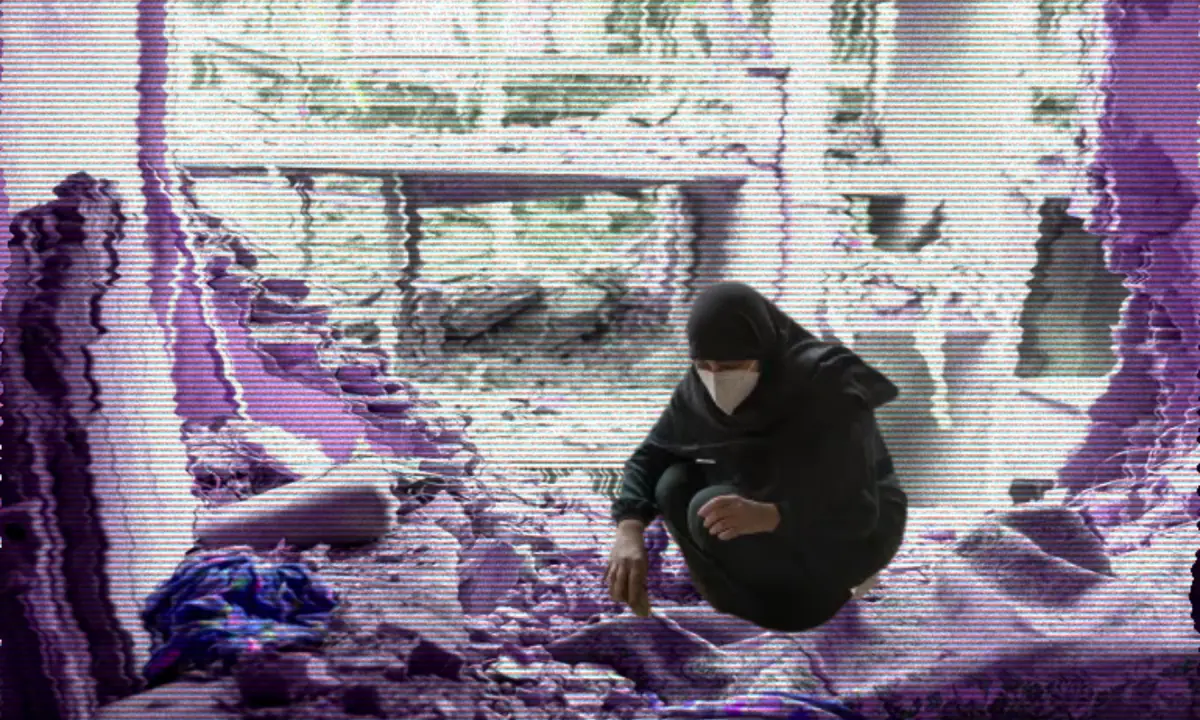
The stillness in the dust of a razed university or a flattened neighbourhood is the physical residue of interrupted lives, the atomised remains of private libraries, generational homes, and the collective memory of a community.
When we see a camp in Khartoum, the flaming wreckage of buildings in Beirut, or a crater in Gaza and categorise it as a humanitarian variable rather than a crime scene, we are performing a violent act. The cost of this detachment is the atrophy of the global imagination.
By training ourselves to look at a landscape of rubble and see only a logistical hurdle, we forfeit our ability to understand a world dismantled.

