



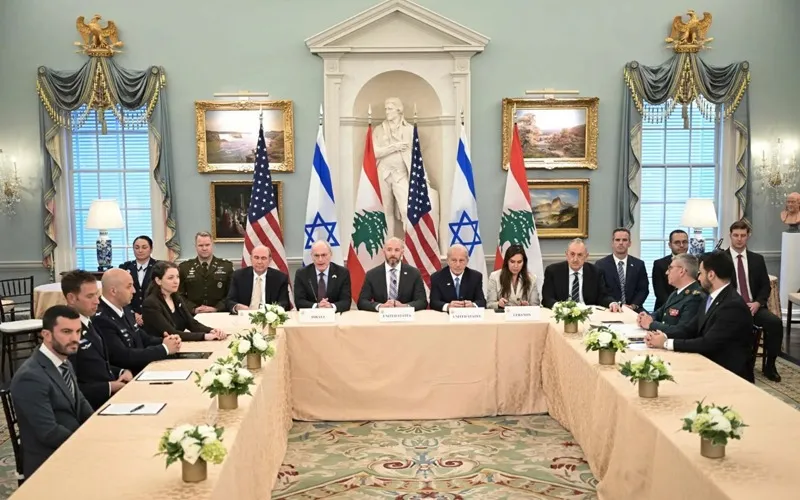

WASHINGTON: In a major diplomatic development amid escalating Middle East tensions, Israel and Lebanon have agreed to implement a ceasefire, the Trump administration announced on Wednesday.
The move raises fresh hopes for a broader regional agreement that could eventually ease the ongoing US-Israeli conflict with Iran.
The breakthrough follows weeks of heightened violence and comes as Tehran had repeatedly linked any potential understanding with Washington to an end to fighting between Israel and Lebanon.
However, regional instability persisted after Iran launched strikes on Kuwait, damaging airport infrastructure and injuring dozens in what Tehran described as retaliation for recent US military operations near the Strait of Hormuz.

According to a joint statement issued by the US State Department after negotiations in Washington, the ceasefire arrangement depends on a complete halt in Hezbollah military activity and the withdrawal of all operatives from the South Litani Sector in southern Lebanon.

Read More: Pakistan urges immediate ceasefire in Lebanon at UN Security Council
Under the proposed framework, the Lebanese Armed Forces will gradually assume exclusive control of designated pilot zones, effectively excluding all armed non-state groups from those territories.
The move is being facilitated under US supervision in an effort to stabilise the border region and prevent renewed clashes.
Officials said Israel and Lebanon have also agreed to continue direct negotiations, aimed at strengthening trust and resolving unresolved political and security disputes. Further talks are expected during the week of June 22, with both sides seeking a more durable settlement.
The latest announcement comes despite a previous ceasefire agreement reached last month that failed to fully contain violence. Hostilities continued after Israel intensified military operations in Lebanon in March, targeting Hezbollah, which had increased cross-border attacks in support of Iran.
Meanwhile, regional tensions remain high as recent attacks in the Gulf have placed additional pressure on an already fragile ceasefire involving the United States, Israel, and Iran.
Oil prices climbed nearly 2 percent amid ongoing disruption to shipping routes through the Strait of Hormuz, a corridor responsible for a substantial share of global oil and liquefied natural gas transport.
In Kuwait, airport operations were temporarily suspended after drone and missile attacks damaged facilities and diplomatic compounds, killing one person and injuring more than 60 others, according to local authorities and state media. Commercial flights later resumed following emergency safety measures.
Iran’s Islamic Revolutionary Guard Corps (IRGC) denied responsibility for targeting Kuwait’s airport, claiming the destruction resulted from failed American interceptor missiles. However, the US military rejected the allegation, insisting Iranian drones deliberately targeted the facility.
Iranian media earlier claimed that Tehran had also targeted the US Fifth Fleet headquarters in Bahrain, an American airbase, and a commercial vessel identified as Panaya. However, US Central Command (CENTCOM) dismissed the claims, saying Iranian ballistic missiles failed to strike regional military positions.
CENTCOM later confirmed a new round of what it described as “defensive strikes” in southern Iran, targeting missile launch infrastructure, naval vessels allegedly attempting to deploy mines, and military sites on Qeshm Island near the Strait of Hormuz.
Since the launch of US-Israeli military operations against Iran on February 28, Tehran has repeatedly targeted locations across the Gulf region that host American military assets.
Although a temporary ceasefire in early April briefly reduced hostilities, tensions have repeatedly resurfaced as Washington pushes to reopen maritime traffic through the Strait of Hormuz, previously responsible for nearly one-fifth of global energy shipments.
Diplomatic efforts have continued behind the scenes. Iranian Foreign Minister Abbas Araqchi, speaking to Lebanese broadcaster Al Mayadeen, said negotiations with the US had not collapsed but acknowledged that no meaningful progress had yet been achieved.
Tehran continues to seek several concessions, including sanctions relief, access to frozen oil revenues, fewer restrictions on crude exports and ports, and guarantees tied to regional security concerns.
US President Donald Trump reiterated that preventing Iran from acquiring a nuclear weapon remains Washington’s central objective, while Tehran continues to insist its nuclear programme is solely for peaceful purposes.
In a podcast interview released Wednesday, Trump suggested that Iran had shown willingness to avoid pursuing nuclear weapons and hinted that Supreme Leader Ayatollah Ali Khamenei remained involved in diplomatic discussions.
Speaking later at the White House, Trump indicated that meaningful progress in negotiations could emerge “as soon as this weekend,” though he did not elaborate further.
Despite ceasefire efforts, Israeli military operations continued in Lebanon. Lebanese security officials reported that Israeli drone strikes killed at least six people in southern Lebanon, while another strike targeted a vehicle south of Beirut. Israel, meanwhile, said it intercepted a hostile aircraft believed to have been launched by Hezbollah.
Araqchi warned that Iran would respond forcefully if Israeli operations expanded toward Beirut.
Trump also disclosed details of a tense exchange with Israeli Prime Minister Benjamin Netanyahu, saying he urged the Israeli leader to ease military operations in Lebanon.
“At some point, I told Bibi, we’ve got to stop this,” Trump said, referring to Netanyahu by his nickname.
Netanyahu later acknowledged occasional “tactical disagreements” with Trump but maintained that both leaders remain aligned on key concerns surrounding Iran.
The prolonged conflict has already claimed thousands of lives, primarily in Iran and Lebanon, while severely disrupting energy markets, shipping routes, and broader regional stability.

