



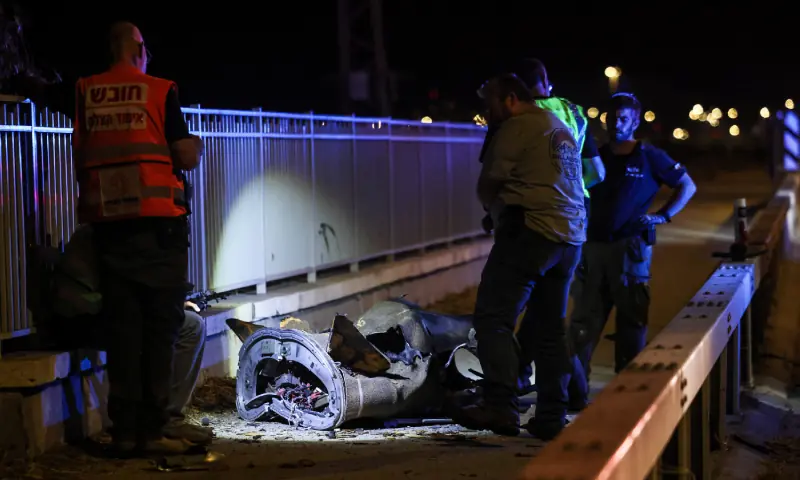

Israel and Iran traded fire on Monday, seriously testing a fragile truce and threatening hopes for a deal to end the Middle East war.
The new attacks, including a strike on an Iranian petrochemical complex, came hours after US President Donald Trump called on Israel to refrain from retaliating against Tehran’s missiles.
AFP journalists in Jerusalem heard a series of explosions as they took shelter and the Israeli army said it worked to intercept a new wave of Iranian missiles.
The retaliation followed Israel saying it fired on western and central Iran, tit-for-tat action against Tehran’s strikes on Sunday of 11 missiles, all of which were intercepted, with no casualties.

Israel’s military and Iranian local media said Monday that Israel struck a petrochemical company in Mahshahr in southwestern Iran.

Trump had sought to rein in Israeli Prime Minister Benjamin Netanyahu, as Israel accused Tehran of making a “grave mistake”.
Trump has also said new strikes by Israel and Iran would not affect his administration’s peace talks with Tehran, adding that Israeli Prime Minister Benjamin Netanyahu “doesn’t call the shots.”
He has leaned on Israel to stop its attacks in Lebanon to allow room for a deal to end the wider war with Iran, including rebuking Netanyahu with obscenities in a phone call last week.
However, earlier on Sunday, Israel launched strikes in the Beirut area for the first time since the US announced a truce plan for Lebanon last week.
Iran fired a salvo of missiles at Israeli targets in retaliation, putting US-Iran peace talks at risk. But Trump insisted that an agreement to end the wider war remained well within reach.
“It’s not going to have any impact on the deal,” Trump told the Financial Times. “I call the shots. I call all the shots. He (Netanyahu) doesn’t call the shots.”
A few hours later, Israel’s defence forces said they had struck Iranian military targets.
Iran’s Revolutionary Guards said Israel used air-launched ballistic missiles in its attacks.
“Everyone has had enough of this maniacal Iranian regime,” Israel’s ambassador to the United States, Yechiel Leiter, said on X, adding that Iran had fired 11 ballistic missiles at Israel. “No self-respecting country in the world would tolerate such an attack, and neither will Israel,” he said, adding that Israel was targeting Iran’s surface-to-surface missile launch sites and infrastructure facilities unrelated to the energy sector.
The latest hostilities drove oil prices up more than three per cent in early trading on Monday, with benchmark Brent futures back above $96 a barrel.
Iran’s Revolutionary Guards said they had targeted Ramat David air base, near Nazareth. The Israeli military said it identified missiles launched from Iran and its defence systems had intercepted them. As air raid sirens sounded in Tel Aviv, according to a Reuters witness, the Israeli military added it had identified the launch of a missile from Yemen toward its territory with aerial defence systems activated to intercept the threat.
The attack is also the first from Yemen on Israel since the April 8 truce.
Trump urges Netanyahu
Trump spoke with Netanyahu by telephone from his golf club in Bedminster, New Jersey, for a little less than half an hour on Sunday, an Israeli official said, without giving details.
The White House and the Israeli prime minister’s office did not immediately respond to requests for comment.
Trump told Netanyahu during the call to refrain from further strikes because “we are close to doing something good in terms of a deal,” according to a US official quoted by Axios.
In a separate interview with Fox News, Trump said: “What I would suggest to Iran: You’ve shot your missiles, that’s enough, get back to the table and make a deal.”
Since the start of the talks, Israel has kept up attacks in Lebanon in a conflict with Hezbollah that Israeli officials insist should be treated separately from any Iran ceasefire. Tehran has long said any peace deal with the US would depend on a ceasefire also holding in Lebanon, which Israel invaded in March.
Iran’s chief peace negotiator, Parliamentary Speaker Mohammed Baqer Qalibaf, said US bases and Israeli assets were legitimate targets because of hostile acts, including the “violation of agreements over Lebanon.”
Before Sunday, Iran had not attacked Israel since a ceasefire in the wider war started in April, although Hezbollah had done so.
Trump has repeatedly insisted that Washington and Tehran were close to an agreement on ending the war.
“We’re very close to a deal, or I’m going to blow the hell out of them,” Trump told NBC News’ ‘Meet the Press’ in a recorded interview that aired on Sunday to mark 100 days of the conflict.
Trump wants no attacks in Lebanon
Israel has never halted its Lebanon campaign, which has killed thousands of people and driven hundreds of thousands more from their homes.
Hezbollah, which kept out of truce talks, has also continued its attacks and says it will not give up its weapons unless Israel halts its attacks and withdraws from Lebanon.
Netanyahu said Israel’s Sunday strikes on Beirut’s southern outskirts, a district known as Dahiyeh and a longtime Hezbollah stronghold, were ordered in response to Hezbollah firing toward Israel.
The wider war has been stalled since the US and Israel paused attacks on Iran in early April, with Tehran blocking most shipping through the Strait of Hormuz, the main transit route for a fifth of the world’s crude oil and liquefied natural gas.
Washington has imposed its own blockade of Iranian ports.
Though Washington and Tehran have said they are close to a preliminary deal to reopen the strait, they have repeatedly traded strikes, with escalations in recent days that included attacks on nearby Arab states hosting US bases.
Trump has said any agreement to end the war must prevent Iran from developing a nuclear weapon, and he is under pressure to deliver terms tougher than those agreed in 2015 under then-President Barack Obama in a deal Trump later repudiated.
Tehran’s demands include the lifting of US and international sanctions, recognition of its sway over the strait and the release of billions of dollars in frozen assets.

