


In meeting with Kallas, Dar says Pakistan sees considerable untapped potential in cooperation with EU

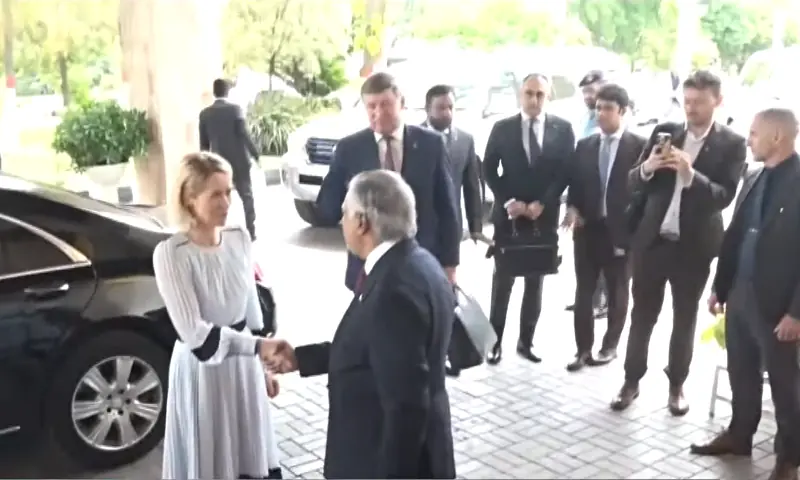

Deputy Prime Minister and Foreign Minister Ishaq Dar on Monday noted there was “considerable untapped potential” for cooperation between Pakistan and the European Union as he met the latter’s top diplomat, Kaja Kallas, in Islamabad.
Kallas, who serves as vice-president of the European Commission and the EU high representative for foreign affairs and security policy, is visiting Pakistan at the invitation of Dar. Both will co-chair the 8th EU-Pakistan Strategic Dialogue, which the Foreign Office (FO) said is the “highest-level platform for structured discussion between the two sides”.
“We have a great relationship with the EU; there is a great history. Pakistan sees considerable untapped potential in our cooperation,” Dar said, addressing a press conference.
“We have a number of areas where we can work together, particularly trade and many other areas,” the deputy premier noted.

According to FO, both sides “acknowledged the positive trajectory of Pakistan-EU ties and agreed to further strengthen the mutually beneficial partnership”.

“The two leaders also exchanged views [on] regional and global developments, ahead of the 8th Pakistan-EU Strategic Dialogue which is being held subsequently,” it added.
During his press briefing, Dar stressed the need to maintain a frequency of six months’ gap in strategic dialogues, as was the case between the current and the last dialogue.
“We hold deep appreciation for the EU leadership and your engagement, particularly,” Dar said.
He added that he and Kallas remained in touch on various matters, including the Pakistan-India conflict last year and the ongoing US-Iran war.
“We keep exchanging notes and you have been very kind,” Dar remarked. “I think this interaction is very welcome,” he added.
Dar mentioned an EU “strategic vision, which aims at providing long-term direction and strategic cooperation toward partnership”.
The deputy PM expressed the hope that European Commission President Ursula von der Leyen would find some time to visit Pakistan, as there was a standing invitation from the prime minister.
Earlier in the day, state-run PTV showed visuals of Kallas being welcomed at the Ministry of Foreign Affairs by Dar and meeting officials.
‘Multidimensional partnership with EU’
According to the FO, Kallas’s visit reflects the growing momentum in high-level political exchanges and both sides’ commitment to further strengthening their multifaceted partnership.
“Pakistan deeply values its long-standing, multidimensional partnership with the European Union, which is anchored in shared values, robust economic cooperation, and a mutual commitment to multilateralism,” the FO said.
Kallas will also hold meetings with President Asif Ali Zardari, Prime Minister Shehbaz Sharif and Chief of Defence Forces and Chief of the Army Staff Field Marshal Asim Munir, the EU said. The FO confirmed that she was set to meet Pakistan’s “senior leadership”, including the president and the premier.
The EU is Pakistan’s second-largest trading partner, with the GSP+ status allowing the country to enjoy duty-free or minimum duty on European exports.
The status was granted by the EU in 2014, with the European Parliament unanimously voting in October 2023 to extend it until 2027 for developing countries, including Pakistan.
According to the EU, GSP+ status is a special incentive awarded to developing countries to “pursue sustainable development and good governance” in exchange for cutting import duties to zero on two-thirds of the tariff lines of its exports.
Governments with this status need to implement 27 international conventions on human rights, labour rights, good governance and the environment.
Though it has the status, EU Ambassador to Pakistan Raimundas Karoblis said last November that the country needs to “do better” to fulfil its obligations, specifically on blasphemy, enforced disappearances and minority rights.
In December 2025, the EU welcomed certain steps taken by Pakistan towards implementing international conventions under the GSP+ framework, while also reiterating the “need for further reforms in the medium and long term”.
More to follow

