




Revised business hours apply to standalone grocery, neighbourhood convenience stores
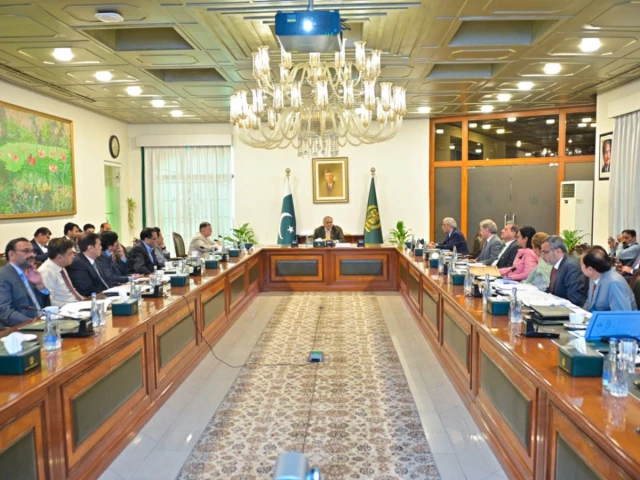
Deputy Prime Minister Ishaq Dar chairs a meeting of the Committee for Monitoring and Implementation of Fuel Conservation and Additional Austerity Measures. PHOTO: X
The government on Wednesday extended a series of austerity measures until June 30 and allowed standalone grocery and kiryana stores to remain open until 10pm, following a meeting chaired by Deputy Prime Minister and Foreign Minister Ishaq Dar in Islamabad.
Earlier this month, the federal government relaxed business closing hours as part of revised energy conservation measures, citing rising temperatures and longer summer daylight hours. Under the changes announced on June 3, shops, markets and shopping malls were allowed to remain open until 9pm, while restaurants and food outlets could operate until 11pm. Marriage halls and marquees were permitted to stay open until 10pm.

The decisions were taken during a meeting of the Committee for Monitoring and Implementation of Fuel Conservation and Additional Austerity Measures, which also considered extending measures that were due to expire on June 13.

Deputy Prime Minister / Foreign Minister Senator Mohammad Ishaq Dar @MIshaqDar50 chaired a meeting of the Committee for Monitoring and Implementation of Fuel Conservation and Additional Austerity Measures.
The Committee reviewed several cases submitted by various Ministries and… pic.twitter.com/22XYEe39S2
— Office of the Deputy Prime Minister (@DPM_PK) June 10, 2026
According to an official statement, the committee “reviewed several cases submitted by various Ministries and Divisions seeking exemptions from the applicability of certain austerity measures” and finalised its recommendations.
“It was also decided that Consular Attestation services at the Ministry of Foreign Affairs and its liaison offices in Quetta, Karachi, Peshawar, Gujrat, and Lahore would remain operational on Fridays as well for public facilitation,” the statement added.
Read: Govt revises market timings, citing longer daylight hours, rising temperatures
The committee further recommended extending the duration of some austerity measures that were due to expire later this week.
“The committee further recommended extending the applicability period of those additional austerity measures whose expiry date had been notified as June 13, 2026 until June 30, 2026,” the statement said.
In a move affecting retailers, the committee approved revised business hours for standalone grocery and neighbourhood convenience stores.
“The committee also decided to extend the closing time of standalone grocery and kiryana stores to 10:00pm on all days of the week, including Saturdays and Sundays,” according to the statement.
The meeting was attended by the Ministers for Petroleum, Climate Change, and IT & Telecom; the Special Assistant to the Prime Minister (SAPM) on Finance; the Special Assistant to the Deputy Prime Minister (SADPM); the Secretaries of Cabinet, Commerce, Petroleum, and IT & Telecom; as well as senior officials from the Ministry of Foreign Affairs and other relevant Ministries and Divisions.
Read More: ICT imposes early closure for markets
Austerity
The austerity measures were introduced after a sharp escalation in tensions between Iran, Israel and the United States disrupted global energy markets. Following military exchanges and Iran’s subsequent closure of the Strait of Hormuz, international oil prices surged, driving up Pakistan’s import bill and putting pressure on domestic fuel prices.
In response, the government raised petroleum prices several times, with the steepest increases recorded in April. Officials said the adjustments were necessary to reflect higher international oil prices and ensure fuel supplies remained uninterrupted.
In March, to curb fuel consumption and reduce energy costs, the federal government imposed a series of austerity measures across Punjab, Khyber-Pakhtunkhwa, Balochistan, Islamabad, Gilgit-Baltistan, and Azad Jammu and Kashmir. These included earlier closing times for markets and commercial centres, an additional weekly holiday for government offices, cuts to free fuel allocations for ministers, and restrictions on the use of official vehicles.
The restrictions were temporarily eased ahead of Eid but were reinstated from April 1 as the government sought to manage the impact of the ongoing fuel crisis.

