



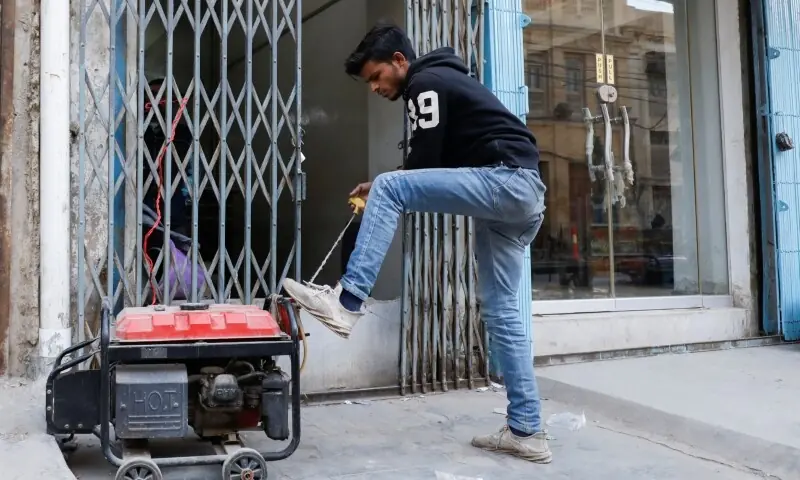

ISLAMABAD: Amid fuel constraints, the government on Tuesday formally announced more than two hours of daily loadshedding to prevent a rise in electricity tariffs.
“The government has decided to suspend the electricity supply for about 2.25 hours daily between 5:00pm and 1:00am,” the Power Division said in a statement.
“This step is aimed at reducing the use of costly fuels and preventing a sharp rise in tariffs,” it added.
This stems from the suspension of liquefied natural gas (LNG) imports following the force majeure declared by Qatar due to attacks on its gas field amid the US-Israel war on Iran. Qatar is the main LNG supplier to Pakistan under two long-term contracts envisaging up to 1,000 million cubic feet per day (mmcfd).
The Power Division said it was capable of meeting full demand but this had negative consequences.

“The main challenge at present is during peak hours from 5:00pm to 1:00am. During this time, demand increases significantly, mainly due to reduced hydel generation. Relying on expensive fuels to meet this demand could lead to a substantial increase in electricity prices,” it said.
The Power Division said that its consistent efforts had led to a reduction in electricity prices for consumers across the country. From July to February, the average tariff has decreased by 71 paisa per unit despite rising fuel costs. This has resulted in a total relief of Rs46 billion, it said.
It said that the reduction was achieved through structural reforms, targeted relief measures, strict implementation of the merit order, improved planning and more efficient system operations. It said priority was given to low-cost generation sources, while better use of generation capacity and improvements in transmission and administration helped reduce losses.
It added that these combined efforts had improved overall system performance and provided sustainable relief to consumers.
The Power Division further said that despite challenging global conditions, the country’s power generation remained stable, adding that the system was capable of meeting electricity demand as required.
It said the situation was being closely monitored under the direct supervision of Prime Minister Shehbaz Sharif.
“The government has directed that electricity prices must not increase sharply. Even if the use of furnace oil leads to some increase, all possible steps are being taken to keep it to a minimum,” it said.
It added that in line with these directions, 80mmcfd of local gas had been provided to power plants, which had helped avoid an increase of about 80 paisa per unit and also reduced the need for additional load management.
It said that the limited load management of 2.25 hours during peak times was intended to prevent an increase of around Rs 3 per unit.
“Even with restricted use of furnace oil, there may still be an increase of about Rs1.5 per unit. Without these measures, the increase could have reached Rs5 to Rs6 per unit,” the Power Division said.
It went on to say that distribution companies had been directed to share feeder-wise outage schedules with consumers at all levels to ensure that consumers were aware of outage timings.
“No unscheduled outages will be allowed. In case of local faults, the concerned offices will inform consumers accordingly,” it said.
It asserted that the government was making every effort to minimise the impact of international conditions on the public and all possible measures were being taken to provide relief to consumers.
It said that this step was not loadshedding but part of the government’s “Peak Relief Strategy” aimed at controlling possible increases in electricity prices during peak hours.
“The government remains committed to providing maximum relief to the public despite global challenges. It will continue to take all necessary steps to keep electricity prices under control. Coordinated efforts by federal and provincial governments, including the timely closure of commercial markets, can further reduce demand and help limit any potential increase in electricity costs,” the statement concluded.


