


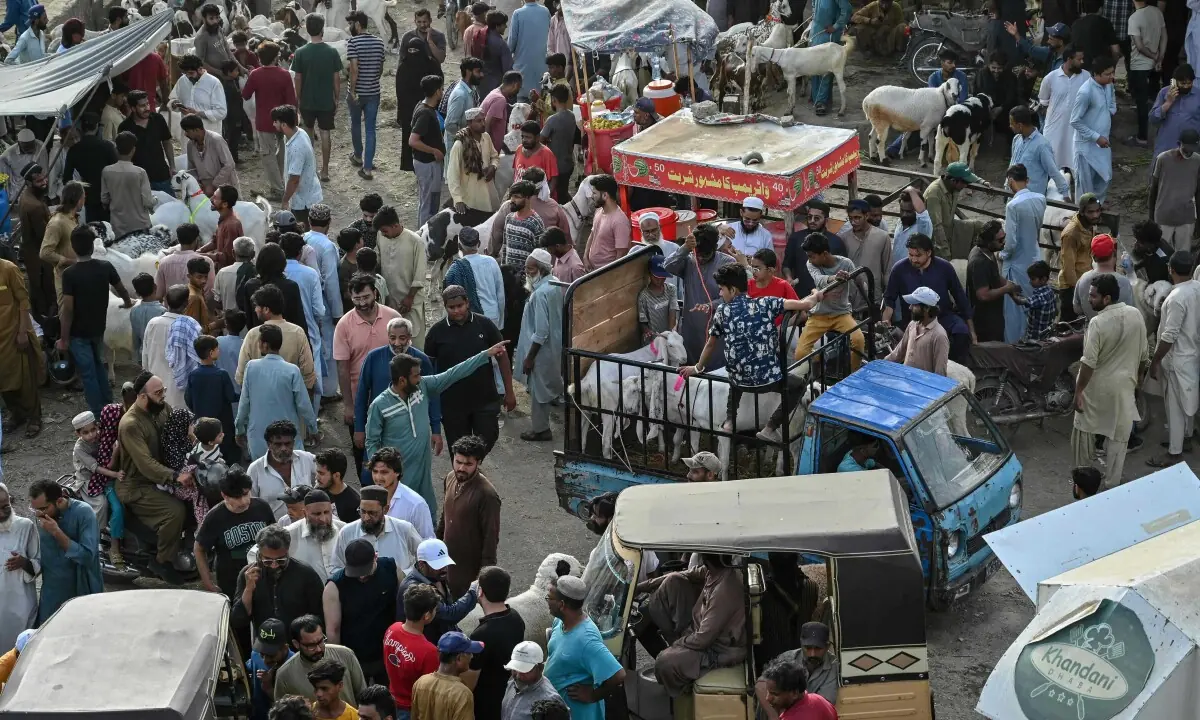

Pakistan’s obsession with everything Bakra Eid is hard to overstate. Whether it’s young boys heading to the mandi every other night to size up animals, uncles asking the price outside your house, or families having barbecues for the entire week — the festival generates a level of commercial and cultural energy that few other events in the country can match. And all of that energy translates into an enormous amount of money changing hands; almost entirely cash. More than seven million animals were sacrificed nationally in 2025, according to the Pakistan Tanneries Association, with total estimated sales of roughly Rs600 billion.
Few other segments of the economy concentrate this much money in so few places over such a short period. The activity clusters around a small number of large mandis, often at city outskirts, where buyers and sellers carry large sums across distances with real risks of theft and counterfeit notes. It is precisely the kind of environment where digital payments should, in theory, take off. No wonder the State Bank has been trying to do exactly that since 2024, through its “Go Cashless in Cattle Markets” campaign, which has now entered its third year.
In 2024, the campaign facilitated around 13,000 digital transactions worth Rs560 million across its initial set of markets. Last year, the coverage expanded to 54 markets with 24 participating banks, and the numbers jumped to 64,553 transactions valued at Rs4.65bn ie roughly an eightfold increase in throughput and a fivefold rise in volume. Similarly, the average ticket size climbed from approximately Rs43,000 to Rs72,000.
While the growth is promising, the base is still too small. Going by the estimates above, not even one per cent of the mandi economy is routing via digital payments. For context, almost 65pc of the banking transactions are going through an online channel. So why has the uptake remained low?

In 2025, the campaign’s coverage increased fivefold in volume over 2024; this year nearly double that number of markets are covered

One major, and perhaps underappreciated, part of the problem remains data reporting. Monitoring digital transactions for a specific use is tricky, as the overwhelming majority prefers the regular fund transfers, which are technically not meant for commercial purposes but have a massive organic pull. But that makes it difficult to attribute to a specific campaign.
In fact, background conversations with sellers for this piece suggest a real shift towards digital payments, even though not necessarily attributable to the Go Cashless campaign. One middleman, who sources animals from rural parts of Sindh and usually sells them to buyers in Karachi, said that almost half of their transactional value is now going through online channels, both inflows and outflows. Another farm owner, Jameel Memon, shared a somewhat similar mix, saying that around 60pc of the inflows come through digital channels.
While not exactly a significant hindrance for relatively wealthier clients, a majority of financial services app users in Pakistan happen to have m-wallets, whose limits are often not enough to purchase even a goat, let alone a cow, based on the current market prices. In the latest scheme, the SBP has introduced temporary relaxations on transaction and account balance limits, effective May 14 through June 5, to accommodate the higher values typical of livestock purchases.
On the demand side, a recurring complaint remains network connectivity, which makes the whole digital payment experience clunky and unreliable. Despite these challenges, there is good reason to believe the transaction numbers will shoot up as campaign coverage has nearly doubled to 96 cattle markets.
The campaign has also expanded beyond mandis to include institutions involved in collective sacrifice arrangements ie ijtemai qurbani, potentially capturing a segment that involves larger, more structured payments, according to Ahson Saeed, the CEO of Raast Payments Pakistan, the State Bank-owned entity responsible for operating and proliferating the national instant payment scheme in the country.
This initiative needs to be looked at as part of the broader cashless economy drive from the Prime Minister’s office. To push QR codes, the government, last year, announced a subsidy to cover the merchant discount rate on transactions, covering 0.5pc or Rs100 — whichever is lower.
Though the Go Cashless campaign comprises both person-to-person and person-to-merchant, the regulator is naturally pushing towards the latter. In fact, one major move this season is that of QR transactions; financial institutions have been instructed to ensure settlement on the merchant leg instantly. Such payments require instant credit to the payee by the payor, as delays can cause disputes which are difficult to manage, considering the nature of trade in the mandis, according to Mr Saeed.
Meanwhile, financial institutions seem to have significantly amped up their efforts and deployed a field force across key cattle markets. “Our representatives are guiding both merchants and buyers to drive adoption,” said Suhail Jan, Head of Channels at JazzCash, which is active across 85 markets this season.
But what do the early results show? Well, it is too early to say. “The data is still preliminary, as around 60pc of transactions happen in the last three to four days before Eid ul Azha. However, we are seeing a noticeable increase in QR transactions as the State Bank of Pakistan and financial institutions have ramped up awareness campaigns,” he continued.
Pakistan is not the only country trying to crack this. Bangladesh, which is believed to be the largest market in terms of Bakra Eid economy, launched a similar central bank-led pilot at cattle markets in 2022. It’s not exactly clear if the objectives were achieved or not, since there have been few monitoring updates ever since. For us, that could be the biggest takeaway: measuring performance the right way is almost as important as the campaign itself.
Published in Dawn, The Business and Finance Weekly, May 25th, 2026

