



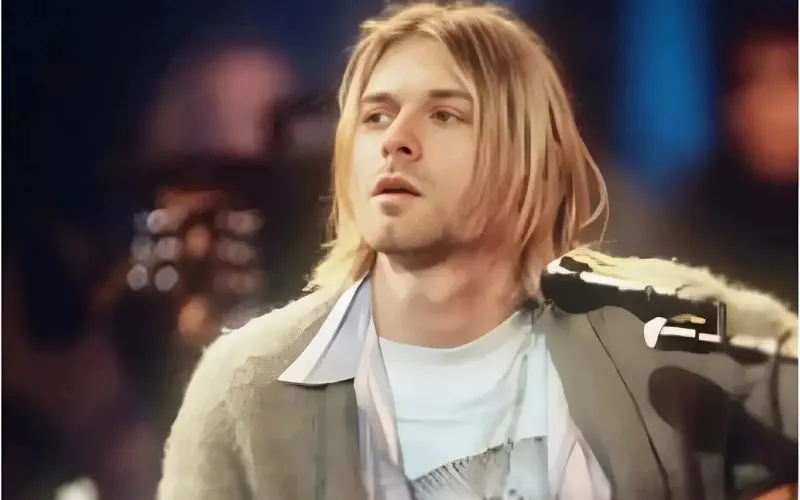

Decades have passed, yet the final hours of Kurt Cobain the enigmatic frontman of Nirvana remain shrouded in speculation, intrigue, and unanswered questions.
The story of a musical icon whose raw talent defined a generation has never been merely about the music it is entwined with a tragedy that continues to captivate and confound.
For years, the world has accepted the narrative of a self-inflicted gunshot as the final act of a tortured genius. But now, nearly thirty years later a new wave of forensic analysis is challenging that long-held conclusion casting shadows of doubt over what truly happened in that Seattle home.
A team of independent investigators, led by forensic specialist Brian Burnett and researcher Michelle Wilkins, has urged authorities to revisit Cobain’s 1997 death.

Their examination of the autopsy and crime scene suggests discrepancies that do not align with conventional suicide, raising the possibility that Cobain may have been incapacitated by a heroin overdose and that the scene could have been deliberately staged.

“The autopsy reveals physiological inconsistencies incompatible with a conventional shotgun suicide,” Wilkins explained. “Necrosis of the brain and liver occurs in the context of a prolonged overdose, not an instantaneous firearm discharge. In such a state, he would have been physically incapable of executing the act himself.”
The team’s investigation highlights several anomalies: pulmonary fluid, ocular hemorrhaging, and organ necrosis suggest oxygen deprivation over time consistent with heroin toxicity rather than a sudden gunshot.
The crime scene itself appeared unusually pristine, while Cobain’s hand, gripping the Remington Model 11 shotgun, displayed no blood spatter a scenario virtually unheard of in shotgun suicides.
Adding to the suspicions is the meticulous placement of drug paraphernalia near the body, and inconsistencies in the mechanics of the weapon when replicated by Burnett’s team.
Even Cobain’s suicide note has come under renewed scrutiny, with portions resembling a farewell to the music industry and only the closing lines referencing suicide, possibly in a different handwriting.
Despite these revelations, the King County Medical Examiner’s Office and Seattle Police Department have consistently declined to reopen the investigation, maintaining that no new evidence justifies revisiting the case.
Cobain’s influence on music and culture remains indelible. Nirvana’s 1991 album Nevermind, propelled by “Smells Like Teen Spirit,” transformed grunge from an underground movement into a global phenomenon, with Cobain’s anguished vocals capturing the alienation of a generation.
Yet while his music continues to inspire millions, the enigma surrounding his final hours persists, leaving a shadow over the legacy of one of rock’s most iconic and enigmatic figures.
As of February 2026, Kurt Cobain’s death remains officially classified as suicide, but the debate, fueled by new forensic analysis, shows no signs of abating.

