



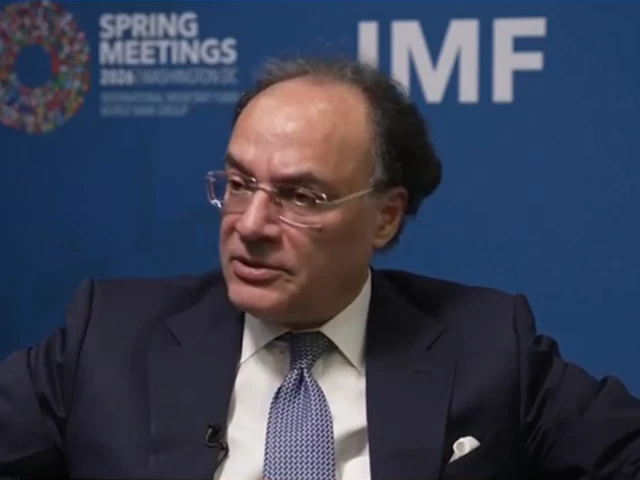

Finance Minister Muhammad Aurangzeb in an interview at the World Bank Spring Meetings 2026 with China Global Television Network’s program “The Heat”. PHOTO: SCREENGRAB
ISLAMABAD:
Finance Minister Muhammad Aurangzeb has cautioned that even if an immediate ceasefire is achieved in the Gulf region, the economic repercussions for Pakistan could persist for up to a year.

Speaking during a Senate session chaired by Chairman Syed Yousaf Raza Gilani on Wednesday, the minister said the government is making efforts to shield vulnerable segments of society through targeted subsidies despite fiscal constraints.

He noted that the petroleum levy was linked to commitments made with the International Monetary Fund (IMF), adding that adjustments were being made to balance the burden.
Responding to a calling attention notice, Aurangzeb informed the house that over Rs5.4 billion in subsidies had already been provided, benefiting approximately 800,000 motorcycle users through subsidised petrol for three months.
Additionally, Rs4.6 billion had been extended to farmers to offset rising fuel costs. “Our objective has been to prevent an increase in transport fares and reduce pressure on the common man,” he said.
He highlighted improvements in revenue collection, stating that FBR receipts had increased from Rs7.5 trillion to an expected Rs13.5 trillion by the end of the current fiscal year.
The session also witnessed strong criticism from the opposition benches regarding the political situation in the country, particularly in G-B and AJK.
Leader of the Opposition in the Senate, Senator Allama Raja Nasir Abbas, rejected the results of the recent G-B elections, alleging large-scale rigging and manipulation. He said delays in announcing results and selective dissemination of outcomes had undermined public confidence in the electoral process.
“If the public mandate is stolen, the entire system loses legitimacy and becomes incapable of handling crises,” he said, adding that growing political disenfranchisement could have long-term consequences.
The opposition leader also criticized the handling of protests in Azad Kashmir, urging the government to adopt dialogue instead of force. He warned that using coercive measures against citizens could deepen divisions and weaken democratic institutions.
Responding to the criticism, Prime Minister’s Adviser on Political Affairs Senator Rana Sanaullah rejected allegations of electoral rigging, asserting that the G-B polls were conducted peacefully and transparently.
NA session
The National Assembly on Wednesday held a wide-ranging debate on issues including Pakistani prisoners abroad, rising HIV cases, the recent G-B elections and the situation in AJK, with the opposition pressing the government on electoral transparency and political freedoms.
Opposition Leader Mahmood Khan Achakzai criticized the government over the prevailing situation, including developments in Balochistan, Kashmir and restrictions on meetings with the PTI founder. He accused the government of curbing political freedoms and called for a more inclusive approach.
Law Minister Azam Nazeer Tarar rejected the opposition’s allegations, stating that the government was open to consultation on the appointment of the Chief Election Commissioner. He also dismissed claims of rigging in the G-B polls, inviting the opposition to engage in dialogue with the prime minister to address concerns.

