



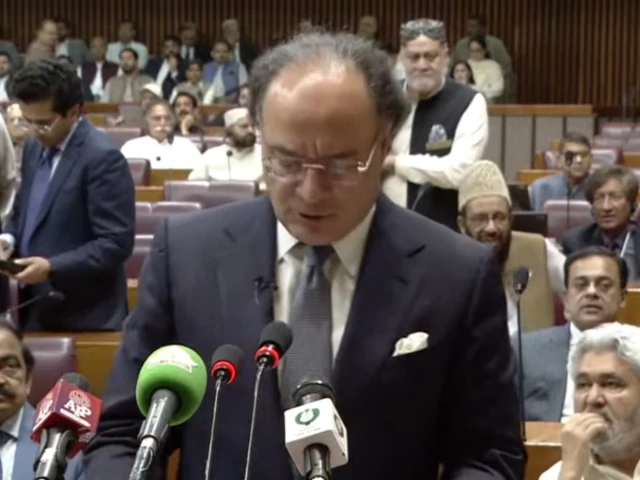

Finance Minister Muhammad Aurangzeb presents Budget 2026-27 in the National Assembly on Friday. — SCREENGRAB
Finance Minister Aurangzeb is presenting the Federal Budget for fiscal year 2026-27 while the opposition disrupts proceedings with loud chanting
Aurangzeb said, “Mr Speaker, it is a matter of great honor for me to present our government’s third budget for the fiscal year 2026-27 before this august House”.
“Pakistan and Saudi Arabia have reached a defence agreement, which marks a strategic partnership,” he said.


This budget is being presented at a time when Pakistan, in the eyes of its people and the world, has achieved the status of a country whose voice is heard and whose friendship is desired, he added.
Our defense industry has also become a source of earning valuable foreign exchange. This is proof that a strong defense is not only vital for our integrity but can also assist in the country’s economic development.
He said Pakistan has responded forcefully to India’s aggression. India was compelled to discuss peace. Our Operation Bunyanum Marsoos was a major success.
Pakistan has achieved a massive diplomatic success in recent months and successfully brought the United States and Iran to the negotiating table to resolve regional conflict, he added.
The American and Iranian presidents have repeatedly praised the particularly important role of Prime Minister Shehbaz Sharif and COAS and CDF Field Marshal Syed Asim Munir. This is an unprecedented success which has enhanced our respect and stature in the comity of nations, and our efforts have been appreciated at every level and forum, have been appreciated, he said.
Aurangzeb said Pakistan-China relations remained “an important pillar of the economy” and noted that Pakistan and Saudi Arabia had reached a defence agreement that marked a strategic partnership.
Turning to the economy, he said Pakistan’s economic growth reached 3.7 per cent in FY2025-26 despite floods and regional conflict, while the size of the economy had reached $452 billion.
He said large-scale manufacturing productivity was recording its highest growth in four years, while per capita income had increased to $1,901.
The finance minister said foreign exchange reserves had risen from less than $4 billion three years ago to more than $17 billion, sufficient for approximately three months of imports.
Discussing inflation, Aurangzeb said it stood at 7 per cent and was expected to decline following the easing of Middle East tensions.
“Owing to Middle East tensions, inflation has increased, but with the resolution of the conflict, the inflation rate will come down,” he said.
He said the recent conflict involving Iran had pushed up international petrol and diesel prices, creating unexpected pressure on household budgets. However, he said the government had not passed on the full impact to consumers and instead provided a targeted petroleum subsidy of Rs128 billion during the recent oil crisis.
“Local prices of petrol and diesel did not fully reflect the intense severity of the international market,” he said.
Aurangzeb also said Pakistan had returned to the international bond market after four years, raising $750 million through Eurobonds.
He added that Pakistan had entered the Chinese capital market for the first time through a Panda Bond issue, where demand exceeded expectations.
The minister said 11 IPOs had been launched in the stock market during the year, while more than 250 companies had started business in Pakistan’s Special Technology Zones.
“Pakistan’s image has improved significantly and its voice is being heard internationally,” he said.
This is a developing story and will be updated further.

