



Session delves into shift towards global weaponisation, ‘pre-war’ readiness, fraying of the nuclear order
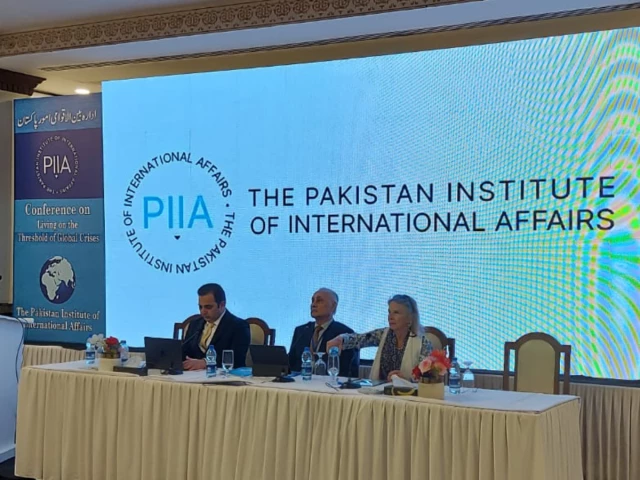
A photo of the panel on Crisis Readiness in a Pre-War World at the Pakistan Institute of International Affairs conference on Sunday, May 10. Seated from left to right: research scholar Dr Tahir Mahmood Azad, former ambassador Mustafa Kamal Kazi, and historian Victoria Schofield. PHOTO: THE EXPRESS TRIBUNE
Experts warned on the second day of an international conference titled “Living on the Threshold of Global Crises” that the world was no longer merely preparing for a future conflict but was already structurally embedded in a “pre-war” international order amid the conflict between the United States and Iran.
Organised by the Pakistan Institute of International Affairs (PIIA), the session on Sunday delved into the shift towards global weaponisation and “pre-war” readiness, the fraying of the nuclear order and the “poison” of information warfare.

The morning session, chaired by former ambassador to Russia, the Netherlands, Indonesia and Iraq, Mustafa Kamal Kazi, focused on “Crisis Readiness in a Pre-War World”. Dr Tahir Mahmood Azad, a research scholar in the Department of Politics and International Relations at the University of Reading, spoke on weaponisation and defence transformation in the Global South.

He said that the traditional lens of “militarisation” — defined by quantitative expansion and large budgets — did not capture today’s qualitative transformation; it was more accurately captured by “weaponisation”.
“We are no longer simply witnessing militarisation … we are witnessing systematic weaponisation within a pre-war international order,” he said, adding that global military expenditure had reached $2.9 trillion, representing 2.5% of global GDP, while the distinction between peacetime and wartime was “functionally erased”.
Azad identified China as a “challenger to the entire Western-dominated arms export architecture”, offering a “GPS-independent weapon ecosystem” to the Global South without any political conditions.
“The pre-war world is not approaching. We are already inside it.”
Dr James Nixey, former director of Chatham House Russia and an independent consultant whose work focuses on Russia, addressed the utility of “strategic ambiguity” in foreign and security policy, warning that while it could keep an opponent guessing, it was often mistaken for “paralysis or worse, cowardice”.
Criticising Western policies in Ukraine, he argued that “Russia plays the strategic ambiguity game relatively well,” while the West has been too clear about what it will not do. “That supposed strategic ambiguity … that paralysis … does have a lot of blood on it,” Nixey said.
Historian and commentator on international affairs Victoria Schofield provided a look at conflict zones, specifically occupied Kashmir, where she noted that “peace prospects were better” in the 1990s than they were today. After 30 years of documenting the dispute, she observed that “wars are easier to start than to conclude”.
She concluded with a plea for humanity, quoting Persian poet Saadi from his poem Bani Adam: “If you have no sympathy for human pain, the name of human you cannot retain.”
Deterrence in the age of ‘unseeable’ threats
The second panel, chaired by Dr Rukhsana A Siddiqui, who has a PhD in international relations from the University of Pennsylvania, explored the “Nuclear Order Under Strain”.
Physicist Dr Abdul Hameed Nayyar warned that emerging technologies such as quantum sensing were “undoing some of the work” of modern stealth platforms by making them visible. “Quantum sensing threatens to upend modern warfare by making the invisible visible,” Nayyar explained, adding that even submarines deep in the ocean could now be detected via “magnetic field shifts”.
He detailed nuclear treaties throughout the years, explaining how the expiry of many nuclear treaties was leading to “instability in the nuclear order”.
“The withdrawal from ABM [Anti-Ballistic Missile] Treaty and the collapse of INF [Intermediate-range Nuclear Force] Treaty were two basic problems that started the sign of instability of this nuclear order. Then the New START Treaty … expired early this year in January, and no work has been done since then to restart it. And that is a problem,” he said.
Johnmark Ochieng, a Kenyan communications specialist at the Research Institute for Innovation and Sustainability, said that deterrence was no longer just about military capacity but perception. He warned that “nuclear language has entered everyday political discourse” through social media, which “blurs the line between rhetorical posturing and actual commitment”.
Ochieng said that the “normalisation of nuclear rhetoric” caused it to lose its exceptional status, making the unthinkable feel routine.
Dr Ahmed Ijaz Malik, associate professor at the School of Politics and International Relations at Quaid-i-Azam University, critiqued the foundations of arms control, calling existing frameworks “epistemologically deficient”.
He stated that the purpose of arms control frameworks was to prevent global nuclear conflict, but the conclusion that nuclear weapons were “merely weapons of deterrence, crisis causation and strategic coercion” was far-fetched.
Misinformation, control and narrative warfare
The final session, “Information Wars and Narrative Control”, chaired by human rights activist and journalist Zohra Yusuf, addressed the “tsunami of information”.
Journalist, columnist and cohost of private television programme Zara Hat Kay, Zarrar Khuhro compared modern social media to ancient Roman times when Octavian, the adopted heir of Julius Caesar, inscribed coins with insults defaming Mark Antony.
“What has changed in the intervening centuries, millennia? It is not the nature of propaganda; it is the nature of the technology that disseminates that propaganda.”
He stated that one reason misinformation spread quickly was because of a person’s desire to believe something that aligned with their worldview, “and when we want to believe, then we are willing to believe anything, and that is why this spreads.”
One reason behind people spreading misinformation was from what he described as a “financial motive”, referencing a recent story of an AI-generated viral right-wing influencer by the name of Emily Hart, where a young man had created this avatar simply as a means to “farm engagement” as a way to pay for his education.
He also spoke about state actors pushing misinformation and “near-state actors”, such as people working for political movements, pushing misinformation to serve certain agendas. He ended by warning that truth was losing the race: “By the time the truth has gotten up out of bed … lies have burnt the whole city down”.
Dr Mabel Lu Miao, co-founder and secretary general of the Centre for China and Globalisation, spoke via video from Beijing, asserting that the Global South was “rewriting the story” of multilateralism. She claimed the old Western-led narrative had collapsed, failing to address conflicts or nuclear strain.
“We are no longer begging for a seat at the table … we are demanding the table be rebuilt,” she said, highlighting the expansion of BRICS and the Shanghai Cooperation Organisation as new models of “diversified inclusive multilateral cooperation”.
Journalist and co-founder of Safe Journalism, a platform seeking to unite media practitioners and civil society in efforts to provide justice to journalists in Pakistan, Mehmal Sarfraz, highlighted the “information siege” surrounding Palestine, stating that “the new normal is disinformation”.
“Tools are now being used worldwide to disenfranchise the media and civil society as a result of the rapid change in technology and the advent of AI,” she said, going on to detail the severe risks faced by journalists and noting that Israel was responsible for killing two-thirds of all media workers in 2025.
Turning to Pakistan, she described a “coordinated online harassment” campaign against female journalists involving “sexualized abuse, doxing” and “rape threats”.
“There are more pictures, AI videos, rape threats and death threats, and attempts to hack our social media accounts like Twitter. Facebook, Instagram, Snapchat, even our emails have become a norm.
Sarfraz urged a united front: “We have to rise above our differences … because if we don’t, our future is bleak.”
Concluding the two-day event, Dr Masuma Hasan, honorary chairman of PIIA, and former senator Mushahid Hussain Sayed thanked all the participants for their attendance. Hasan noted at the end that the breakdown of multilateralism had allowed “impunity” to take root globally.
“Spheres of influence are being created through the barrel of a gun and peace built through business deals.”