



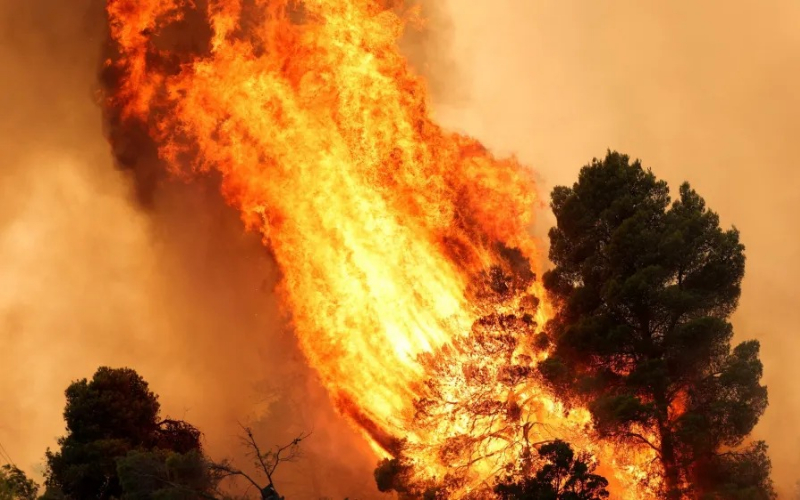

ATHENS: A deadly accident struck Greece’s firefighting efforts on Sunday when two helicopters collided while battling a massive wildfire near Athens, killing two people as emergency teams continued to fight destructive blazes spreading across parts of Europe.
Greece’s Fire Service said two people aboard one helicopter a Greek and a Danish national died in the crash, while the crew of the second helicopter, including a Greek and a British national, survived. Authorities have launched an investigation into the cause of the collision.
The crash occurred in the Psatha area of Attica, where firefighters were working to contain a major wildfire that has destroyed more than 100 homes and forced residents to evacuate. Another wildfire on the tourist island of Kefalonia also led to evacuations.
Footage shared by Forecast Weather Greece appeared to show the two helicopters flying close to each other at a low altitude before the rotor of one aircraft struck the underside of the other. The lower helicopter then crashed and caught fire, while the second helicopter released its water load and moved away from the area.

Reuters has not independently verified the footage.

Greek authorities are also investigating the cause of the wildfire that spread from the Boeotia region into Attica. According to local media reports, the blaze may have been caused by sparks from electrical conductors on a private network carrying power generated by wind turbines.
Read More: Greek F-16 fighter jet crash-lands at Zakynthos Airport
Two Greek nationals were arrested on suspicion of negligence, while another suspect remains wanted, according to reports.
Strong winds that had fuelled the fire near Porto Germeno, around 60 kilometres northwest of Athens, later weakened. However, flames crossed a mountain toward the settlement of Veniza and reached a military firing range, where unexploded ammunition caught fire.
Emergency crews focused their efforts on preventing the fire from spreading toward the coastal town of Megara, which has a population of around 30,000.
Greek Prime Minister Kyriakos Mitsotakis described the situation as a major challenge, saying extreme weather conditions had exceeded normal firefighting capabilities.
“There are moments when the force of nature and the intensity of weather conditions exceed all human planning and every operational capability,” Mitsotakis said.
Authorities issued evacuation warnings for several settlements in western Attica, including an industrial area near Megara.
In the village of Agios Konstantinos, residents worked alongside emergency teams to slow the spread of flames.
“The fire has been burning since last night. It is certain that they cannot have forces everywhere. We as residents are doing everything we can,” resident Tasos Tzempelikos said.
On the Ionian island of Kefalonia, several communities were evacuated overnight after a wildfire broke out in the Pastra area.
The fires in Greece are part of a wider wildfire crisis affecting Europe this summer, following record-breaking heatwaves and limited rainfall. Scientists have linked the increasing frequency and intensity of such extreme weather events to climate change.
In France, a wildfire in the southwestern Var region changed direction after shifting winds pushed flames into a difficult-to-access forest area. Another fire near the southern city of Carcassonne, believed to have been caused by a burning vehicle, forced authorities to close a highway and evacuate a nearby animal park.
In Spain, wildfires that burned through tens of thousands of hectares over the past week were largely brought under control, although firefighters continued efforts to contain new outbreaks.
A forest fire in Cáceres province forced around 800 people to evacuate. Residents were later allowed to return but remained under restrictions as firefighting operations continued.
Alongside wildfires, several European countries are facing severe drought and falling water levels in major rivers, including the Rhine and Danube.
In Hungary, declining water levels in the Danube forced the country’s only nuclear power plant to temporarily shut down for the first time in more than four decades.
Low water levels have also disrupted shipping and tourism activities, while more than 100 towns and villages have introduced water-use restrictions.
In Serbia, the Danube reached its lowest level since 1985, reducing production at the country’s largest hydropower plant to around 20%, according to officials.
With extreme heat, drought, and dry conditions continuing across Europe, authorities are preparing for further wildfire risks in the coming weeks. Emergency teams remain focused on controlling fires, protecting communities, and limiting damage.

