



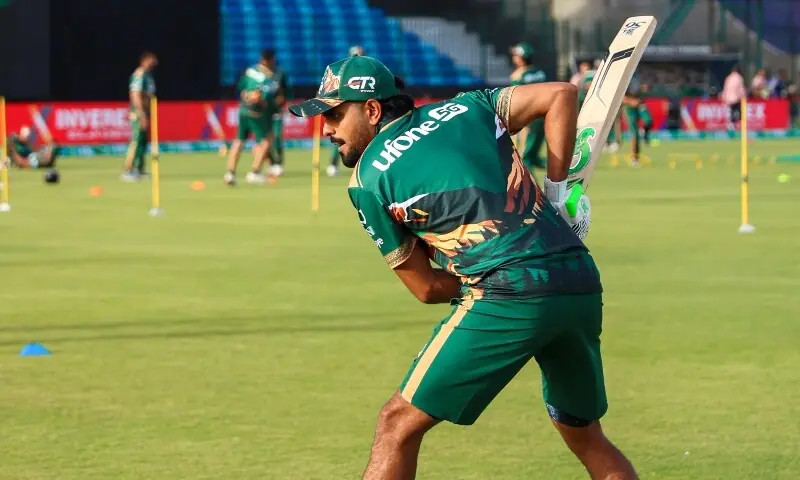

As the evening set in over the Hanif Mohammad High-Performance Centre on Monday and a gentle breeze eased the blazing Karachi sun, Peshawar Zalmi’s players scattered across the facility.
It was their only training session ahead of their HBL Pakistan Super League Qualifier against Islamabad United. Prayers were offered, the sun soaked in — it was time to get to work.
Babar Azam, the captain, padded up and strolled to the middle of the HPC Oval. First ball — Sufiyan Muqeem’s left-arm wrist spin — Babar rocked back into the crease and pushed it forward. The intensity gradually increased and so did the echo of bat meeting ball, soon reverberating across the facility.
And the loudest came from the bat of New Zealand all-rounder Michael Bracewell, who practised his swing towards midwicket as Zalmi head coach and former Pakistan captain Misbah-ul-Haq, clad in a yellow bucket hat, threw balls at him.

Each shot was met with calls of “well done!” and “excellent!”. Not long after, Babar, done with the main nets, replaced Bracewell, submitting himself to Misbah’s tutelage.

There were discussions — not as audible from a distance as Babar’s shots — but hand signals and body movements suggested a class was in session.
It appears such sessions have played a role in Babar’s return to form this PSL season. Opening the batting, he has piled up 485 runs, averaging 80.83 at a strike rate of 141.39, helping Zalmi win eight of their 10 league-stage matches.
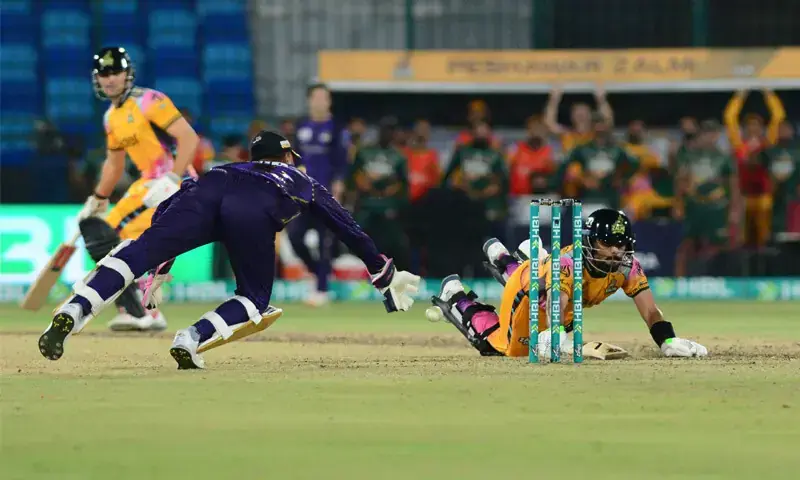
The former Pakistan skipper has done so with characteristic ease, playing his natural game and rarely looking uncomfortable at the crease — in stark contrast to his struggles during last month’s T20 World Cup.
Batting at number four for Pakistan, the right-hander managed just 91 runs in six outings during the tournament, drawing criticism from fans who once revered him.
According to Misbah, the sessions held after the T20 World Cup and before the PSL were more about unlearning than learning.
“The credit goes to Babar himself,” Misbah said after two long hours of training, wiping sweat off his forehead.
“He realised before the PSL that he was losing his [batting] shape and was forcing things. He is a timer — he scores through elegance, by picking the gaps.”
“He did some rethinking after the T20 World Cup and worked on himself. When he joined the camp, he had conversations with the head coach [Ottis Gibson] and me. We both told him the same thing: ‘go there, use the pace, time the ball, maintain your shape and hit the gaps’.”
The lesson appears to have eased Babar’s nerves — most notably during his unbeaten 100 off 52 balls against Quetta Gladiators.
In that innings, Babar played just one dot ball and had struck only five boundaries until the 17th over before launching a late assault that included four sixes and another boundary.
It was his first T20 century in two years, reaching the milestone after 67 innings — a knock that signalled his return to top form.
“I think he is back to what he used to be,” Misbah observed. “All we have done is give him confidence and some preparation. The rest is his own effort and the work he has put in.”
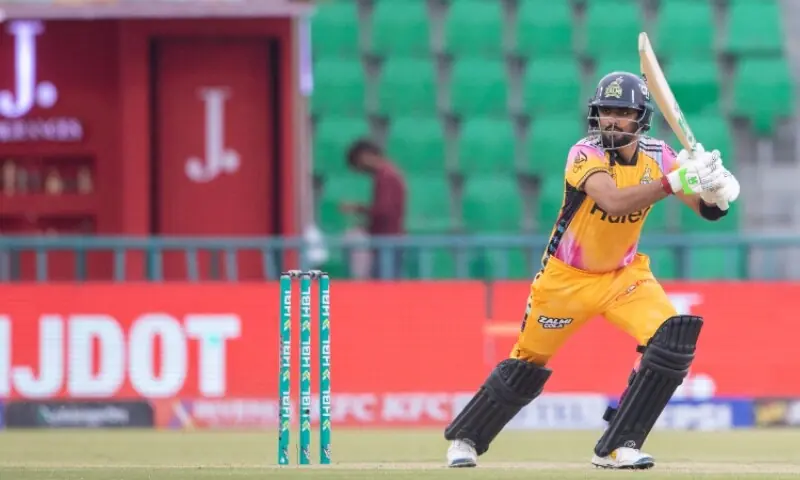
It would not be incorrect to say that Peshawar’s team composition has allowed Babar to stick to his natural game, relieving him of the burden of forcing the pace and taking undue risks.
Zalmi’s batting line-up includes the explosive Mohammad Haris at the top, capable of providing brisk starts. But the standout has been Kusal Mendis at number three.
The Sri Lankan wicket-keeper-batter leads the run charts this season with 500 runs at an average of 62.50 and a strike rate of 170.64.
Mendis, however, has credited Babar for providing the platform, even as his own proficiency against spin has blunted opposition attacks in the middle overs.
Together, the pair have added 435 runs in partnerships, giving Zalmi a decisive edge.
“When a team is built, the idea is to ensure all resources complement each other,” Misbah said. “Yes, there was a thought process behind this combination.
“Out of six batters, someone has to act as the glue. The idea behind placing Babar and Mendis in the top three was exactly that, because both can play this role.
“Mendis can adapt — against spin or pace — either as aggressor or anchor. Babar brings consistency and continuity.
“That balance at the top allows players like Haris and others to accelerate. It was not about making Babar do more, but about bringing the best out of each player.”
The approach has worked for Misbah and his team, as Zalmi now look to continue their dominance with a win in the Qualifier and a place in the PSL final — something that has eluded them since 2021.

