




AMD appears to be preparing the next generation of AI-powered graphics technology.
A new upcoming hidden features found in its latest graphics driver “FSR” suggest major improvements could be on the way.
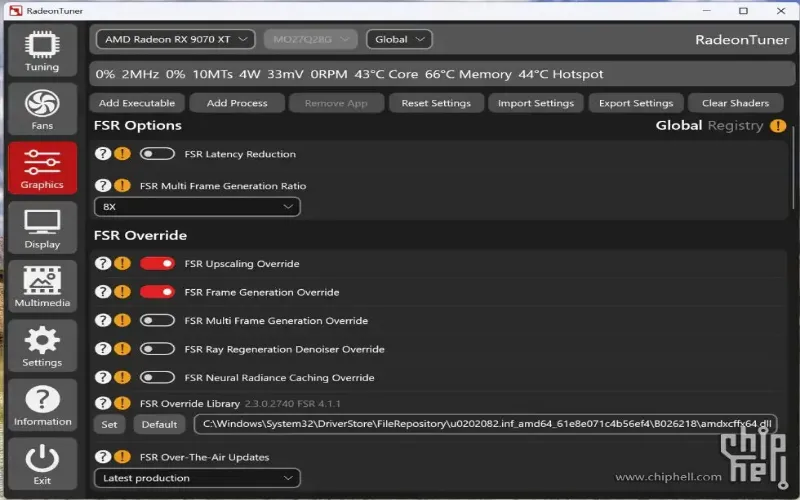
The newly discovered options were found inside AMD’s Adrenalin 26.6.2 graphics driver using the RadeonTuner utility.
Although AMD has not officially announced these features, the findings indicate the company is continuing to expand its Fidelity FX Super Resolution (FSR) technology.


The discovery follows AMD’s ongoing work on FSR Redstone. In April, the company quietly added early support for Multi-Frame Generation (MFG) to the ADLX FidelityFX SDK. More recently, AMD released FSR 4.1.1, showing continued progress in its AI-based graphics software.
A member of the Chiphell Forums used RadeonTuner, an alternative to AMD’s Adrenalin software, to examine the latest driver.
The tool exposed several hidden FSR settings while running Adrenalin 26.6.2 with the FSR 4.1.1 Override Library on a Radeon RX 9070 XT.
The most notable addition is support for Multi-Frame Generation ratios of up to 8x. If the technology works as expected, it could theoretically increase a game running at 60 FPS to an output close to 480 FPS by generating additional AI-powered frames.
However, the hidden features are not currently functional. Reports suggest they are experimental and may require unreleased FSR software components or internal AMD files before they become available to users.
The new options are also expected to work with RDNA 4 graphics cards and future Radeon GPUs. AMD’s current FSR Override feature already allows supported RDNA 4 hardware to upgrade compatible games to FSR 4.1 with machine learning-based Frame Generation.
Features such as Multi-Frame Generation, Ray Regeneration, and Neural Radiance Caching could become part of a major FSR update in the future, offering higher performance and better image quality for PC gamers.

