



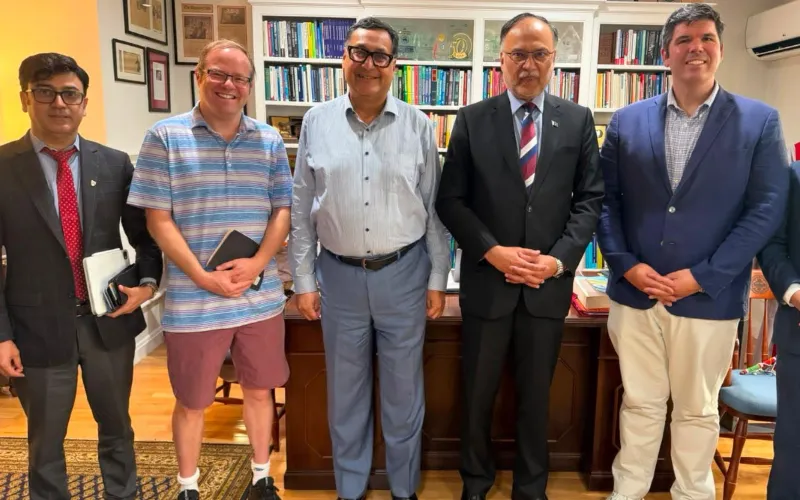

Federal Minister for Planning, Development & Special Initiatives, Ahsan Iqbal, held a series of high-level engagements with academic leaders, researchers and innovation institutions in Boston on Wednesday, aimed at strengthening Pakistan’s collaboration with leading American universities in higher education, climate resilience, economic transformation, public policy and innovation.
During his visit to Boston University, the Minister met Prof. Adil Najam and Dr. Ken Lutchen, Vice President for Research, where discussions focused on expanding academic cooperation and strengthening Pakistan’s human capital through advanced research partnerships.
The Minister briefed the participants on the Government’s flagship US–Pakistan Knowledge Corridor, launched to enable 10,000 Pakistani scholars to pursue PhD studies at the world’s leading universities. He proposed a collaborative model under which Pakistani doctoral researchers could undertake research at top American universities on Pakistan’s priority development challenges, with academic institutions facilitating tuition support while Pakistan bears logistical costs. The proposal was welcomed, and both sides expressed interest in exploring the partnership.
Speaking on the occasion, Ahsan Iqbal said, ” The strength of the United States lies in the strength of its universities. Pakistan is committed to building a knowledge-based economy by investing in quality education, research and innovation through partnerships with world-class institutions. ”

The Minister also highlighted Pakistan’s efforts to expand higher education enrollment and noted that the country is among the few that co-finances Fulbright scholarships, resulting in one of the largest cohorts of Pakistani students studying in the United States. He emphasized Pakistan’s interest in learning from American universities on integrating artificial intelligence into higher education, particularly in curriculum development, teaching methodologies and student assessment.

At Boston University’s Institute for Global Sustainability (IGS) and the Global Development Policy Center (GDP Center), the Minister met Dr. Benjamin Sovacool and Dr. William Kring to discuss climate resilience, sustainable development and research collaboration.
Highlighting Pakistan’s vulnerability to climate change despite contributing less than one percent of global greenhouse gas emissions, the Minister recalled the devastating 2022 floods and stressed the urgent need for research-driven adaptation and resilience strategies. He invited Boston University to collaborate with Pakistan in identifying climate vulnerabilities, strengthening biodiversity conservation, promoting clean energy transition and exploring innovative climate adaptation financing.
The discussions also explored institutional collaboration between the Institute for Global Sustainability, the Global Development Policy Center and the Pakistan Institute of Development Economics (PIDE) to support evidence-based policymaking on climate resilience and sustainable development.
The Minister also visited the Harvard Kennedy School’s Growth Lab, where discussions focused on Pakistan’s long-term economic transformation under the URAAN Pakistan initiative. He invited the Growth Lab to partner with the Government in developing a comprehensive growth strategy aimed at achieving the vision of a one-trillion-dollar economy by 2035.
The discussions covered Pakistan’s macroeconomic challenges, export competitiveness, fiscal reforms, industrial policy, trade strategy and productivity enhancement. The Minister emphasized that Pakistan seeks practical policy recommendations and implementation support to strengthen exports, develop industrial clusters, improve supply chains and achieve the national target of increasing exports to US$100 billion by 2035.
Addressing the meeting, the Minister remarked, ” * Pakistan’s next phase of growth must be driven by productivity, innovation and exports. We seek partnerships that not only diagnose our development challenges but also help us implement practical solutions for sustainable economic transformation * ”
During his visit to J-PAL, the global research centre jointly led by Harvard University and the Massachusetts Institute of Technology (MIT), the Minister met Executive Director Iqbal Dhaliwal to discuss evidence-based policymaking and poverty reduction.
The Minister shared the Government’s URAAN Pakistan framework, emphasizing that investments in education, health and population management remain central to improving human development outcomes. He also proposed an independent evaluation of Pakistan’s Benazir Income Support Programme (BISP) to assess its effectiveness in enabling beneficiaries to graduate out of poverty and discussed the importance of strengthening fiscal incentives that support sustainable development outcomes.
Concluding his engagements, Ahsan Iqbal visited the Cambridge Innovation Center (CIC) and Venture Café, where he received a briefing on one of the world’s leading innovation ecosystems that connects startups, universities, investors and industry. The Minister appreciated the role of collaborative innovation platforms in transforming research into commercially viable enterprises and expressed Pakistan’s interest in developing similar innovation ecosystems to promote entrepreneurship, technology commercialization and startup growth.
The Minister reaffirmed the Government’s commitment to strengthening partnerships with leading American academic and research institutions to build Pakistan’s human capital, accelerate innovation and support the country’s transition towards a competitive, knowledge-driven economy under the vision of URAAN Pakistan.

