




Agreement says an attack on one signatory will be treated as an attack on all, strengthening collective deterrence
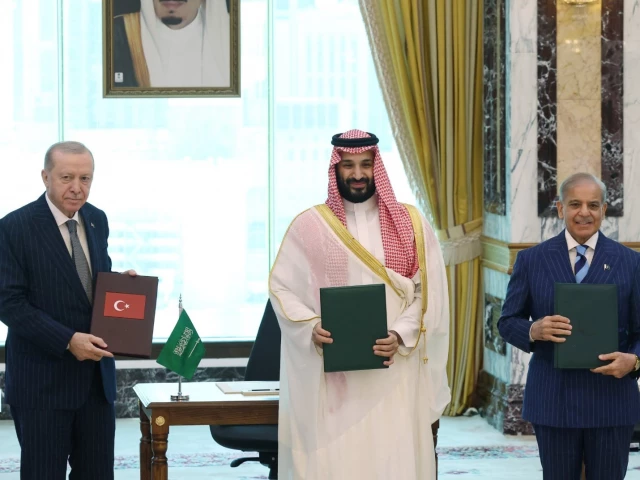
Turkish President Tayyip Erdogan, Saudi Crown Prince Mohammed bin Salman and Prime Minister Shehbaz Sharif pose after signing a joint defence agreement in Makkah, Saudi Arabia on August 7, 2026. PHOTO: REUTERS
Pakistan, Saudi Arabia and Türkiye on Friday signed the Makkah Joint Defence Agreement, reaffirming their commitment to collective security, defence cooperation and regional stability, according to the Ministry of Foreign Affairs (MoFA).
According to the ministry, the agreement establishes a framework for collective deterrence against acts of aggression and stipulates that an armed attack against any one of the three signatory states will be regarded as an attack against all three.

The ministry said the pact was guided by the three countries’ “longstanding historical ties”, the “enduring bonds of brotherhood and Islamic solidarity” and their shared strategic interests and defence cooperation.

It added that the agreement reflects their “shared commitment to further strengthening their collective security” and to promoting “peace, security and stability in the region and beyond, in pursuit of a secure and prosperous future.”
The agreement also provides for enhanced cooperation across all aspects of defence between Pakistan, Saudi Arabia and Türkiye, the Foreign Office said.
🔈 PR No. 2️⃣0️⃣4️⃣/2️⃣0️⃣2️⃣6️⃣
Makkah Al-Mukarramah Summit for Joint Defence
🔗⬇️ pic.twitter.com/mIzASADmau
— Ministry of Foreign Affairs – Pakistan (@ForeignOfficePk) August 7, 2026
The agreement was signed by Prime Minister Shehbaz Sharif, Turkish President Recep Tayyip Erdoğan and Saudi Crown Prince and Prime Minister Prince Mohammed bin Salman during the Makkah Al-Mukarramah Summit for Joint Defence, held at Al-Safa Palace in Makkah, it added.
The ministry said the three leaders reviewed the longstanding relations among Saudi Arabia, Pakistan and Türkiye, as well as a range of issues of mutual interest. The three nations share growing concerns over Middle East chaos and an increasingly assertive Israel, as the United States struggles to contain regional threats.
The Saudi Ministry of Foreign Affairs also released a statement regarding the “Makkah Joint Defence Agreement,” stating that the agreement was based on “the longstanding historical ties among the three countries, the bonds of brotherhood and Islamic solidarity that unite them, and their shared strategic interests and close defence cooperation.”
According to the statement, they echoed that the agreement is intended to strengthen collective security, achieve “security, peace, and stability in the region and the world”, and expand defence cooperation among the three countries.
The ministry said the agreement “stipulates that any armed attack on any one of the three countries shall be considered an attack on all of them.”
البيان المشترك لقمة مكة المكرمة للدفاع المشترك بين المملكة العربية السعودية والجمهورية التركية وجمهورية باكستان الإسلامية 🇵🇰🇸🇦🇹🇷 pic.twitter.com/7dUlPmOT5q
— وزارة الخارجية 🇸🇦 (@KSAMOFA) August 7, 2026
Turkey has NATO’s second-largest military. Saudi Arabia, the strongest Gulf state, is home to Islam’s holiest sites and one of the world’s top oil exporters, while Pakistan is the only nuclear-armed Muslim country.
Ahead of the ceremony, Erdogan arrived in Saudi Arabia for a one-day working visit. His plane landed at King Abdulaziz International Airport in Jeddah, where he was welcomed by Mishaal bin Abdulaziz Al Saud, deputy governor of the Makkah Region, Türkiye’s Ambassador to Riyadh Emrullah Isler, and Consul General in Jeddah Mustafa Unal.
Cumhurbaşkanı Erdoğan, günübirlik çalışma ziyareti için Suudi Arabistan’da
▪️ Cumhurbaşkanı Erdoğan ve beraberindekileri taşıyan özel uçak, Kral Abdülaziz Uluslararası Havalimanı’na iniş yaptı
📌 Kara yoluyla Mekke’ye hareket eden Cumhurbaşkanı Erdoğan, çalışma ziyareti… pic.twitter.com/9mHVx8T2p9
— Anadolu Ajansı (@anadoluajansi) August 7, 2026
Earlier, sources with knowledge of the matter told Reuters that Turkiye, Saudi Arabia and Pakistan are expected to sign a joint defence agreement in Makkah amid regional turmoil with Gulf states coming under fire from Iran after it was attacked by the US and Israel.
Two regional sources with direct knowledge of the matter said the deal would be signed on Friday, which was later confirmed by a Turkish official. Another regional source said it was not clear whether the agreement would also be publicly announced on Friday.
PM Shehbaz, accompanied by Chief of Defence Forces and Chief of Army Staff Asim Munir, arrived in Jeddah on Thursday and performed the Umrah pilgrimage in Makkah. They met the Saudi crown prince, whose country has been repeatedly struck by Iran, as well as by the Houthis in Yemen and militia in Iraq, since the war began on February 28.
The conflict has also exposed Gulf states’ security vulnerabilities and disrupted shipping in the Strait of Hormuz, through which a fifth of global oil and liquefied natural gas transited before the war. Their pact follows nearly a year of negotiations, reported by Reuters in January, when Turkish Foreign Minister Hakan Fidan said Ankara favoured a broader regional security platform to promote cooperation and stability.
Also Read: Pakistan, KSA sign defence pact
This defence pact also follows the “Strategic Mutual Defence Agreement” signed in September 2025 between Saudi Arabia and Pakistan. It stated that “any aggression against either country shall be considered an aggression against both”, according to a Pakistan-Saudi joint statement at the time.
It added that the agreement “reflects the shared commitment of both nations to enhance their security and to achieving security and peace in the region and the world, aims to develop aspects of defense cooperation between the two countries and strengthen joint deterrence against any aggression.”
At the time, the pact was seen as significant as Israel had conducted strikes on Qatar, however a Saudi official told Reuters that the agreement was not meant to respond to any specific event rather reflected the longstanding strategic cooperation between Islamabad and Riyadh.
In practice, Pakistan has sought to avoid becoming militarily entangled in the Iran war, instead opting to try to mediate with Iran.
Pact builds on longstanding military ties
Turkiye and Pakistan, on the borders of the Middle East, are anxious to calm conflicts that threaten their own security and economic health.
For Saudi Arabia, the consequences of three years of widespread Middle East conflicts have been more severe – bringing it under direct fire from three directions, imperilling its oil exports and ambitious development plans and drawing big questions over the reliability of its longstanding US security umbrella.
Sealing Friday’s agreement in Makkah, the holiest site in Islam, will add symbolic heft to a pact that builds on longstanding bilateral military ties among the three countries.
Pakistan has provided training and technical assistance to Saudi forces for decades, while Turkiye and Pakistan have exchanged warships and training aircraft. In 2023, Riyadh agreed to buy Turkish drones in what Ankara called its largest defence export contract.
Pakistan has since deployed about 8,000 troops, fighter jets, drones and an air-defence system to the kingdom, Reuters reported in May, and has pursued wider Gulf security ties. It has opened negotiations with Kuwait over an expanded pact in exchange for energy cooperation and investment, Reuters reported in July.

