




Police say weapons and documents were recovered, while JAAC rejects allegations and vows peaceful protest
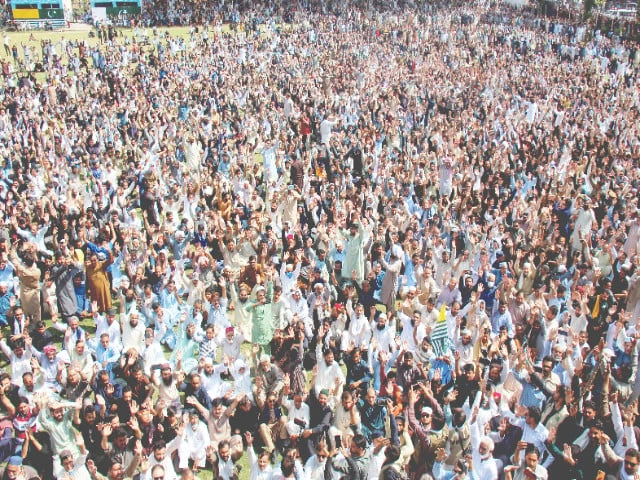
People chant slogans as they gather to attend the funeral of men who were killed during a protest following a shutter-down strike in Muzaffarabad. Photo: REUTERS
Police in Azad Jammu and Kashmir (AJK) on Saturday said they had arrested around 72 individuals allegedly affiliated with the Joint Awami Action Committee (JAAC) during operations carried out over the past 18 hours, a day after the government outlawed the organisation under anti-terrorism laws.
The development came after the AJK government banned the JAAC, accusing it of involvement in terrorism, promoting hatred and creating anarchy in the state ahead of a protest announced for June 9.

In a statement, the AJK Police said the arrests were made as part of efforts to maintain law and order and protect citizens’ lives and property.

Read: AJK govt bans Joint Awami Action Committee as tensions rise ahead of June 9 protest call
The police claimed that weapons, communication devices and suspicious documents had been recovered during the operation. Authorities also alleged they had seized material related to plans that could affect public order, as well as evidence purportedly indicating organised protest and violent activity patterns.
The statement further claimed that investigators had found indications of suspected contacts with foreign individuals and that inquiries into the recovered material were continuing.
According to the police, preliminary evidence suggested that certain elements were planning to disrupt public order, damage public and private property, influence the electoral process and incite hostility against state institutions through what it described as unconstitutional and violent agitation.
Law enforcement agencies were examining the recovered material, digital evidence and other information in accordance with legal requirements, the statement added.
The inspector general of police said the state respected peaceful expression of opinion, constitutional demands and lawful protest.
“However, no individual or group will be allowed to engage in violence, incitement, use of weapons, road blockades, damage to public property or disruption of citizens’ daily lives,” the police chief was quoted as saying.
The statement said all those arrested would face investigation and judicial proceedings under the relevant laws.
Appealing to the public to remain calm, police urged citizens to avoid rumours and inflammatory content, cooperate with law enforcement agencies and stay away from sensitive locations and unlawful gatherings.
Reaffirming its commitment to maintaining law and order, the police said all roads and markets across the state remained open.
“No attempt to disturb peace, promote violence or incite people towards unconstitutional activities will be allowed to succeed,” the statement said.
AJK PM defends ban
Meanwhile, AJK Prime Minister Chaudhry Faisal Mumtaz Rathore defended the decision to ban the JAAC, saying the move had become unavoidable given the evolving situation in the state.
Speaking to a private television channel, Rathore said progress had been made on most of the points agreed between the government and the committee.
Referring to negotiations with the JAAC, he said that out of 38 points, some of the 37 agreed-upon points had already been implemented, while others had been partially fulfilled.
“If you believe that the abolition of these seats in the state is essential and consensus has to be built on the issue, then give us another five to seven days. But they did not give us that time,” he said.
The prime minister said the situation developing in the state was creating difficulties for ordinary citizens and that the government could not allow matters to descend into chaos.
“Given the direction in which the situation was moving, a ban on the JAAC had to be imposed,” he said.
Asked whether elections scheduled for the 27th would be held on time, Rathore said they should proceed as planned.
“We want to ensure that the environment which has emerged does not persist. All political parties, as well as the public, should demonstrate responsibility,” he said.
Recalling previous negotiations, the premier said an agreement had been drafted after the last round of talks broke down but collapsed at the point of signing over a single issue.
“When our last negotiations collapsed, an agreement was written on the table. When it was about to be signed, it broke down over one point. After that, 13 human lives were lost, and then the same agreement was eventually reached. That could have happened earlier as well,” he said.
Responding to a question about possible Indian involvement in the unrest, Rathore said that regardless of whether India was directly involved, instability in the state would benefit New Delhi.
“Whether India is involved or not, when disorder is created in the state in the name of rights, the greatest benefit goes to India. We have seen this in the past and we are seeing it today as well,” he said.
“At such a time, giving India space to exploit the situation and strengthen its narrative on Kashmir is, in my view, not appropriate for either Pakistan or Kashmir,” he added.
Rathore warns against chaos, anarchy
Later, in a post on X, Rathore warned against anarchy and unrest, saying the state had the right to take action against lawlessness while condemning violence “whether in the name of authority or protests”.
He said recent statements by leaders of a proscribed group had indicated an inclination towards “creating mass chaos, as seen in the past”.
We condemn violence, be it in the name of authority or protests. However, every State has the right to take action against lawlessness and anarchy. Recent statements by leaders of the proscribed group had pointed to their inclination towards creating mass chaos, as seen in the… https://t.co/yTd3ZCv62T
— Faisal Mumtaz Rathore (@PMofAJK) June 6, 2026
“We condemn violence, be it in the name of authority or protests. However, every State has the right to take action against lawlessness and anarchy,” he wrote.
The prime minister added that there was no justification for threats against state institutions, alleging that the proscribed group had repeatedly used such tactics even while talks were ongoing.
“I had repeatedly requested them to show some lenience in negotiations and talks as after the announcement of schedule for elections, our powers to play an effective role would be limited,” he said.
He said the group’s “stubbornness and determination to overpower the State machinery” had prevented any reasonable outcome.
“Now they’re blaming everyone but themselves, even though they are the only ones to be blamed,” he added.
He also criticised abusive language directed at him on social media, saying it reflected the group’s approach to resolving differences.
“Their abusive language under my posts is reflective of their general approach of resolving differences. This could never succeed,” he said.
JAAC rejects allegations
Separately, JAAC leader Shaukat Nawaz Mir painted a starkly different picture of the situation.
In a statement, he said internet services had been shut down across the region and that raids were being conducted to arrest Action Committee members.
Mir alleged that in Rawalakot, committee member Umar Nazir had been attacked and that another activist, Shazib Habib, had been killed.
“Our morale is high, and our resolve is stronger than ever before. This state belongs to us, and its protection is our responsibility as well,” he said.
He said a formal announcement regarding the future course of action would be made after consultations following the funeral prayers of Habib and reiterated that the planned long march would go ahead.
“The long march will be carried out in full force. Our movement is entirely peaceful, and our demands are just and popular,” he said.
Mir urged supporters to avoid damaging public or private property.
“All comrades should refrain from any actions that could cause damage to government or private property. Our goal is construction, reform, and the attainment of rights — not damage and chaos,” he said.
Appealing to Kashmiris abroad and human rights organisations, he said: “We make a fervent appeal to our Kashmiri brothers around the world and to human rights organisations to become our voice and highlight this situation on the global stage.”
تمام کشمیری عوام اور ساتھیوں کو آگاہ کیا جاتا ہے:
آزاد کشمیر میں اس وقت صورتحال انتہائی سنگین ہے۔ حکومت نے پوری وادی میں انٹرنیٹ سروسز مکمل طور پر بند کر دی ہیں۔ ایکشن کمیٹی کے ممبران کی گرفتاری کے لیے مختلف مقامات پر چھاپے مارے جا رہے ہیں۔ راولاکوٹ میں ہمارے ساتھی عمر نذیر پر…— Awami Action Committe (@JAAC__Official) June 6, 2026
He also urged supporters not to spread unverified information.
“Fake news is being spread regarding the arrest of core members. The public is requested not to believe unverified news and to refrain from spreading rumours,” he said, adding that supporters should avoid abusive language and maintain the traditions and values of Kashmiri society.
کور ممبران کی گرفتاری کے حوالے سے فیک نیوز چلائی جا رہی ہیں۔عوام سے گزارش ہے کہ غیر مصدقہ خبروں پر یقین نہ کریں اور افواہوں کو آگے پھیلانے سے گریز کریں۔ایک ضروری بات، کسی کو گالی نہ دیں۔ یہ کشمیریوں کی روایت نہیں۔ ہمارا مؤقف، ہماری جدوجہد اور ہمارا احتجاج دلیل، اخلاق اور شعور کے…
— Awami Action Committe (@JAAC__Official) June 6, 2026
Internet disruption, political reaction
Internet services remained disrupted across parts of AJK following the JAAC’s call for protests on June 9.
According to NetBlocks, metrics showed a major disruption to internet connectivity in AJK.
⚠️ Confirmed: Metrics show a major disruption to internet connectivity in Pakistan-administered Azad Jammu and Kashmir.
The shutdown comes ahead of protests as authorities use anti-terrorism powers to ban the Joint Awami Action Committee and is likely to limit coverage of events. pic.twitter.com/aUQiqshtGB— NetBlocks (@netblocks) June 5, 2026
The ban on the group also drew criticism from several political figures.
Former senator Mushahid Hussain Sayed described the move as a “wrong decision at the wrong time” in a post on X, saying it repeated past mistakes in dealing with dissent and questioned the use of anti-terror laws against political opponents.
Wrong decision at wrong time, repeating past mistakes of mishandling dissent: at a time when India is totally on the run in the region, isolated diplomatically because of their failed & flawed policies on Pakistan & Indian Occupied Kashmir, Pakistan’s Officialdom creates new… pic.twitter.com/dAlItc9GUl
— Mushahid Hussain Sayed (@Mushahid) June 6, 2026
Former senator Afrasiab Khattak called the ban “a gross violation of all the fundamental rights in the Constitution”.
Banning the Jammu Kashmir Awami Action Committee, a non-violent voice of the people, under anti-terrorist act is a gross violation of all the fundamental rights in the Constitution. “Conquering” Kashmir by force instead of winning hearts & minds will have dangerous consequences.
— Afrasiab Khattak (@a_siab) June 6, 2026
In a post on X, he said: “Banning the Jammu Kashmir Awami Action Committee, a non-violent voice of the people, under the anti-terrorist act is a gross violation of all the fundamental rights in the Constitution.”
The leader of the Haqooq-i-Khalq Party, Ammar Ali Jan, also criticised the decision, arguing that repression during elections would increase resentment and instability.
After blatant pre-poll rigging in Gilgit-Baltistan where PTI was not allowed to campaign, the state has banned Awami Action Committee in Kashmir. Repression during elections will only fuel resentment & create further instability. Reverse this suicidal policy before its too late.
— Ammar Ali Jan (@ammaralijan) June 6, 2026

