


3rd phase of AJK polls: Voting begins in Poonch Division's Bagh and Haveli districts

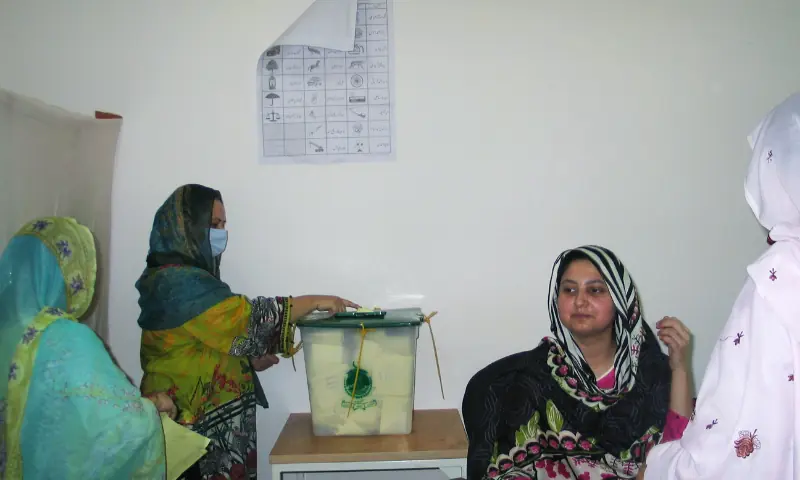

The third phase of elections in Azad Jammu and Kashmir (AJK) has begun in four constituencies in Poonch Division’s Bagh and Haveli districts.
Polling began at 8am and will continue until 5pm.
Government officials have anticipated clashes in some areas, while the Election Commission has classified most of the 803 polling stations in the four constituencies as either sensitive or highly sensitive.
“Apart from the regular police of both districts, we have dispatched an additional 10,300 troops to maintain law and order and provide a fear-free atmosphere to voters,” Election Commission Secretary Raja Mohammad Shakeel told Dawn earlier.

Elections are being held across AJK in phases amid tensions between protesters and the authorities. Polling in Mirpur and Muzaffarabad divisions was held on July 27 and Aug 2, respectively, with the PML-N securing 24 seats. The PPP has only secured 10 seats so far.

The third phase of the polls was originally meant to cover all of Poonch Division. The division comprises 11 constituencies, including three in Bagh, one in Haveli, five in Poonch district and two in Sudhnoti district.
However, last week the AJK Election Commission announced that polling would only go ahead as scheduled in Bagh and Haveli due to concerns over the law and order situation. The AJK election commissioner has hinted that polling on the remaining seven constituencies could be held by Aug 20 or 21.
Rathore, two ex-AJK PMs face crucial electoral test
AJK Prime Minister Faisal Mumtaz Rathore and two of his predecessors — Sardar Tanveer Ilyas and Sardar Attique Ahmed Khan — face a battle for political survival as voters head to the polls.
Around 238,664 men and 221,707 women are eligible to cast their ballots at 803 polling stations comprising 1,254 polling booths.
A total of 82 candidates are in the fray, with LA-14 (Dhirkot) attracting the highest number of candidates at 30 and LA-17 (Haveli) the lowest at nine.
In LA-17, Rathore is facing PML-N candidate Engr Mohsin Aziz and independent candidate Khawaja Tariq Saeed, a member of the AJK Council.
Rathore and Saeed had been political allies and, under an agreement, had agreed to contest the seat alternately. However, after becoming prime minister, Rathore asked Saeed to step aside in his favour, a request he did not accept, turning the former allies into rivals.
Aziz, whose father, Chaudhry Mohammad Aziz, had won the seat at least three times, draws support from the sizeable Gujjar community. His recent large election rally in Forward Kahuta reportedly surprised his rivals and underscored the strength of his campaign.
Saeed, meanwhile, is believed to enjoy the backing of a sizeable section of the Kashmiri community, as well as an alliance of several smaller clans.
Rathore, however, remains confident of retaining the seat, citing the performance of his government during his relatively brief tenure as prime minister.
The constituency has also witnessed allegations of electoral irregularities on social media, with reports claiming that two presiding officers had been caught manipulating results in favour of Rathore. Shakeel dismissed the allegations but at the same time confirmed that complaints had been received against the two officials and that they had subsequently been relieved of election duties.
In LA-15 (Wasti Bagh), former prime minister Ilyas is facing PML-N candidate and former minister Mushtaq Ahmed Minhas, PPP nominee and sitting minister Sardar Ziaul Qamar, and Jamaat-i-Islami candidate retired Brig Dr Mohammad Khan, a respected educationist.
Ilyas, who secured a little over 3,300 votes from Upper Neelum in the second phase of the elections, had initially announced a boycott of the third phase. He subsequently reversed the decision and resumed campaigning, claiming that his victory would enable the constituency to “secure either the presidency or prime ministership.”
Ilyas and Qamar belong to the same Madiyal tribe, while Brig Khan belongs to the Narma clan and enjoys the support of former JI chief Abdul Rashid Turabi and former adviser Raja Yasin Khan.
Minhas has the advantage of belonging to the PML-N, which is poised to form the next government after emerging as the largest party in the elections held so far. His campaign has also stressed the argument that voters should elect a candidate from the party that is set to occupy the government benches rather than send their representative to the opposition.
In LA-16 (Sharqi Bagh), former ministers Sardar Mir Akbar and Sardar Qamar Zaman are the principal contenders, representing the PML-N and PPP, respectively.
The fourth contest, LA-14 (Dhirkot), has drawn particular attention because of the challenge faced by Sardar Attique, head of the once-dominant Muslim Conference (MC).
Attique is reportedly facing a strong challenge from Sajid Iqbal Abbasi of the relatively new Awam Dast-o-Bazu Party. A contractor and philanthropist, Abbasi is said to have spent millions of rupees from his own resources on public welfare projects in the constituency, helping him build a sizeable personal following.
Attique, who has represented the constituency successively since 2006, when he first became prime minister, faces an additional challenge in that Abbasi also belongs to the same tribe.
Among nearly two dozen other candidates are PML-N’s nominee Raja Faisal Azad and PPP candidate Raja Mubashar Ejaz. While the main contest is seen as being between Attique and Abbasi, the PML-N and PPP nominees are expected to vie for the second runner-up position.

