


In today’s Karachi, equity is missing in how access is distributed. Public spaces often feel exclusionary because of unequal safety, comfort, and even healthcare.
Consider this: she gets back home after a long hard day at work. “It’s 10pm already,” she thinks to herself, as something outside the window catches her eye. It’s her roommate excitedly waving a cricket bat at her.
She now begins to notice her surroundings: almost 15 girls from her neighbourhood out on the street. All positioned for the game, all looking as disheveled as one can be, yet they all have this fiery spark in their eyes. Clearly they feel passionately for the game. They play for the next two hours.
Unperturbed by any restrictions. The dark shadows on the street do not scare them. Time is of no concern. They feel free. Their energy, loud passionate voices, and roaring laughter fill the dimly lit street. No one cares for their appearance, they just run and trip and get back up. They get into silly brawls over the rules of the game. By the end of the night, they are drained but they return to their homes content.

The kind of contentment almost every young girl and woman in Karachi is starved for; to occasionally be able to show up back home past midnight after having a carefree time with her friends.

You see, this simple image of freedom feels like a distant reality for most women in Karachi. Something as simple as existing outside one’s home can be as complicated for a woman as it is unnatural for a man to remain confined within it. Most public spaces in our city are predominantly occupied by men; almost all force a woman to constantly adjust herself away from prying, judging, and stalking eyes simply to survive.
The not-so-silent exclusion
All of this, despite being a majority, at least statistically.

Women’s enrolment at colleges and universities in Karachi is higher than that of the other gender. At medical schools, an estimated 85 per cent of students are females. Similarly, about 76pc of teachers at primary and secondary schools here are women.
Even outside of Karachi, official estimates place the number of home-based workers in Pakistan at around 4.4m to 4.8m, while unofficial sources suggest the total could be as high as 20m. Out of this, 12m are women, which comes to 60pc.
They, the women, are everywhere — from malls to banks, offices, and even marketplaces. Yet, proportionate to their overall number, the workplace participation of women is at a meagre 17pc, and it often has to do with the environment.
In today’s Karachi, equity is missing in how access is distributed. Public spaces often feel exclusionary because of unequal safety, comfort, and even healthcare.
Women can not walk the streets freely; movement is always cautious, always calculated. Every step is taken with an awareness of risk. The city assumes a default male body able, unburdened, and unconcerned with safety, while women are expected to adapt to spaces never designed with them in mind.
But in an ideal Karachi, safety is guaranteed to all; a place without any social divide. If we are to ask whether this city can ever become ‘ideal’, we must first understand what feminism truly means.
Women with men, not against
Feminism should be natural. It isn’t women against men, it’s women with men. Our city needs equality, kindness, safety, and joy. It doesn’t need debates on whether it’s okay for a woman to be out on the street post midnight. It needs better-lit streets, accessible public spaces, and more freedom of movement for women.
Feminism pursues a kindness that nurtures, fosters, and protects political, social, environmental, personal, and economic spaces. Its goal is an equitable world that balances justice, dignity, and emotional well-being. It calls to create a balanced world that is constantly moving to eradicate poverty of all kinds: poverty of mind, poverty of income, poverty of health, and poverty of justice. It seeks a balance between all genders, their freedom of choice over their own lives and bodies, and their freedom of movement in a city that doesn’t stop moving.
That is feminism.
A ‘feminist’ city
Think of it like this: a feminist city is a place where a woman doesn’t have to constantly think about herself, how she is walking, what she is wearing, or whether it is safe to be outside. She just moves, the same way anyone else does, without that extra layer of caution. The streets feel open and calm, not because they are empty, but because they are shared without fear.
A city where public transport, parks, and markets are all designed with the understanding that women belong there just as much as anyone else. What really changes is not just the physical space, but the feeling of it. There is less tension, less hesitation. A woman does not have to plan her movements or limit herself. She can just be present. And in that simple freedom, the city starts to feel like it truly belongs to her.
A place where women can ride scooties and motorcycles without it being a novelty, and men can look after the household chores without any social stigma attached to it. Where a housewife managing finances is as applaudable as a man being the breadwinner of the family, a place where everyone’s work is equally valued and appreciated. Where being a single mother, widow or divorcee is not seen as a disgrace to the family.
But here is the harsh truth: Karachi is built on endurance, speed, and survival, and demands constant adjustment instead of offering support. Its streets reward those who can move quickly, claim space loudly, and exist without explanation. Others have to adjust silently and survive; a survival often mistaken for strength.
An ideal city
But isn’t an ideal city meant to be lived in rather than survived in? And that is definitely what Karachi is.
As loved as this city is, it is also ruthless — one that constantly demands movement and yet confronts its people with potholes at every turn. And it is tiring, very tiring.
It is built on reclaimed land where roads and buildings try to colonise the sea. It’s a landscape built on an imbalance of power. The concrete is wide, smooth, and expansive, yet it feels suffocating; it is a design that ignores the pulse of the citizen for the sake of private view.
From the changing sea shore to the Malir and Lyari river basins, our city’s geography shifts from ego to neglect. The rivers should be the city’s nurturing lungs; instead, they are scars. This is the negative space in the city — the parts left to drown in the rush of real estate development. When entire neighbourhoods are neglected this way, what should women, who are living in these very neighbourhoods and are navigating a city that offers them little room to breathe, expect?
Karachi is unkind to women. The streets belong to the men, while women are shadows moving quickly through the margins. For some reason, everything belongs to men, and women are expected to just exist somewhere on the crossroads.
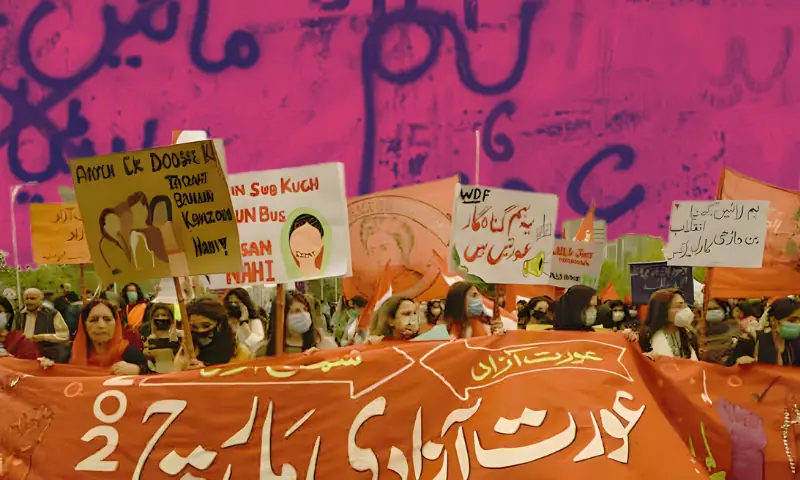
An ideal city would let women live without having to fight for respect or basic rights. It would accommodate all without an extra layer of caution. This city wouldn’t call a woman vulgar when she protests for her freedom; it would stand by her. Safety and dignity would be treated as public priorities rather than private burdens. Public transport would be reliable, affordable, and monitored, making movement possible without dependence.
No “ladies section”, no hurried pace, just the freedom to linger in every space. A feminist Karachi would be a city that everyone can own, a city that pays attention, a city that understands that when spaces are safer and fairer for women, they become better for everyone.
Reimagining Karachi would mean that public spaces welcome women as citizens, not guests. This reimagining also values visible labour. Domestic work, care giving, and emotions are acknowledged as essential to the city’s functioning and reflected in accessible transport, childcare spaces and inclusive infrastructure.
Viewing the city through a feminist lens brings the realisation that designing a just city is not only about infrastructure but also about the mindset. A feminist Karachi would prioritise care for women, for pedestrians, for workers, for rivers, and for forgotten spaces like old bookshops. It would be walkable, accessible and inclusive, not divided by class, gender or gated boundaries. And that development does not silence land or water. Most importantly, it would require unlearning the biases we hold about place, poverty and power.
Finally, a feminist Karachi is one where the “City of Lights’ refers to the safety and dignity afforded to the most vulnerable. It is a city that protects your peace by ensuring that the necessities of life — income, shelter, water, light and safety are treated as sacred rights, not just charity. It is a metropolis that functions with a fierce, mothering kind of love, where a woman’s freedom isn’t a hard-won battle but a quiet daily reality.
In this Karachi, an all-women street cricket match wouldn’t raise eyebrows; it would be applauded and cheered by the neighbourhood.
Written by the Indus Valley School of Art and Architecture’s class for ‘Approaching the City Through Literature and Creative Writing.’ Essay compiled and edited by class member Suraksha Ramesh.
Contributors: Sana Mehmood Sajwani; Rahma Inayatullah, Aiza Fatima Malick; Aiza Abbasi; Ayma Faisal; Ghazaleh Raza; Esha Asim; Kainat Ali; Faiqa Hammad; Khadejah Kawish; Kanwal Mumtaz; Laiba Imran; Mahnoor Hussain; Maha Majid; Nashrah Shaiq; Rafeeyah Baig; Maryam Asif; Saleema Sohaib; Zahra Kayumi; Suraksha Ramesh; Raiha Fareed; Syeda Marium Moosa; Zeerak Hasib