What legal recourse do Pakistanis arrested in Bahrain over Iran war videos have? – Pakistan



Over 23,000 Pakistanis are currently imprisoned abroad, many of whom face trials without sufficient legal assistance or translation.
On March 10, as the US-Israel war with Iran entered its second week, the Bahrain government announced the arrest of six persons hailing from Asian countries — five of them Pakistanis — on charges of filming, publishing and reposting “videos related to the effects of the treacherous Iranian aggression”.
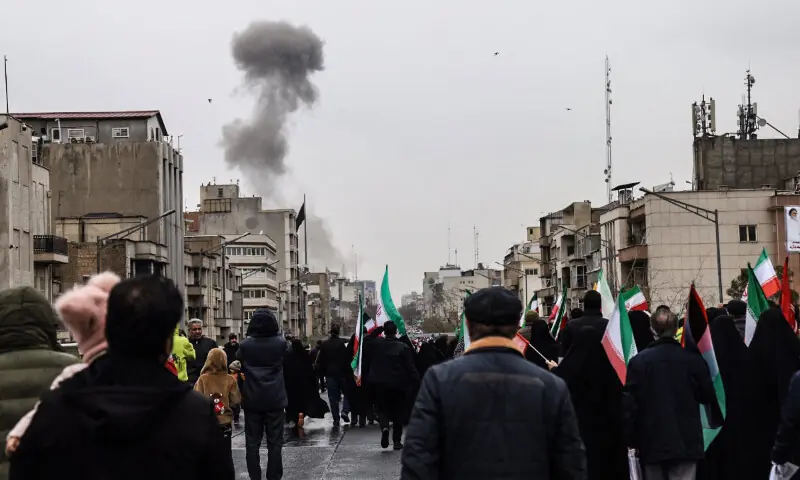
The Iran conflict — which broke out on February 28 after the United States and Israel launched joint strikes on the Islamic Republic and assassinated then-supreme leader Ayatollah Ali Khamenei, along with other top security officials and hundreds of civilians — has now spiralled into a Middle East war.
Today, the entire region is on fire as Tehran continues to retaliate with attacks on Israel and at least seven Gulf states, including Bahrain, which has reported intercepting 114 missiles and 190 drones since the beginning of the war.

In an X post on March 8, Bahrain had issued a warning against the photographing of “vital sites and facilities” and publishing them on social media.

Two days later, a statement issued by the Bahrain police media centre said six suspects had been arrested in this regard.
They expressed “sympathy with and glorified those hostile acts in a manner that harms security and public order”, it noted, adding that the videos in question were circulated through the suspects’ social media accounts, which contributed to “misleading public opinion and spreading fear among citizens”.

“Legal procedures have been taken, and the suspects have been referred to the public prosecution,” it added. The statement also included photographs of the suspects, who all appear to be middle-aged.
The Gulf is a hotspot for countries like Pakistan that rely heavily on foreign remittances and therefore hosts millions of Pakistanis who emigrate to foreign lands to seek better opportunities. It seems that the five Pakistani men behind bars in Bahrain had done the same.
And so, the arrests have raised questions about what legal protections Pakistanis detained abroad are entitled to, and what role Islamabad can play in securing their release.
The protocol
First things first, what does the general protocol in such circumstances say?
According to Oves Anwar, director of the Research Society of International Law, the procedure begins with a consular notification, wherein the arresting country must inform the detainee that they can contact their home country’s consulate.
This is followed by a consular visit where the consulate sends an official to meet the detainees, check on their well-being, understand the charges, and subsequently help the detainees access a local lawyer.
Then comes diplomatic communication, Anwar explained, which involves the home country’s embassy engaging with the host country’s foreign ministry to understand the situation and advocate for leniency or early resolution.
Ultimately, the protocol reaches its final stage: repatriation or trial. Depending on the charges, the suspect either faces a trial under the law of the host country (Pakistan cannot override it) or is released/deported through diplomatic negotiation.
In the current situation, however, things are not as simple; these are the times of war, and it has Pakistan walking on eggshells. So far, the Foreign Office has not issued a media statement with respect to the arrests in Bahrain.
What does international law say?
While international law is generally permissive during times of armed conflict and active hostilities, Anwer explained to Dawn, it was the domestic laws that were given precedence.
“What international law does impose are basic human rights standards that have to be adhered to, such as those found in the International Covenant on Civil and Political Rights,” he said, highlighting that ICCPR’s Article 19 provides for Freedom of Expression.
“But remember this can be curtailed by law on national security grounds.”
Ahmar Bilal Soofi, former caretaker federal law minister, concurred and elaborated that the ICCPR talks about the freedom of information, which then translates into various domestic laws, which are in turn subject to “certain qualifiers” on the basis of which some countries can legislate.
“So it is possible that this particular legislation (linked to social media posting) was done along these exceptional zones,” he said. “But these restrictions have to be matched with proportionate penalties.”
At the same time, Article 14 (Right to a Fair Trial) of the ICCPR requires that the accused persons be informed of their crimes, be brought before a judge, have access to a lawyer, not be coerced or forced to confess, and receive a fair and public hearing.
The other set of obligations on Bahrain are those stemming from the Vienna Convention on Consular Relations 1963, Anwar continued, which requires the host state to notify the diplomatic mission of persons arrested in their territory.
Simply, Bahrain would have to inform the Pakistani Embassy and allow for consular access to the detained persons. This can mean that the Pakistani embassy can arrange for legal representation, can make representations and provide assistance where necessary, and most importantly, it can help establish contact with the arrested persons’ families.
These safeguards are particularly important where individuals may not understand the local legal system or language.
What must Pakistan do?
While Pakistan cannot interfere with Bahrain’s judicial process, it has a clear obligation under both international law and its own Constitution to protect the due process rights of its citizens abroad, stressed Rimsha Asif, lawyer and advocacy officer at the Justice Pakistan Project.
This includes seeking immediate consular access, ensuring that the detainees have legal representation and interpreters if needed, and monitoring whether their fair trial rights are respected.
“Pakistan’s missions should also ensure that families are informed and that the detainees can communicate with them,” Rimsha said.
Anwar, too, listed the same actions while speaking to Dawn, expanding that Pakistan also must request full details of the charges against its nationals arrested in Bahrain and inform others to respect local laws, refrain from similar activities and undertake backchannel diplomatic efforts to secure their release.
Meanwhile, Soofi advised that the government should reach out to Bahrain on the diplomatic level, “request them to show leniency”.
“The Foreign Office should first find out the criminal law under which these people were arrested and then plead for either a reprimand or the release of Pakistanis behind bars,” he suggested, adding that countries under the Gulf Cooperation Council were known for showing “flexibility”.
The gaps
However, there is a problem. Per Anwar’s experience, Bahrain does not have a clean record on human rights, especially when it comes to foreign workers.
According to a 2026 Human Rights Watch report, Bahrain continues to enforce the kafala (sponsorship) system that ties migrant workers’ visas to their employers, “meaning if they leave their employer without their employer’s consent, they lose their residency status and can face arrest, fines, and deportation for ‘absconding’.”
This makes it all the more important for the Pakistani government to take prompt action. However, Justice Pakistan Project’s Rimsha pointed out that a key structural gap here was the absence of a prisoner transfer agreement between Pakistan and Bahrain.
“This means that even if individuals are convicted, there is currently no legal framework allowing them to serve their sentences in Pakistan … and this limits options for humanitarian transfer.”
“Strengthening consular protection mechanisms, improving legal aid for overseas detainees, and expanding prisoner transfer agreements with Gulf countries remain essential steps to better protect Pakistani nationals facing criminal proceedings abroad,” she stressed.
More broadly, such cases reflect the challenges faced by many Pakistanis detained overseas, who often struggle to navigate foreign legal systems without adequate support.
Over 23,000 Pakistanis are currently imprisoned abroad, many of whom face trials without sufficient legal assistance or translation, added Rimsha.