War diary day 7: Less of a quick military campaign, more a prolonged test of endurance – World


Latest estimates circulating in Washington suggest that sustaining the war is costing between $Rs6-7 billion a day.
Seven days into the war between the United States-Israeli coalition and Iran, the conflict has transitioned from initial high-intensity exchanges to a phase defined by the former’s air and naval dominance and the latter’s asymmetric resilience.
The coalition, over the past twenty-four hours, maintained clear conventional superiority, including sustained strikes on Tehran, buried targets, and Hezbollah strongholds in Lebanon. Still, at the same time, Iran has adapted effectively. The Iranian ballistic missile volume has been reported by Centcom and other sources in the region to be down 80–90 per cent, yet verified penetrations with cluster munitions on Tel Aviv and confirmed strikes on Bahrain’s BAPCO refinery demonstrated Iran’s capability to impose meaningful political, economic, and psychological costs.
Iran’s multi-nodal command structure and underground “missile cities” appear to have helped sustain operations despite heavy losses. Tehran has clearly adjusted its approach and is now fighting a different kind of war, one in which endurance and cost imposition appear to be replacing large-scale missile exchanges as it relies on fewer but carefully selected attacks that are designed to penetrate defences and demonstrate that damage can be inflicted upon politically sensitive targets.

This was visible in the latest wave of Iranian strikes that Israeli authorities say involved Kheibar Shekan ballistic missiles carrying cluster submunitions. The missiles were directed at central Tel Aviv, synchronised with Hezbollah drones that approached from the north at roughly the same time. Israeli civil defence networks recorded more than 160 air raid alerts across multiple districts. Following the hits, fires were reported in several neighbourhoods and emergency services reported several casualties.

According to Israeli accounts, the mood inside Israel is already grim and public support for the war is low, with what they describe as “terrible days” filled with chaos, shattered homes, dust-choked streets, and interrupted celebrations for the Jewish holiday Purim a few days back. Trump’s call to the Israeli president to pardon Netanyahu has led to questions about whether the conflict was about earning him a reprieve.
Militarily, the Iranian barrage was not among the largest of the war, but politically it carried significance because it showed that even after a week of sustained bombardment, Tehran retains the ability to land blows that disrupt daily life inside Israel and force the use of expensive interceptor systems.

At the same time, Tehran widened the economic dimension of the conflict. A confirmed Iranian strike hit Bahrain’s Bapco refinery, the second time the facility has been targeted within twelve hours. Bahraini authorities said the resulting fire was brought under control, but refinery operations were disrupted, underlining the vulnerability of Gulf energy infrastructure, even in countries hosting extensive American military deployments.
Another unusual element of the seventh day involved attacks directed at digital infrastructure in the Gulf. Data centres associated with Microsoft’s Azure cloud platform in Bahrain and the United Arab Emirates were targeted by Iranian operations in an attempt to pressure the logistical and financial systems that support US military activity in the region.
Projectiles were also reported near Kuwait’s Ali al Salem air base and the American embassy in the region temporarily restricted its operations. None of the attacks caused major casualties, but they added to the steady harassment that American forces in the region have faced since the beginning of the war.
These actions illustrate a shift in Iranian tactics, which, rather than relying primarily on large missile barrages like before, are now combining drones, limited ballistic launches and cyber operations to widen the battlefield and increase the economic costs for coalition partners. Increasingly, analysts say, the US administration appears to be losing the initiative, with Iran shaping the war’s length, cost, and geography.
Meanwhile, pressure on American interests continued in Iraq. Groups linked to the Islamic Resistance in Iraq claimed more than two dozen operations against US facilities and interests over the past day. Iraq risks becoming an even more active theatre, especially after the edict by Sayyid Hashem al-Haidari.
The Lebanese front, meanwhile, was also active where Hezbollah not only launched additional rockets and drones toward northern Israel, targeting military installations including the Haifa naval base and the Ramat David air base, but also engaged advancing Israeli infantry units in occupied border areas, including near the southern Lebanon towns of Al-Khiam and Ed Dhayra in ground clashes which resulted in eight Israeli casualties. Israeli Finance Minister Bezalel Smotrich’s son has also reportedly been injured.
Houthis have held public mobilisation marches and reiterated readiness to resume Red Sea and Israel strikes if Arab regimes cross red lines. Their strategy, therefore, is of calibrated solidarity, while keeping a latent escalation threat to keep the coalition’s Arab allies tied down. These actions by Iran’s allies implied that they are participating in a calibrated manner, applying pressure without yet triggering a simultaneous full-scale regional escalation.
Inside Iran, however, the humanitarian consequences of the war have continued to deepen.
International health authorities say at least thirteen healthcare facilities across the country have now been hit during the week of fighting. Several pharmaceutical production plants have also been struck, including a fourth factory on the outskirts of Tehran in recent days. These incidents follow earlier attacks on a girls’ school in Minab in which over 160 girls perished, Tehran’s Gandhi Hospital, a football stadium and parts of the historic Golestan Palace complex. The pattern of strikes on civilian and medical infrastructure has already begun to narrow the diplomatic window as humanitarian concerns intensify.
Iranian officials say the civilian death toll has now crossed 1,200. Furthermore, the damage to medical facilities, medicine production plants and water infrastructure is already raising fears of a broader public health crisis if the conflict continues at the present pace.
Another development quietly unfolding during the seventh day involves Iran’s western frontier.
Small reconnaissance teams linked to Kurdish opposition groups have reportedly crossed from northern Iraq into Iranian territory. The activity appears limited for now and is connected to American efforts to explore possible ground pressure against Tehran through Kurdish factions such as the KDPI and PJAK. The move is being read in some regional capitals as a sign of Washington’s increasing reliance on surrogate options as the war drags on.
The plan carries considerable uncertainty. Intelligence assessments suggest that any large-scale attempt to open a Kurdish front could trigger reactions not only from Iran but also from neighbouring countries concerned about separatist movements. For the moment, the crossings appear exploratory rather than operational, but they highlight the search in Washington for additional leverage as the conflict stretches beyond its initial timeline.
The economic implications of the war are also becoming clearer, with several Gulf states now reviewing major investment commitments and security arrangements linked to the US. Officials familiar with regional discussions say agreements worth billions of dollars are being reassessed as governments weigh the risks of prolonged involvement in the conflict and the growing vulnerability of regional infrastructure.
Within the American military establishment, expectations of a short campaign have also faded, and the latest estimates circulating in Washington suggest that sustaining the war is costing between $Rs6-7 billion a day once missile defence, air operations and naval deployments are taken into account. What was initially discussed as a five-day coercive campaign has effectively turned into an open-ended attritional war.
After a week of fighting, the conflict has begun to look less like a quick military campaign and more like a prolonged test of endurance. For the moment, the US remains reactive and increasingly vulnerable, with interceptor and Tomahawk stocks reportedly under strain and Gulf partners quietly questioning the long-term implications of hosting the war’s infrastructure on their soil.
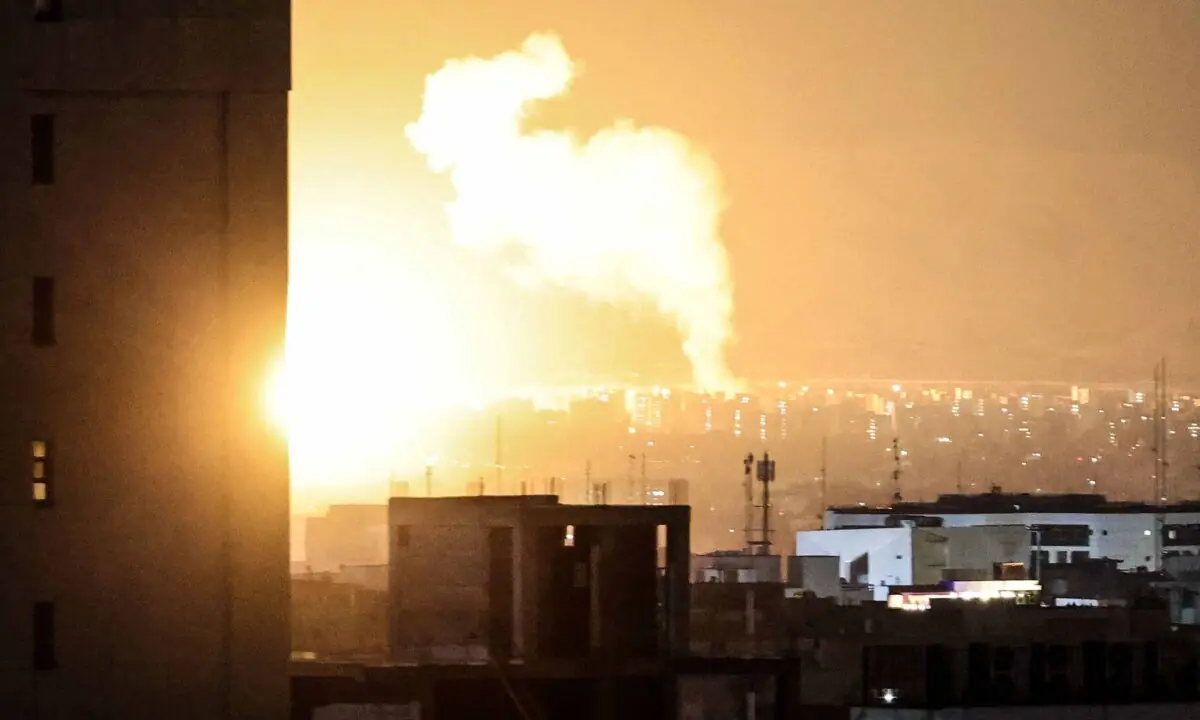
Header image: Smoke and fire rise from the site of airstrikes in a central area of the Iranian capital Tehran on March 6, 2026. — AFP