
Developments illustrate a conflict that is increasingly being fought through multiple interconnected pressure points.
On the 15th day of the US-Israel war against Iran, strategic signalling between the warring sides intensified after American forces struck Kharg Island, Iran’s principal oil export hub, while Tehran and its regional allies increased pressure across multiple theatres stretching from the Gulf to Iraq and Lebanon.
US aircraft conducted strikes on Kharg Island on the night of March 13, targeting what Washington described as military facilities associated with the Islamic Revolutionary Guard Corps Navy. The attacks reportedly hit a short airstrip, air defence positions, docks linked to the Joushan naval base, a control tower and helicopter hangars. Iranian state media acknowledged damage but said air defences were restored shortly afterwards and confirmed that oil export infrastructure was deliberately spared. Reports on Saturday afternoon suggested that oil exports from Kharg Island remained unaffected and at least two ships had docked for loading.
US President Donald Trump described the raid as one of the most “powerful bombing operations” in the region’s history and said all military targets had been destroyed. The limited nature of the strike, however, suggested a calibrated attempt to signal the credibility of a larger threat rather than to cripple Iran’s export capacity outright.

Kharg Island handles roughly 90 per cent of Iran’s crude exports, but the decision not to strike loading terminals or pipelines indicated that Washington was attempting to exert pressure without triggering immediate energy retaliation from Tehran or adding to chaos at the energy markets.

The operation was therefore designed as a compellence signal linked to the standoff over the Strait of Hormuz, where disruptions to tanker traffic have already begun affecting global oil markets. US planners appear to have concluded that a prolonged closure of the Strait, through which nearly one-fifth of global oil trade passes, would carry significant economic consequences if not reversed quickly. Oil prices have already been keeping above the $100 per barrel threshold for two consecutive days.
Alongside the airstrike, reports emerged that the amphibious assault ship USS Tripoli, carrying the Japan-based 31st Marine Expeditionary Unit, had been ordered toward the region to reinforce existing carrier groups. The deployment adds about 2,500 Marines along with F-35B strike aircraft and helicopter assets. The move has led to speculation that Washington could consider a limited ground operation against Kharg Island to deny Iran its main export node if the Hormuz blockade continues.

Analysts, however, caution that such a move would carry substantial risks. Iranian ballistic missiles and drones already cover the island’s approaches, which means any American landing force would face sustained attacks once ashore. Kharg also hosts a civilian population and several historical sites, factors that would complicate any attempt at occupying the area. For now, the Marine deployment appears more likely intended to strengthen coercive leverage rather than signal an imminent seizure attempt.
Iran, for its part, continued missile and drone operations under Operation True Promise 4, while relying increasingly on allied groups to widen the battlefield. In Iraq, militias aligned with Tehran intensified attacks on American installations. A missile strike hit the helipad area of the US embassy compound in Baghdad, causing a fire, while earlier drone attacks targeted coalition positions in Erbil and elsewhere.
The Iraqi strikes have added political complications for Washington because US retaliatory attacks on militia positions have prompted renewed debate in Baghdad about the presence of foreign forces. Statements by Iraqi political figures have warned that continued strikes were undermining Iraqi sovereignty and could draw the country deeper into the regional war.
Pressure has also increased along Israel’s northern frontier, where Hezbollah continued sustained rocket and drone attacks. Israeli air defence systems have faced increasingly frequent salvos, forcing the Israeli military to maintain substantial forces along the Lebanon front even as the broader confrontation with Iran intensifies.
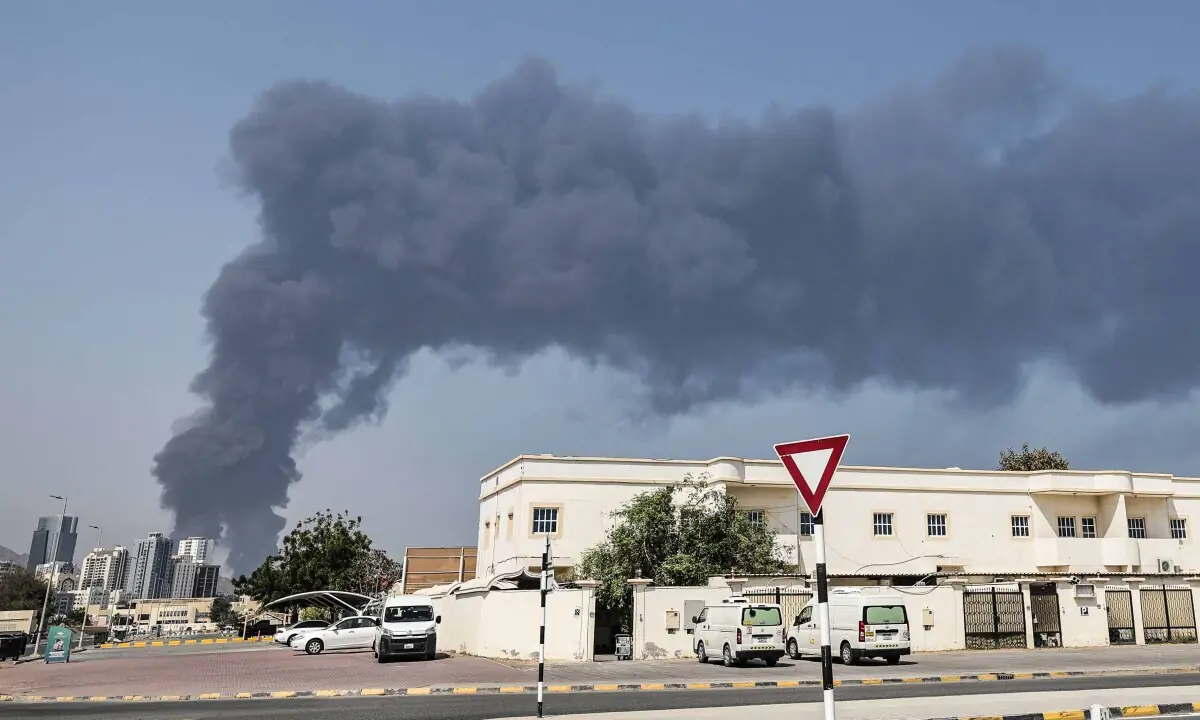
Meanwhile, the Gulf energy theatre expanded further after a major fire erupted at the Fujairah oil storage hub in the United Arab Emirates. Satellite imagery showed damage to storage tanks and heavy smoke over the port, one of the key export routes designed to bypass the Strait of Hormuz. The incident occurred within hours of Iranian military warnings that Gulf facilities supporting US operations could become legitimate targets.
The attack underscored Tehran’s strategy of mirroring pressure on energy infrastructure across the region. By targeting facilities in states hosting American forces, Iran is signalling that economic costs will also be borne by the countries supporting Washington and Tel Aviv’s campaign.
Another potential escalation point emerged from Yemen, where senior Houthi officials announced that their movement had decided to align militarily with Iran and would soon declare what they described as “Hour Zero” for coordinated operations. The statement hinted at the possible closure of another maritime chokepoint, widely interpreted as a reference to the Bab al Mandab Strait linking the Red Sea with the Gulf of Aden.
Such a move would threaten a second critical global trade route and compound the impact of disruptions already affecting the Strait of Hormuz. Although Houthi forces have not yet launched large-scale attacks since the war began, their entry into the conflict would significantly widen the maritime dimension of the confrontation.
Taken together, these developments illustrate a conflict that is increasingly being fought through multiple interconnected pressure points. US and Israel appear focused on applying economic and military coercion aimed at reopening maritime routes, while Iran is attempting to distribute the costs of the war across a wider regional network of fronts.
If things remain as such and nothing dramatic happens, the war is likely to continue expanding across energy routes and proxy theatres, steadily increasing the economic and political stakes for all parties involved.
Header image: Smoke rises from the direction of an energy installation in the Gulf emirate of Fujairah on March 14, 2026. — AFP