


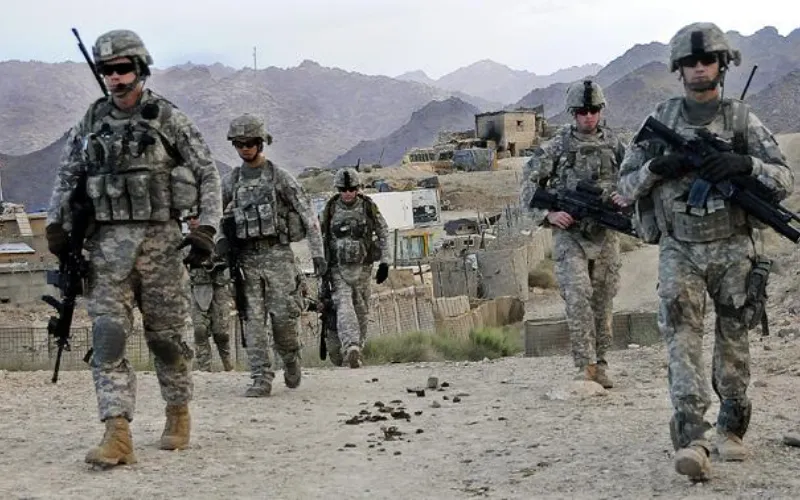

In the aftermath of nearly two decades of sustained global military engagement, the United States has once again intensified its operational footprint abroad.
Despite prior assurances to curtail America’s involvement in protracted foreign conflicts, President Donald Trump, in coordination with Israel, has orchestrated a significant offensive against Iran, targeting strategic leadership, nuclear infrastructure, and missile capabilities.
This action underscores a persistent paradigm of military intervention that continues to shape regional geopolitics and global security dynamics.
Since the September 11, 2001 attacks, the United States has executed three full-scale wars and conducted military operations in over ten nations, spanning Afghanistan, Iraq, Pakistan, Syria, Yemen, Somalia, Libya, Nigeria, Venezuela, and Iran.

These operations have encompassed large-scale invasions, precision airstrikes, drone campaigns, and multifaceted counterterrorism missions, often sustained over protracted periods.

The human and economic toll has been staggering. Research by Brown University’s Watson Institute for International and Public Affairs estimates that US-led conflicts have directly precipitated approximately 940,000 fatalities across Afghanistan, Iraq, Syria, Yemen, and Pakistan.
Indirect consequences, including displacement, infrastructure collapse, restricted access to medical care, and food insecurity, have compounded the humanitarian impact.

Financially, the post-9/11 military enterprise has consumed an estimated $5.8 trillion, comprising $2.1 trillion from the Department of Defence, $1.1 trillion from the Department of Homeland Security, $884 billion added to the Pentagon’s baseline budget, $465 billion for veterans’ healthcare, and roughly $1 trillion in interest on war-related borrowing.
Future obligations for veterans’ care are projected to exceed $2.2 trillion over the next three decades, bringing the cumulative financial burden to an estimated $8 trillion.
Against this historical and strategic backdrop, the recent US-Israel operation against Iran represents a decisive escalation.
Witness accounts from Tehran report extensive structural damage, dense plumes of smoke, and active rescue operations.
Israeli authorities claim precision targeting of Iranian missile launch pads and air defence installations, while reports indicate structural damage to the presidential office and the Supreme National Security Council headquarters.
The offensive reportedly extends to additional regions, including Hamadan, Isfahan, Shiraz, Qom, Yazd, and Fars province.
Iranian officials confirm that at least 787 fatalities have occurred over the past five days, with thousands more injured.
The intensified hostilities have markedly amplified regional instability, heightening the risk of further escalation and complicating diplomatic avenues for conflict resolution.
Analysts assert that the latest military maneuvers exemplify the enduring imprint of US-led interventions, which have fundamentally reshaped international relations, strategic balances, and security architectures across conflict-prone regions.