
White House official says no unified support yet for strike on Iran despite Trump’s rhetoric so far
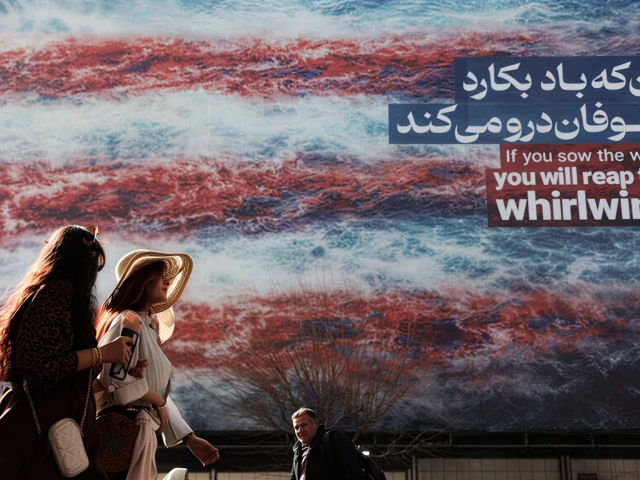
Iranian women walk past an anti-U.S. billboard in Tehran, Iran, February 19, 2026. REUTERS
Iran and the United States are sliding rapidly towards military conflict as hopes fade for a diplomatic solution to their standoff over Tehran’s nuclear programme, officials on both sides and diplomats across the Gulf and Europe say.
Iran’s Gulf neighbours and its enemy Israel now consider a conflict to be more likely than a settlement, these sources say, with Washington building up one of its biggest military deployments in the region since the invasion of Iraq in 2003.

Israel’s government believes Tehran and Washington are at an impasse and is making preparations for possible joint military action with the US, though no decision has been made yet on whether to carry out such an operation, said a source familiar with the planning.

It would be the second time the US and Israel have attacked Iran in less than a year, following US and Israeli airstrikes against military and nuclear facilities last June.
Regional officials say oil-producing Gulf countries are preparing for a possible military confrontation that they fear could spin out of control and destabilise the Middle East.
Two Israeli officials told Reuters they believe the gaps between Washington and Tehran are unbridgeable and that the chances of a near term military escalation are high.
Some regional officials say Tehran is dangerously miscalculating by holding out for concessions, with US President Donald Trump boxed in by his own military buildup, unable to scale it back without losing face if there is no firm commitment from Iran to abandon its nuclear weapons ambitions.
“Both sides are sticking to their guns,” said Alan Eyre, a former US diplomat and Iran specialist, adding that nothing meaningful can emerge “unless the US and Iran walk back from their red lines — which I don’t think they will”.
Read More: Trump says change of power in Iran would be ‘best thing’
“What Trump can’t do is assemble all this military, and then come back with a ‘so-so’ deal and pull out the military. I think he thinks he’ll lose face,” he said. “If he attacks, it’s going to get ugly quickly.”
![[1/2] People gather near a missile on display during the 47th anniversary of the Islamic Revolution in Tehran, Iran February 11, 2026. PHOTO: REUTERS](https://i.tribune.com.pk/media/images/iran-r1771167942-0/iran-r1771167942-0.jpg)
People gather near a missile on display during the 47th anniversary of the Islamic Revolution in Tehran, Iran, February 11, 2026. PHOTO: REUTERS
Talks have stalled
Two rounds of Iran-US talks have stalled on core issues, from uranium enrichment to missiles and sanctions relief.
When Omani mediators delivered an envelope from the US side containing missile-related proposals, Iranian Foreign Minister Abbas Araghchi refused even to open it and returned it, a source familiar with the talks said.
After talks in Geneva on Tuesday, Araghchi said the sides had agreed on “guiding principles”, but the White House said there was still distance between them.
Iran is expected to submit a written proposal in the coming days, a US official said, and Araghchi said on Friday he expected to have a draft counterproposal ready within days.
But Trump, who has sent aircraft carriers, warships and jets to the Middle East, warned Iran on Thursday it must make a deal over its nuclear program or “really bad things” will happen.
He appeared to set a deadline of 10 to 15 days, drawing a threat from Tehran to retaliate against US bases in the region if attacked. The rising tensions have pushed up oil prices.
US officials say Trump has yet to make up his mind about using military force, although he acknowledged on Friday that he could order a limited strike to try to force Iran into a deal.
Also Read: Where Trump’s world order is headed
“I guess I can say I am considering that,” he told reporters.
The possible timing of an attack is unclear. US Secretary of State Marco Rubio is due to meet Israeli Prime Minister Benjamin Netanyahu on February 28 to discuss Iran. A senior US official said it would be mid-March before all US forces were in place.
What’s the endgame?
European and regional officials believe the scale of the US deployment to the region would enable Washington to launch strikes on Iran while simultaneously defending its military bases, allies and Israel.
The core US demand remains unchanged: no uranium enrichment on Iranian soil. Iran, for its part, says it must keep its nuclear capability and refuses to discuss its ballistic missiles. It denies planning to build a nuclear weapons arsenal.
If talks fail, defence analyst David Des Roches said, US activity in the Gulf already signals how any strike would begin: blind Iran’s air defence and then hit the Revolutionary Guards Navy, the force behind years of tanker attacks and threats to close the Strait of Hormuz, the route for a fifth of global oil.
But some Arab and European officials say they are unsure what Trump’s endgame is, and European governments want the US to spell out what strikes would be meant to achieve — to degrade Iran’s nuclear and missile capabilities, deter escalation or pursue something more ambitious, such as “regime change”.
Some regional and European officials question whether military action can alter the trajectory of Iran’s ruling establishment, led by Supreme Leader Ayatollah Ali Khamenei and protected by the powerful Islamic Revolutionary Guards Corps.
Some say that, with no obvious alternative political force in Iran and the leadership’s resilience largely intact, it is perilous to assume strikes could trigger “regime change”.
Also Read: Iran prepares counterproposal as Trump weighs strikes
Military action may be easier to start than to control, and much harder to translate into a strategic outcome, they say.
Are concessions likely?
There have been a few signs of compromise. Ali Larijani, a close adviser to Khamenei, told Al Jazeera TV that Iran was ready to allow extensive monitoring by the International Atomic Energy Agency (IAEA) to prove it is not seeking nuclear weapons. Tehran has since informed IAEA chief Rafael Grossi of its decision.
A source familiar with the talks said Iran’s backing for regional militias had not been formally raised at talks, but that Tehran had no objection in principle to discussing US concerns about proxies.
Three regional officials said Iranian negotiators had made clear that any substantive concessions rest with Khamenei, who regards enrichment and missile development as sovereign rights.
David Makovsky of The Washington Institute said each side was betting on the other’s limits.
Washington believes overwhelming force will compel Tehran to yield, while Tehran believes Trump lacks the appetite for a sustained campaign and Israel believes the gaps are too wide to close, making confrontation all but inevitable, he said.
Trump’s advisers urge focus on economy
Trump’s fixation on Iran has emerged as the starkest example yet of how foreign policy, including his expanded use of raw military force, has topped his agenda in the first 13 months of his second term, often overshadowing domestic issues such as the cost of living that public opinion polls show are much higher priorities for most Americans.
A senior White House official said that despite Trump’s bellicose rhetoric, there was still no “unified support” within the administration to go ahead with an attack on Iran.
Trump’s aides are also mindful of the need to avoid sending a “distracted message” to undecided voters more concerned about the economy, the official told Reuters on condition of anonymity because they were not authorised to speak to the press.
White House advisers and Republican campaign officials want Trump focused on the economy, a point that was stressed as the top campaign issue at a private briefing this week with numerous cabinet secretaries, according to a person who attended. Trump was not present.
Read Further: Trump says weighing strike on Iran as Tehran says draft deal coming soon
A second White House official, responding to Reuters questions for this story, said Trump’s foreign policy agenda “has directly translated into wins for the American people”.
“All of the President’s actions put America First — be it through making the entire world safer or bringing economic deliverables home to our country,” the official said.
November’s election will decide whether Trump’s Republican Party continues to control both chambers of the US Congress. Loss of one or both chambers to opposition Democrats would pose a challenge to Trump in the final years of his presidency.
Rob Godfrey, a Republican strategist, said a prolonged conflict with Iran would pose significant political peril for Trump and his fellow Republicans.
“The president has to keep in mind the political base that propelled him to the Republican nomination — three consecutive times — and that continues to stick by him is sceptical of foreign engagement and foreign entanglements because ending the era of ‘forever wars’ was an explicit campaign promise,” Godfrey said.
Republicans plan to campaign on individual tax cuts enacted by Congress last year, as well as programmes to lower housing and some prescription drug costs.
Tougher foe than Venezuela
Despite some dissenting voices, many in Trump’s isolationist-minded “Make America Great Again” movement supported the lightning raid that deposed Venezuelan President Nicolas Maduro last month. But he could face more pushback if he steers the US into war with Iran, which would be a much more formidable foe.
Trump won reelection in 2024 on his ‘America First’ platform in large part because he promised to reduce inflation and avoid costly foreign conflicts, but he has been struggling to convince Americans that he is making inroads in bringing down high prices, public opinion polls show.
Still, Republican strategist Lauren Cooley said Trump’s supporters could support military action against Iran if it is decisive and limited.
“The White House will need to clearly connect any action to protecting American security and economic stability at home,” she said.
Even so, with polls showing little public appetite for another foreign war and Trump struggling to stay on message to fully address voters’ economic angst, any escalation with Iran is a risky move by a president who acknowledged in a recent interview with Reuters that his party could struggle in the midterms.
Varied war reasons
Foreign policy, historically, has rarely been a decisive issue for midterm voters. But, having deployed a large force of aircraft carriers, other warships and warplanes to the Middle East, Trump may have boxed himself in to carrying out military action unless Iran makes major concessions that it has so far shown little willingness to accept. Otherwise, he may risk looking weak internationally.
The reasons Trump has given for a possible attack have been vague and varied. He initially threatened strikes in January in reaction to the Iranian government’s bloody crackdown on nationwide street protests but then backed down.
He has more recently pinned his military threats to demands that Iran end its nuclear programme and has floated the idea of “regime change”, but he and his aides have not said how air strikes could make that happen.
The second White House official insisted that Trump “has been clear that he always prefers diplomacy, and that Iran should make a deal before it is too late”. The president, the official added, has also stressed that Iran “cannot have a nuclear weapon or the capacity to build one, and that they cannot enrich uranium”.
What many see as a lack of clarity stands in stark contrast to the extensive public case made by then-president George W. Bush for the 2003 invasion of Iraq, which he said was meant to rid the country of weapons of mass destruction. Though that mission ended up being based on bad intelligence and false claims, Bush’s stated war aims were clear at the outset.
Godfrey, the Republican strategist, said independent voters, crucial in deciding the outcomes of close elections, will be scrutinising how Trump handles Iran.
“Midterm voters and his base will be waiting for the president to make his case,” he said.