

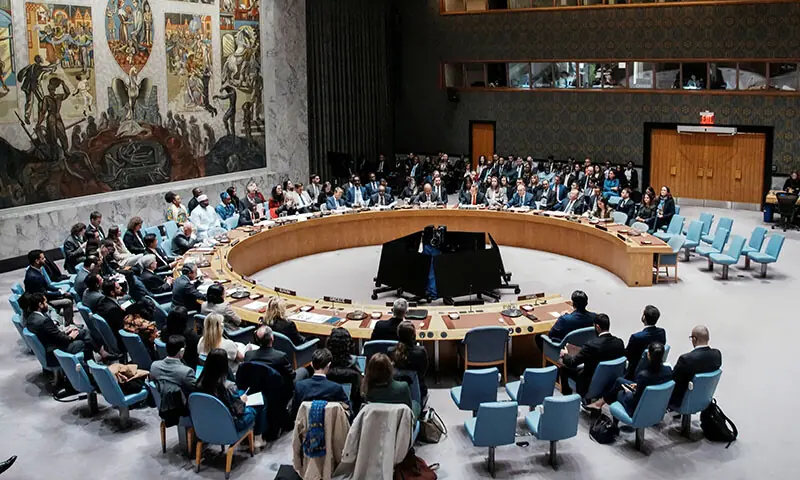

The United Nations Security Council on Monday voted to adopt a US-drafted resolution endorsing President Donald Trump’s plan to end the war in Gaza and authorising an international stabilisation force for the Palestinian enclave.
Israel and Hamas agreed last month to the first phase of Trump’s 20-point plan for Gaza — a ceasefire in their two-year war and a hostage-release deal — but the UN resolution is seen as vital to legitimising a transitional governance body and reassuring countries that are considering sending troops to Gaza.
The text of the resolution says member states can take part in the Board of Peace, envisioned as a transitional authority that would oversee the reconstruction and economic recovery of Gaza.
It also authorises the International Stabilisation Force (ISF), which would ensure a process of demilitarising Gaza, including by decommissioning weapons and destroying military infrastructure.

Trump’s 20-point plan is included as an annexe to the resolution.

Russia, which holds a veto on the Security Council, earlier signalled potential opposition to the resolution but abstained from the vote, allowing the resolution to pass.
Hamas, however, rejected the resolution, saying it fails to meet Palestinians’ rights and demands and seeks to impose an international trusteeship on the enclave that Palestinians and resistance factions oppose.

“Assigning the international force with tasks and roles inside the Gaza Strip, including disarming the resistance, strips it of its neutrality, and turns it into a party to the conflict in favour of the occupation,” the group added.
The Gaza Strip has been largely reduced to rubble after two years of fighting, sparked by Hamas’s attack on Israel on October 7, 2023.
The resolution’s text also says that “conditions may finally be in place for a credible pathway to Palestinian self-determination and statehood” once the Palestinian Authority has carried out a reform program and Gaza’s redevelopment has advanced.
That eventuality has already been firmly rejected by Israel.
“Our opposition to a Palestinian state on any territory has not changed,” Netanyahu said at a cabinet meeting on Sunday.
Russian objections
Prior to the meeting, veto-wielding Russia circulated a competing draft, saying the US document did not go far enough towards backing the creation of a Palestinian state.
Moscow’s text, seen by AFP, asked the Council to express its “unwavering commitment to the vision of the two-state solution”.
It did not authorise a Board of Peace or the deployment of an international force for the time being, instead asking UN Secretary-General Antonio Guterres to offer “options” on those issues.
The US had intensified its campaign to earn support for its resolution, hitting out at “attempts to sow discord” among Council members.
“Any refusal to back this resolution is a vote either for the continued reign of Hamas terrorists or for the return to war with Israel, condemning the region and its people to perpetual conflict,” the US ambassador to the United Nations, Mike Waltz, wrote in The Washington Post.
The US has made known that it has the backing of several Arab and Muslim-majority nations, publishing a joint statement of support for the text signed by Qatar, Egypt, the United Arab Emirates, Saudi Arabia, Indonesia, Pakistan, Jordan and Turkey.
Several diplomats told AFP that despite Russian criticism and hesitance on the part of other member states, they expected the US draft to be adopted.
“We expect broad support for the resolution,” said one diplomat at the UN, requesting anonymity to discuss negotiations on the resolution. “Although Russia has at times hinted at a possible veto, it would be difficult to oppose a text backed by Palestine and the region.”
That would likely also be the case for China, which also holds a veto, the diplomat said.
“The Russians know that while a lot of Council members will go along with the US plans, they share concerns about the substance of the US text and the way Washington has tried to fast-track it through New York,” Richard Gowan of the International Crisis Group told AFP.
He, however, said he doubted that Moscow would use its veto on a resolution backed by Arab nations.
“I think it is more likely that China and Russia will abstain, register their scepticism about the plan and then sit back and watch the US struggle to put it into action,” Gowan said.
‘Suspicious’ flights from Israel show ‘agenda to cleanse Palestinians’
South Africa said today that the surprise arrival of 153 Palestinians on a plane last week indicated “a clear agenda to cleanse Palestinians” out of the Gaza Strip and the West Bank.
The group landed in Johannesburg on a chartered flight last Thursday without departure stamps from Israel in their passports. Reports said a shadowy organisation named Al-Majd was involved in their travel from Gaza.
“We are suspicious, as the South African government, about the circumstances surrounding the arrival of the plane,” Foreign Minister Ronald Lamola told reporters.
South African border police kept the group on the plane for 12 hours before President Cyril Ramaphosa allowed them entry on a standard 90-day visa exemption.
It emerged later that a previous flight carrying 176 Palestinians had arrived on October 28, according to the local Gift of the Givers charity that is assisting the arrivals.
“We do not want any further flights to come our way because this is a clear agenda to cleanse out Palestinians out of Gaza and the West Bank and those areas, which South Africa is against,” Lamola said.
“It does look like it represents a broader agenda to remove Palestinians from Palestine into many different parts of the world, and is a clearly orchestrated operation,” he said, without providing further details.