

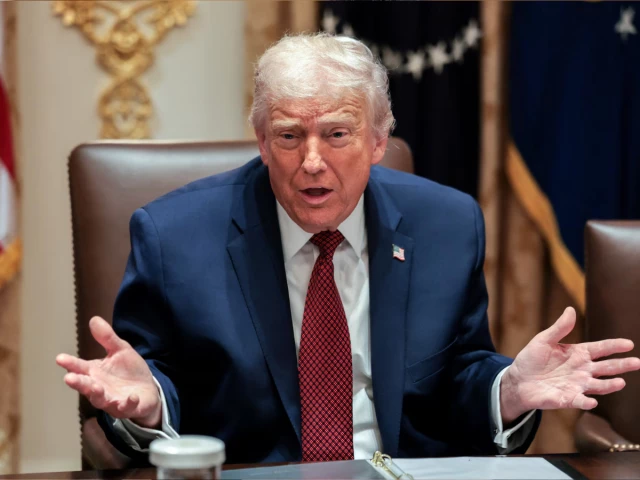

US President Donald Trump said Friday that a change of government in Iran would be “the best thing that could happen,” as he ordered a second aircraft carrier to the Middle East to increase military pressure on the Islamic Republic.
Trump’s remarks were his most explicit call yet for the removal of Iran’s clerical leadership, as he presses Tehran to strike a deal limiting its nuclear program.
“Seems like that would be the best thing that could happen,” Trump told reporters at Fort Bragg when asked if he wanted regime change in Iran.
He declined to name a successor to Supreme Leader Ali Khamenei, saying only that “there are people.”

Trump has previously tempered calls for regime change, warning it could unleash chaos, though he has issued threats toward Khamenei in the past.

Earlier at the White House, Trump said the USS Gerald R. Ford — the world’s largest warship — would be deployed to the Middle East.
“In case we don’t make a deal, we’ll need it,” he said.
Read: Turkiye’s foreign minister says US and Iran showing flexibility on nuclear deal, FT
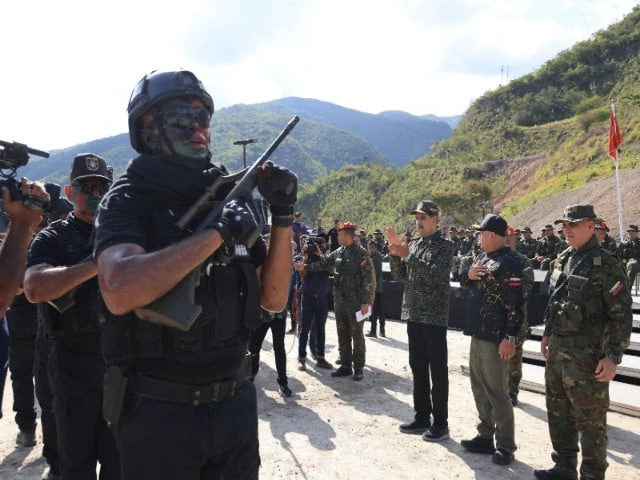
The carrier is currently in the Caribbean following the U.S. overthrow of Venezuela’s Nicolas Maduro. Another carrier, the USS Abraham Lincoln, is among 12 American ships already stationed in the Middle East.
When Iran launched a crackdown on protests last month — which rights groups say left thousands dead — Trump initially said the United States was “locked and loaded” to support demonstrators.
More recently, however, he has focused his threats on Iran’s nuclear program, which US forces struck last July during Israel’s unprecedented 12-day war with Iran.
The protests have since subsided. US-based Reza Pahlavi, the exiled son of Iran’s last shah, renewed calls for international intervention.
“We are asking for a humanitarian intervention to prevent more innocent lives being killed in the process,” he told the Munich Security Conference.
Videos verified by AFP showed demonstrators chanting anti-government slogans this week as Iran’s leadership marked the anniversary of the 1979 Islamic Revolution.
Iran and the United States, which have had no diplomatic relations since shortly after that revolution, held nuclear talks last week in Oman. No new round has been scheduled.
Read More: US moving second carrier to ME as Iran tensions build
Western governments suspect Tehran’s nuclear program is aimed at building a bomb, an allegation Iran denies.
Rafael Grossi, head of the UN nuclear watchdog, said Friday that reaching an agreement with Iran on inspections of its facilities was possible but “terribly difficult.”
Trump said after talks this week with Israeli Prime Minister Benjamin Netanyahu that he wanted to continue negotiations with Iran, despite pressure from Israel for a harder line.
Netanyahu expressed scepticism that any agreement would be sufficient if it failed to address Iran’s ballistic missile program and support for regional proxy groups.
According to the US-based Human Rights Activists News Agency, 7,008 people, mostly protesters, were killed in the recent crackdown, though rights groups caution the true toll may be higher.
More than 53,000 people have been arrested, the group said.
The Norway-based Iran Human Rights organisation said “hundreds” of detainees face charges that could carry the death penalty.
Three politicians from Iran’s reformist camp aligned with President Masoud Pezeshkian were detained this week — Azar Mansouri, Javad Emam, and Ebrahim Asgharzadeh.
They were released on bail Thursday and Friday, their lawyer Hojjat Kermani told the ISNA news agency.