


Under international law, the decision to wage war and the rules that apply within war are entirely different legal frameworks. The decision to wage war is governed by the United Nations Charter, which prohibits the use of force between states except in self-defence or with Security Council approval.
Once a war has started, however, regardless of whether it is lawful or unlawful, defensive or aggressive, the same laws apply. These rules are generally found in the Geneva Conventions and their Additional Protocols and are premised on the notion of ‘equality of belligerents’. The same laws bind every party to the conflict, and even if one party flouts those norms regularly, it does not give the other the right to disregard them.
As over 20 countries across continents are now impacted by the illegal war launched by the US and Israel against Iran, with war crimes and crimes against humanity being committed in the course of hostilities, it is difficult to disagree with the notion that this is the original sin from which a multitude of evils flow.
Based on the timeline, we asked international law expert Ayesha Malik on how the these events may be assessed under international humanitarian law. Here’s what she had to say.

Waging war
War has always been used between empires, states and peoples to resolve disputes in the attainment of certain aims. The regulation to resort to force can be traced back to ‘just war’ doctrines found in classical Greek and Roman times, which led to conditions being placed on the launching of war to restrict its prevalence.

Under this notion, war could only be launched under the authority of the sovereign; it required just cause (reaction to a prior wrong), and was to be launched with rightful intention (such as doing justice and attaining peace). However, after the rise of the nation-state following the Peace of Westphalia in the seventeenth century, states acquired the right to resort to force or war to pursue their claims or protect their security and interests.
International law was generally viewed as indifferent to the use of force by states, so the decision to go to war was not a matter of law, but of expediency, and to be used as an instrument of statecraft. States were still expected to proffer justifications for their actions; however, as they were not viewed as having complete freedom to act, there was no legal norm which prohibited forcible actions. This changed somewhat in the nineteenth century, which saw the first collective security regime in the form of the Concert of Europe (1815-1914), an alliance between the UK, Austria, Russia, Prussia, and France.

The Hague Convention I (1907) included a promise by contracting parties “to use their best efforts to ensure the pacific settlement of international disputes”, but there were no legal norms beyond trying their best not to wage war.
After World War I, states engaged in efforts to regulate the use of force and serious attempts were made at collective security. The League of Nations (1919-46) created a new world order premised on collective security, the obligation to resolve disputes peacefully, limitations on the right to wage war and collective action against aggression. The Kellogg-Briand Pact (1928) also condemned recourse to war, but only as an instrument of national policy and did not define war. Shortly after the pact, Japan invaded Manchuria in 1931, Italy invaded Abyssinia in 1934, and finally Germany invaded Poland in 1939.
After World War II, nations under the guidance of Churchill, Stalin, and Roosevelt adopted the United Nations Charter on June 26, 1945, at the San Francisco Conference. One of the main aims of the drafters of the UN Charter was “to save succeeding generations from the scourge of war”. This was a revolutionary moment in the history of the legal framework governing the use of force. States were giving up their right to use force as a means of asserting or protecting their interests and legal rights, but in return, the UN was to have the power to protect the interests of states in circumstances where force was used against them or where there was a threat to the peace.
There are three key provisions which deal with the use of force in the UN Charter:
The prohibition on the use of force in Article 2(4) to which there are two exceptions: a. Article 51 acknowledges the inherent rights of states to individual and collective self-defence if an armed attack occurs,
b. Article 42 allows the Security Council to authorise the use of force when it considers that there has been a threat to the peace, breach of the peace or act of aggression.
There are several contentious areas within the right to launch a war under international law; namely, when can a state do so in anticipation of an armed attack launched against it? When can it do so in response to an armed attack by an armed group, with or without the armed group being linked to a state? And whether force can be used for humanitarian reasons outside these two exceptions? The rest of this piece will only look at the issue of anticipatory self-defence.
Anticipatory self-defence
The concept of anticipatory self-defence concerns whether a state is allowed to use force to respond to an armed attack which has not yet occurred. This is usually divided into two distinct types: pre-emptive self-defence against armed attacks which are imminent or preventive self-defence against threats which have not yet materialised.
While some states believe that preemptive self-defence is allowed, most believe that preventive self-defence is unlawful. The most quoted example for pre-emptive self-defence is Israel’s strike on Iraq’s Osirak nuclear reactor in 1981.
At the time, Tel Aviv argued in its report to the Security Council that the reactor was designed to produce atomic bombs, the target for which would have been Israel, and therefore it was exercising its inherent right of self-defence. However, UN Security Council Resolution 487 (1981) condemned Israel’s attack as inconsistent with the UN charter and recognised the right of states to develop their economy and industry for peaceful purposes.
The US launched Operation Iraqi Freedom in 2003, resting their legal case on dubious claims, including that of anticipatory self-defence of weapons of mass destruction that the Iraqis did not have, being able to hit Western states in 45 minutes.
A legal opinion by the former British Attorney General, Lord Goldsmith, to UK Prime Minister Blair in the lead up to the Iraq invasion noted: “Force may be used in self-defence if there is an actual or imminent threat of an armed attack…The concept of what is imminent may depend on the circumstances. Different considerations may apply, for example, where the risk is of attack from terrorists sponsored or harboured by a particular State, or where there is a threat of attack by nuclear weapons. However, in my opinion, there must be some degree of imminence. I am aware that the USA has been arguing for recognition of a broad doctrine of a right to use force to pre-empt danger in the future. If this means more than a right to respond proportionally to an imminent attack (and I understand that the doctrine is intended to carry that connotation), this is not a doctrine which, in my opinion, exists or is recognised in international law.”
Later, the Non-Aligned Movement (a forum of over 120 developing nations) stated in 2016 that they “oppose and condemn any categorisation of countries as good or evil based on unilateral and unjustified criteria, and the adoption of the doctrine of pre-emptive attack, including attack by nuclear weapons by certain States, which is inconsistent with international law…”
While some states, the US and Israel in particular, would like to expand the notion of imminence to include the last 47 years and stretch pre-emptive self-defence to include preventive self-defence against some vague future threat, this is not accepted in international law.
The strikes against Iran by the US and Israel in February 2026 are manifestly illegal and a clear violation of Article 2(4) of the United Nations Charter. The Western press has already publicised the incorrect claim that Israel and the US are fighting a war of pre-emptive self-defence against Iran. As international law scholar Marko Milanović points out, the use of force against Iran would be lawful only if “(1) Iran had the intent (i.e. its leadership decided) to attack the US/Israel; (2) it had the capability to do so; (3) and it was necessary to use force today, because today would be the last window of opportunity to prevent this future attack”.
None of these conditions is met, and the argument for pre-emptive self-defence (even if an argument for pre-emption is accepted, which many states reject) is even weaker, considering President Trump said that the US had “obliterated” Iran’s nuclear capability last year.
There is no argument of international law under which these strikes could be lawful, given that there was no imminent armed attack by Iran that was being thwarted. Iran now has the right to self-defence, under Article 51 of the UN Charter, to respond to these attacks.
Iran’s right to self-defence
Iran’s right to use force in self-defence is only permissible if it complies with the requirements that it is necessary and proportionate. It must be imperative for Iran to use force, and that force must be confined to the purpose of self-defence. In this, the use of force must be the only way to repulse the armed attack against it, and Iran’s response must be proportionate to the attack; it cannot be excessive or even punitive.
A key issue when it comes to Iran’s response in self-defence is whether it is lawful for Iran to target the Gulf states. Iran could lawfully strike US bases in the territory of the Gulf states only if it was necessary and proportionate to do so. If US military assets on the territory of Gulf states were not used to attack Tehran, then Iranian strikes against the territorial integrity of those states are not necessary or proportionate to respond to the attacks against them.
This is because allowing your territory to be used in launching an armed attack on another state constitutes an act of aggression under Article 3(f) of General Assembly Resolution 3314. While there is some evidence that Bahrain and Kuwait are now allowing their territory to be used to launch strikes against Iran, it remains to be seen whether they allowed such use before the launch of the first strike against Iran, which would legitimise the Islamic Republic’s use of force as a valid response in self-defence.
Book used: Christian Henderson, The Use of Force and International Law (2nd edn, Cambridge University Press 2023).
Conduct in war
On August 12, 1949, the Geneva Conventions were adopted following the atrocities of World War II. Those conventions were both forward- and backwards-looking — in that they aimed to put an end to the Second World War and prepare for the next one.
In 1977, states also signed Additional Protocols I and II, negotiated after the Vietnam War to accommodate the changing nature of warfare. These treaties form a core of the concerted effort to minimise the human suffering and destruction of war and remain applicable today.
Cave art from the New Stone Age, around 10,000 years ago, depicts bowmen apparently in conflict. These are our first records of men fighting in groups. Around 1,400 BC, the Egyptians negotiated agreements with the Sumerians as well as other states regarding the treatment of prisoners in war. This proves that we have long recognised that there must be rules even in times of armed conflict.
The principles and rules which limit the use of violence during armed conflicts aim to spare those not directly involved in hostilities and limit the effects of violence to the amount necessary for war. It is about diminishing the evils of war as far as military requirements permit. From the ancient Vedic traditions, Sun Tzu’s ‘The Art of War’, Roman law, the Bible, and the Quran, all of these texts include stipulations of what is or is not allowed in war.
In the second half of the nineteenth century, the previously common battlefield practices and restrictions, i.e. the customary law of war, began to coalesce into generalised rules, becoming codified and extended by treaties and domestic laws. By the mid-nineteenth century, states began writing codes that became military laws.
The first international conference to improve the condition of wounded soldiers was convened in 1864, after which the first Geneva Convention was agreed upon. Since then, the contemporary laws of war have developed along two legal currents: the Geneva and Hague conventions. The former are rules related to the protection of persons not taking part in hostilities, such as the wounded, prisoners of war, and civilians. The latter includes rules prohibiting or limiting the use of specific means and methods of warfare.
Cardinal Principles
Distinction
The laws of armed conflict are applied when there is a “resort to armed force between States or protracted violence between governmental authorities and organised armed groups or between such groups within a State”. Therefore, they apply to interstate as well as civil wars.
One of the cardinal principles of the laws of war is that of distinction. This rule states that parties to the conflict shall at all times distinguish between civilians and combatants and between civilian objects and military objectives. Only combatants and military objectives are to be targeted.
However, there are certain caveats to the simple statement of this rule. Civilians can be targeted if they directly participate in hostilities as long as they do so. Moreover, combatants who are injured, surrender, or become prisoners of war cannot be targeted.
Targeting Ayatollah Khamenei:
On the first day of the US-Israel war with Iran, the Israelis targeted Supreme Leader Ayatollah Khamenei. The laws of war allow for the targeting of commanders or civilians directly participating in hostilities. Given the Supreme Leader exercises “supreme command of the armed forces” under Article 110(4) of Iran’s Constitution according to which he is authorised to appoint, dismiss, and accept the resignation of the chief of the joint (general) staff, the IRGC commander, and the commanders of the armed forces, he may be a lawful target in the conduct of hostilities.
However, his family members were not lawful targets, and their deaths would have to be taken into account as ‘collateral damage’ in determining the proportionality of the strike.
Attacks on Oil Refineries:
The definition of military objective has been subject to debate. The law defines military objectives as “those objects which by their nature, location, purpose or use make an effective contribution to military action and whose total or partial destruction, capture or neutralisation, in the circumstances ruling at the time, offers a definite military advantage”.
This generally includes armaments factories, missile depots and command centres; however, it can also include bridges if they are used to supply troops to the front line and hills if they offer a vantage point of high ground. Even hospitals can become a legitimate target if they are used to commit acts harmful to the enemy, though the opposing party must give a warning before attacking a hospital.
The position of the US has been that military objectives include ‘war sustaining’ objectives, as the military advantage comes from the revenues which allow them to support their military operations. This renders the US targeting of oil tankers and cash stockpiles in its war against ISIS lawful.
This interpretation has been contested and criticised. Legal scholar Marty Lederman, for instance, asks whether this approach would allow a state at war with the US to “target Apple headquarters, or various other tax-generating operations in Silicon Valley”.
The US and Israel have also targeted oil production sites in this armed conflict, as has Iran. However, it is unclear whether oil fields in Iran or in the Gulf states were used to ‘sustain’ any armed conflict. Therefore, these strikes are likely unlawful even under the wide American definition of military objectives.
Proportionality
The principle of proportionality provides that the amount of ‘collateral damage’ must be weighed against the military advantage anticipated from an attack. The law itself defines an indiscriminate attack as an “attack which may be expected to cause incidental loss of civilian life, injury to civilians, damage to civilian objects, or a combination thereof, which would be excessive in relation to the concrete and direct military advantage anticipated”.
A key issue with this principle is the inherent difficulty of weighing civilian life in exchange for military advantage and whether they can, in fact, be balanced at all.
While many human rights reports, in particular, simply determine an attack to be disproportionate due to the civilian lives lost, that is not an adequate way to gauge the legality or otherwise of an attack. As military lawyers have stated, “I have approved targets that could have caused 3,000 civilian casualties, and I’ve raised questions about targets predicted to risk fewer than 200 civilian lives. The issue is about the importance of the target.”
However, the importance of the target itself may be subjectively determined, with the importance of the military advantage to be gained being overblown, thereby undermining the calculation made.
Precaution
The principle of precaution requires that feasible measures be taken to ensure that civilians or civilian objects are not being attacked. If a range of options is available, for instance, in destroying a railway line, it would be preferable to destroy the line in the countryside as opposed to in the city, if this is feasible.
Additionally, the attacking state must take precautions in choosing weapons and tactics to minimise incidental injury and collateral damage and select military objectives among those giving similar military advantage expected to cause the least danger to civilian lives or objects. This principle also obliges parties to endeavour to give a warning, if feasible, to civilians who may be affected by an attack.
However, compliance with the principle of precaution does not mean that any of the other obligations (of distinction and proportionality) are lessened in any way. Israel has in the past issued warnings before air strikes through phone calls, text messages or ‘knocks on the roof’.
In doing so, Israel argues that it is abiding by international law. It is contended, however, that giving warnings to civilians who, in practice, have no means to leave may not, in fact, comply with this cardinal principle.
The Minab school strike:
On February 28, the US struck an Iranian school in Minab with Tomahawk missiles, resulting in the death of some 175 civilians, many of them children. As Marko Milanović notes, even if the attack was a ‘mistake’ due to overreliance on AI, the US has violated the principle of precaution under which everything feasible should have been done to verify that the school building was a military objective.
He further states that “if journalists using only open access sources could relatively quickly establish what went wrong, and trace the separation of the school from the wider IRGC compound, I’m pretty sure that the US officers, with all the tools at their disposal, could have done the same before launching this attack”.
Book used: Gary D Solis, The Law of Armed Conflict: International Humanitarian Law in War (Cambridge University Press, 2010).
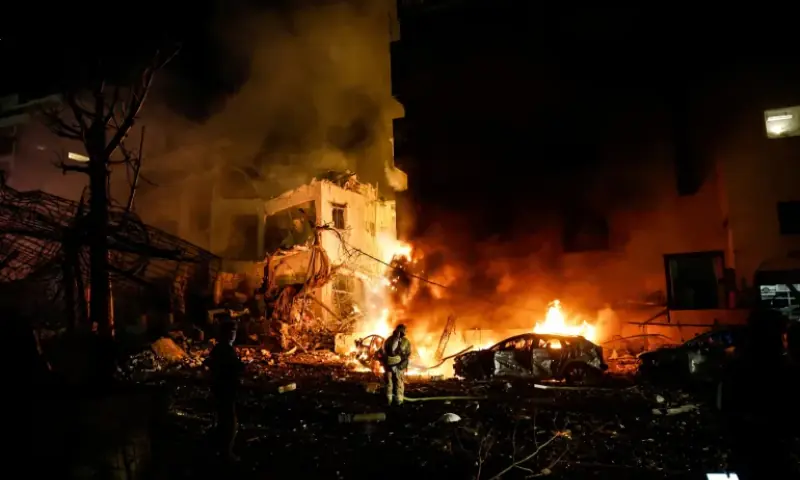
Header image: Firefighters work to put out a fire on a car at a site impacted by a projectile during the US-Israel war on Iran. — Reuters