
KARACHI: In family lore, the year 1976 shines with a particular light. It was the year of the Montreal Olympics, and a young man from Karachi named Marghoob Hasan Ansari carried the dream of representing Pakistan in field hockey.
Whether he stood on the turf or carried the hope only in his heart, that dream became a family heirloom — a lost legacy of sporting ambition that his daughter, Shehla Nasir, would hold onto. With time and distance, it faded into the realm of proud, silent ghosts.
Almost 49 years later, and 3,800 kilometres south, that ghost found its voice.
It did not speak on the AstroTurf, but on a perfect, frozen sheet in Coral Springs, Florida. It did not cheer for a field hockey flick, but for the thunderous clap of a puck against plexiglass. And it did not watch a son, but a grandson.

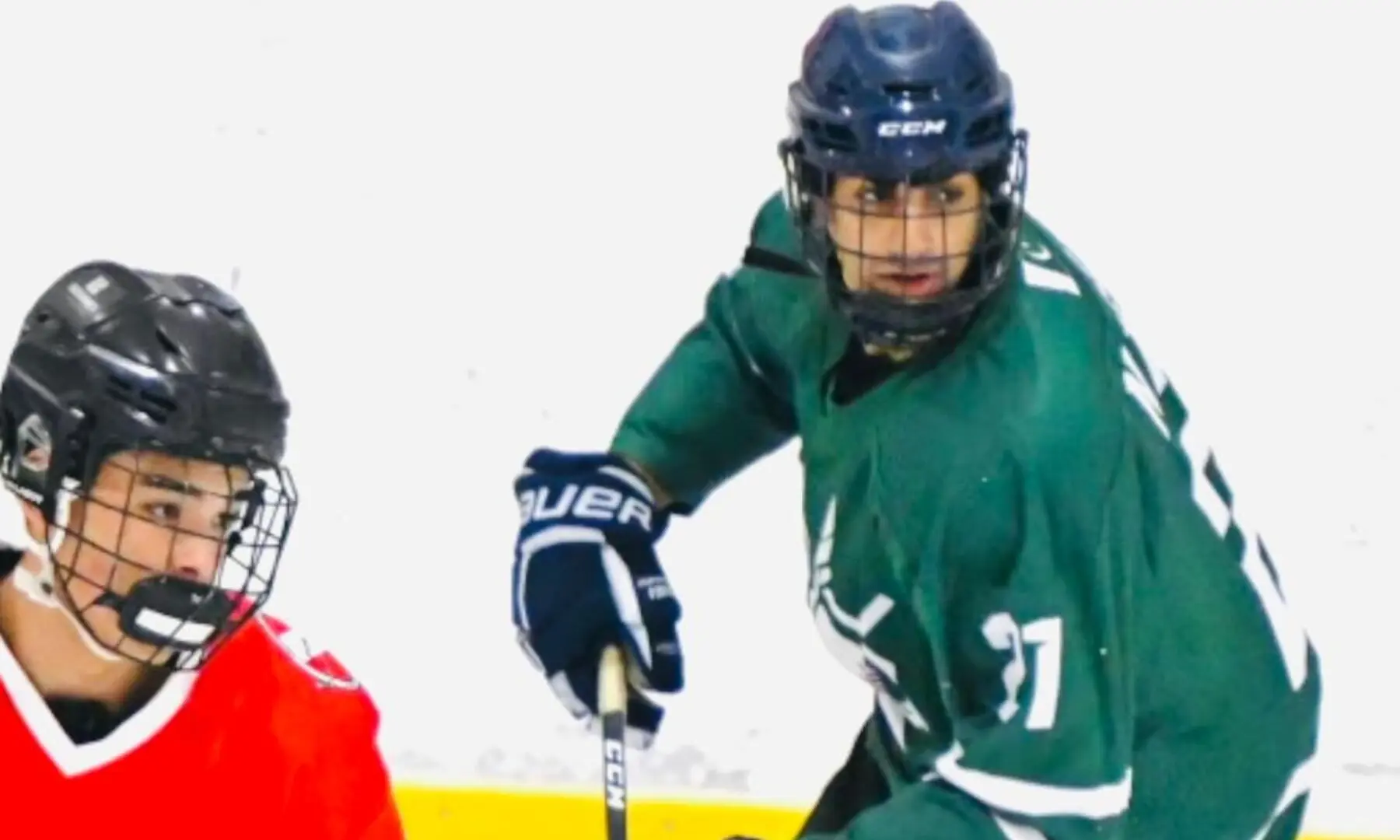
In the stands, surrounded by a sea of opposing colours, a small, defiant cluster of green flags fluttered. Among them stood the Olympian’s daughter, Shehla — her heart a storm of memory and miracle — as her son, Mahd Nasir, weaved through defenders in the colours of Pakistan.

Her feelings, when asked, stuttered into fragments.
“It’s beyond,” she told Dawn. “It’s just … so emotional, so nostalgic, so overwhelming.”

The words failed. They had to. How does one articulate the resurrection of a dream?
This is not a sports fairytale. This is a story of reclamation — of a diaspora stitching together a national team from WiFi signals and sheer will; of families bankrolling glory with second jobs and sacrificed vacations; and of a generation discovering, on the most improbable stage, a belonging they never knew they lacked.
The Pakistan men’s ice hockey team was not born in an arena, but in the ether.
Speaking from Karachi during a visit — where the idea of a national ice hockey team still sounds like fiction — Mahd recalled his first connection to the team.
After a humble, fun-first showing in 2022, the call went out on Instagram. Mahd, a forward raised in the hockey crucible of Vancouver, saw it.
“I saw on Instagram that they were reaching out,” he told Dawn. “They were featured on a couple of big hockey outlets during that first tournament, and that’s where I found them.”
He reached out to a captain. For six months, they talked. Then came the invitation.
Mahd hesitated.
“I didn’t know how the players would be. I didn’t know if I would click.”
He flew to New York to meet his new teammates for the first time. The first gathering was a study in awkwardness.
“It started at breakfast,” he recalled. “It was a little awkward.”
The silence of strangers — bound by a shared passport but separated by different lives — hung in the air. Then something melted.
“By lunch, we broke that awkward boundary. By dinner, everybody was laughing and eating together.”
In twelve hours, they lived the entire metaphor of their project: from disparate parts to a whole. They won bronze at that tournament — Pakistan’s first-ever international ice hockey medal — a historic moment wrapped in the quiet pride of beginnings.
The economy of dreams
Behind the glory lies an economy of dreams, and its currency is sacrifice. There is no federation money. No state sponsor.
“We don’t have any support,” Shehla said plainly. “We’re hoping we get some. We don’t have any support there, and we don’t have any support here [in Pakistan]. So we’re kind of struggling.”
The logistics are a high-wire act funded by parental love.
“For every tournament these guys go to, we as parents have to fund it,” she explained. “Flights, lodging, ice time — ice time is very expensive. It takes a toll on families.”
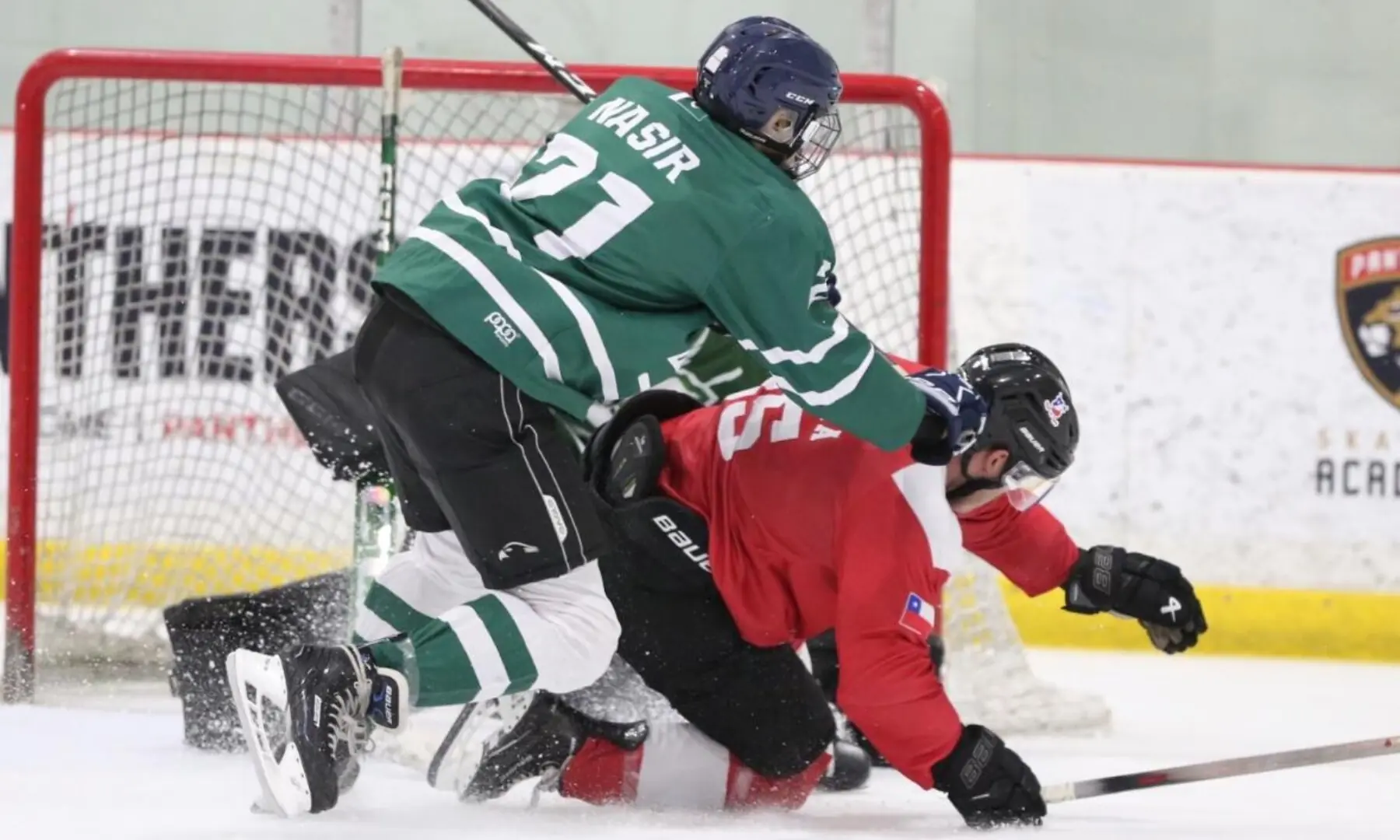
The costs are covered through a patchwork of GoFundMe drives, pooled donations and the kind of communal ingenuity familiar to every immigrant story.
“It’s the Pakistani culture coming together,” she said, and you can almost smell the steam. “It’s biryanis on the table for bachas [kids] and things like that.”
Players don’t stay in hotels. They stay in the homes of other parents, welcomed as sons. They are not just athletes; they are a community’s shared investment, fed on rice and hope.
They have signed formal, five-year contracts binding them to Pakistan — a semi-professional commitment sustained by amateur means, a profound promise made on unstable ground.
A different kind of ice
For Mahd and players like him, hockey has always been a space of cultural dissonance.
“Ice hockey is not a very brown-dominated sport, especially not a Muslim-dominated sport,” he said. “Growing up in Vancouver, there weren’t many Muslim kids playing hockey.”
He is diplomatic but honest.
“It’s not always easy to click with everyone because of cultural differences. Everyone is super nice, but it’s still a different feeling playing with a bunch of white players versus playing with people who come from the same place you came from.”
The Pakistan team is not just a team; it is a homeland on ice. Its chemistry is its most guarded asset.
“We just came from gold, so we’re always looking for new players,” Mahd said. “But we definitely want to keep this chemistry moving forward.”
That sense of identity was tested in Florida in a moment of historical symmetry. For the first time ever, Pakistan faced India — on ice.
“That was the first time India and Pakistan played each other,” Mahd recalled. “It was really cool to see. Everyone was super nice.”
There was respect, not rancour. There was also a glimpse of a path not taken.
“They’re a good team. They’re actually a division higher than us,” he noted. “The Indian community is well-funded. They have a lot of support. India supports its sports better than Pakistan does.”
The observation was not bitter — just clear-eyed.
The new professionals
Mahd is 22. The traditional hockey dream — the NHL — has passed.
“Most people going into the NHL are scouted by 18 or 19,” he said, without self-pity.
“Professional, NHL-level hockey may not be in the cards for me,” he added. “But representing Pakistan on a national stage — and hopefully being inducted into the IIHF — that would be professional.”
His ambition has shifted from personal stardom to national elevation. He studies the hockey map not as a hopeful recruit, but as a strategist.
“In Division Two you have South Korea, China, Spain,” he said. “That’s where we see Pakistan.”
The goal is to host camps in Pakistan’s northern areas — to plant the flag at home.
After the Florida tournament, the world took notice. Instagram reels of their gold-medal run amassed more than two million views.
Mahd was in Europe recently when strangers from Spain recognised him.
“They knew about our team,” he said, smiling. “That was really cool.”
The digital scavenger hunt had come full circle.
The small unit in the stands
Through it all, the parents remain the silent, steadfast chorus.
“The Pakistani community in Vancouver is very small,” Shehla said. “So whoever is there, we’re in the stands. We’re always a very chota [small] unit.”
She described the scene with painful clarity.
“If it’s a Florida team, they have big crowds. We’re always a very small unit.”
Outnumbered, out-spent and out-voiced — but never out-prided.
And for Shehla, the bridge stretches even further back, to Montreal in 1976. Her father’s legacy, once lost to time and silence, now screams back to life in the chill of an ice rink.
“To have a grandson stand there and cheer him on — it’s an honour,” she said. “I can’t tell you how proud I am.”
The lost is found — not preserved, but transformed. From field to ice. From an individual dream deferred to a collective future unfolding.
Her father played for Pakistan that was. Her son plays for the Pakistan that could be.
The foundation
Mahd knows this is only the first shift.
“Of course, this is just the start,” he said. He envisions a five-year horizon. “Eventually, by year five or six, we’ll have a foundation. We won’t need to struggle like this. We can just focus on playing.”
For now, the work is the bond.
“It’s a whole team effort,” he said. “We’re a family.”
A family built on WhatsApp groups and biryani, on GoFundMe pages and gold medals, spanning Vancouver to London, aged 16 to 28.
They are playing for more than promotion. They are playing to turn viral fame into structure, nostalgia into opportunity — to ensure the next wide-eyed Pakistani kid sees not a ghost of a legacy, but a clear path on the ice.
In a Florida arena, a chant began small, born from a small unit in the stands. Fed by the ghosts of Montreal and the hopes of millions, it grew until it shook the glass.
It already lives — in the scrape of a skate, the crack of a puck, and the quiet, overwhelming pride of a mother who finally found the missing photograph not in an album, but in the reflection of the ice, in the eyes of her son.