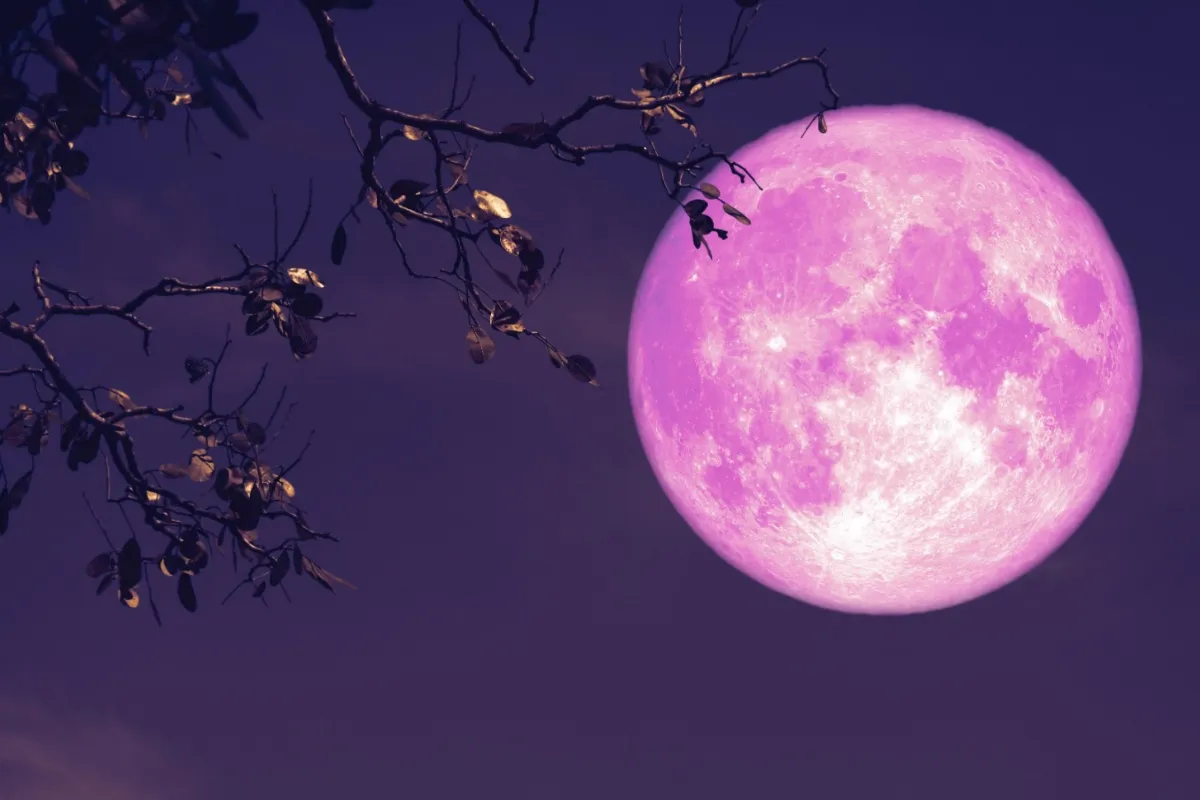

As darkness falls tonight, April 1 the sky is set to host one of spring’s most mesmerizing celestial events the Pink Moon.
Rising in all its luminous glory, this full moon signals nature’s renewal, the arrival of spring, and a time of reflection and new beginnings.
Though its name evokes shades of pink the moon itself remains brilliantly white its magic lying in the way it transforms ordinary nights into unforgettable spectacles.
The Pink Moon is the traditional name for April’s full moon, rooted in Native American, Colonial American, and European traditions. It takes its name from Phlox subulata, or moss pink, a vibrant early spring flower that blooms around the same period. While it doesn’t actually turn pink, the moniker celebrates the season and the fresh energy it brings.

Sometimes referred to as the Paschal Moon, this full moon is the first after the spring equinox and plays a key role in determining the date of Easter, which falls on the first Sunday after this event.

Beyond its calendrical significance, the Pink Moon represents renewal, rebirth, and transition, encouraging people to reconnect with nature and embrace new beginnings.
The moon is also known by several other poetic names, including Sprouting Grass Moon, Egg Moon, Breaking Ice Moon, and Fish Moon, the latter referencing the upstream spawning of shad fish. Each name reflects a natural or seasonal phenomenon, highlighting humanity’s historic bond with the night sky.

In 2026, the Pink Moon will reach peak illumination at 10:12 p.m. EDT on April 1. As it rises, the “moon illusion” may make it appear larger near the horizon, offering a stunning visual treat. The best viewing times for different time zones are:
- Eastern Time (EDT): 10:12 p.m.
- Central Time (CDT): 9:12 p.m.
- Mountain Time (MDT): 8:12 p.m.
- Pacific Time (PDT): 7:12 p.m.
- Alaska Time (AKDT): 6:12 p.m.
- Hawaii-Aleutian (HDT): 5:12 p.m.
- Hawaiian Standard (HST): 4:12 p.m.
For sky watchers this is the perfect opportunity to pause, look up, and immerse themselves in the calm beauty of spring nights.
After the Pink Moon, stargazers can look forward to the Flower Moon on May 1, and later a rare Blue Moon on May 31, marking the second full moon in a single calendar month a phenomenon that adds even more excitement to the night sky calendar.