


PAKISTAN already has widespread crypto adoption, particularly among the youth. Not regulating it is a recipe for disaster, crypto policy czar Bilal bin Saqib has said repeatedly in interviews.
Pakistan ranks among the world’s highest crypto adopters. In 2022, it stood sixth globally for crypto adoption and climbed to third place by 2025, according to Chainalysis, a leading blockchain analytics firm. While the country may be struggling to adopt digitisation, this is one sector where the regulation is trying to catch up with reality.
Over time, the government and state institutions have come to recognise that crypto cannot be ignored or wished away. In 2018, the State Bank issued a notice strongly indicating that trading in cryptocurrencies was illegal. As recently as May 2025, after the Pakistan Crypto Council was officially launched in March, both the State Bank and the Ministry of Finance said that cryptocurrency remains banned in the country and all its transactions are illegal under current regulations.
However, whether crypto is officially legal remains a grey area. The country’s virtual assets regulator, the Pakistan Virtual Assets Regulatory Authority, still displays “launching soon” across key sections of its website, including regulations, licensing, and its public register. That may be understandable: the authority itself is barely five months old, having been formally constituted in July 2025.

What is striking is the timing. Renewed official interest in crypto gathered pace around the same period that a high-profile delegation from World Liberty Financial visited Islamabad. World Liberty Financial is a decentralised finance project linked to the Trump family, with Donald Trump listed as co-founder emeritus, a role he relinquished after assuming office.

The crypto ecosystem in Pakistan is now intertwined with Binance, the Trump family’s crypto interests, and a regulatory framework still under construction.
In multiple interviews, his son Eric Trump, also a co-founder, has laid out the family’s pivot towards crypto. Following the January 2021 US Capitol incident, he claims the Trump family was “debanked,” with hundreds of accounts shut down by major financial institutions, including Capital One, Deutsche Bank, and Signature Bank. The family also faced civil and criminal investigations into its finances. Eric Trump has argued that the financial system was weaponised against them for political reasons.

Seeking to regain control over their finances, the Trumps entered the crypto space with World Liberty Financial in September 2024. Reuters estimates that the family earned more than $800 million from crypto asset sales in the first half of 2025 alone.
Under Donald Trump’s second presidency, the regulatory environment in the United States also shifted sharply. Several Biden-era lawsuits against crypto firms, including Coinbase and Binance, were dropped. Binance — one of the world’s largest crypto exchanges — had pleaded guilty in 2023 to violating US anti-money laundering laws and paid over $4 billion in penalties.
In 2025, MGX, a firm linked to the Abu Dhabi government, purchased $2bn worth of USD1 stablecoins issued by World Liberty Financial to acquire a minority stake in Binance. Soon after, Binance founder Changpeng Zhao, who had served a four-month sentence for compliance failures last year, was pardoned by President Trump, effectively clearing his criminal conviction in October.
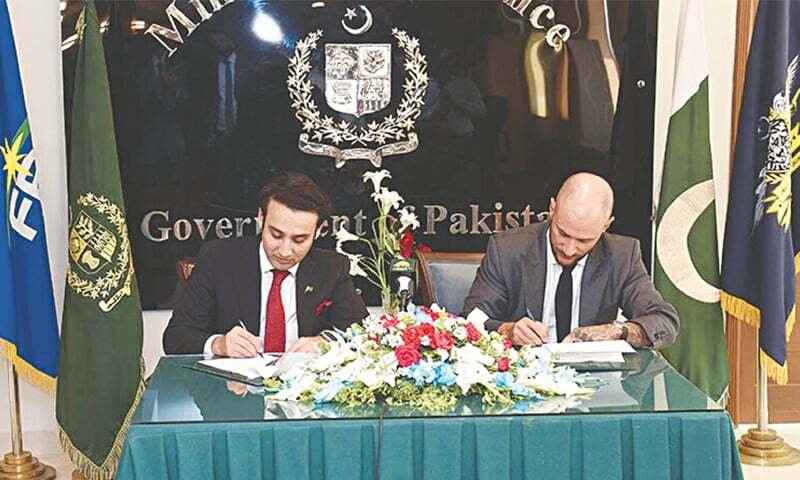
Before the pardon, Zhao met Nawaz Sharif and Maryam Nawaz in April, shortly after the Pakistan Crypto Council was formed, and was appointed its strategic adviser. Binance remains one of the most popular crypto apps in Pakistan, ranking seventh in the finance category and holding the third-most-downloaded finance app position for two consecutive years, according to the Pakistan State of Apps 2024 report by Data Darbar.
Binance has since signed a memorandum of understanding with JazzCash to explore crypto-linked payments and broader digital-asset use cases. It has also entered into a non-binding letter of intent with the Fauji Foundation — whose ecosystem includes Askari Bank — to examine collaboration across blockchain, Web3, and crypto infrastructure.
On the regulatory front, the government has issued no-objection certificates to Binance and cryptocurrency exchange HTX, allowing them to begin structured engagement ahead of full licensing. Separately, Pakistan and Binance have signed an MoU to explore the tokenisation of up to $2bn in sovereign bonds, T-bills, and commodity reserves.
In short, the crypto ecosystem in Pakistan is now intertwined with Binance, the Trump family’s crypto interests, and a regulatory framework still under construction.
“President Donald Trump is making crypto a national priority, and every country, including Pakistan, will ultimately have to follow suit,” Mr Saqib has said in an interview. Yet even as policy momentum accelerates, the true scale of Pakistan’s crypto economy remains opaque.
Some media reports suggest an informal market worth $25bn with roughly 20 million users. That works out to an average of $1,250 per user, a figure that does not seem implausible but remains impossible to independently verify in an ecosystem that has operated largely in the shadows.
According to Chainalysis’s 2025 Geography of Crypto report, stablecoins in Pakistan are used as a hedge against inflation, while many freelancers receive payments in crypto. Much of the crypto activity, however, takes place through peer-to-peer channels that operate without know-your-customer checks. This has raised red flags.
Earlier this year, Malik Bostan, chairman of the Exchange Companies Association of Pakistan, estimated that the country may have lost as much as $600m to illegal crypto transactions; flows that could potentially draw scrutiny from the Financial Action Task Force.
Regulating the crypto ecosystem, then, is not a policy choice so much as a national imperative. However, the speed of Pakistan’s regulatory pivot must be matched by infrastructure that is both robust and tailored to local risks, from consumer protection to financial crime oversight. If bringing crypto into the regulatory fold also aligns with Pakistan’s geopolitical interests and plays well in Washington, so be it. But the primary test of any framework will be whether it protects citizens first.