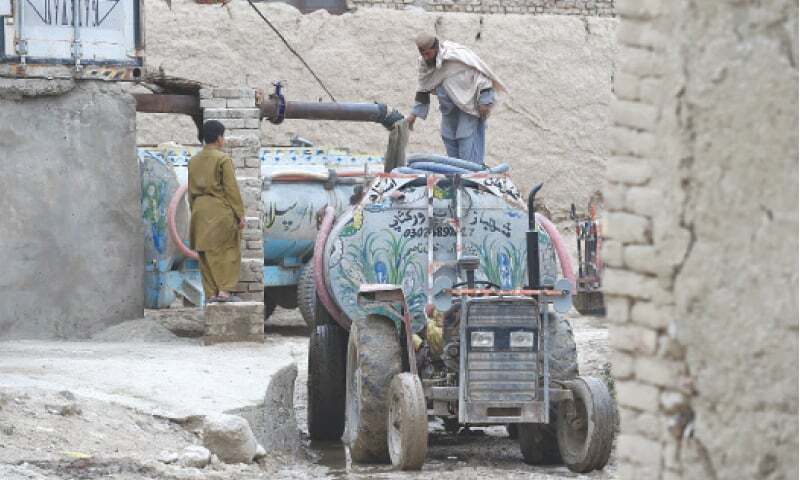

FOR more than three decades, Muhammad Jahangir Khan has lived just off Spinny Road, a settled neighbourhood in Quetta with all the basic markers of an urban locality.
The area has gas and electricity connections, and most streets are paved, but for all the trappings of civilisation, his home has never had running water.
Like many of his neighbours, Jahangir plans his daily routine around the arrival of a private water tanker, an expense that was once considered temporary, but has long since become a recurring cost.
Jahangir says that people living on his street have repeatedly submitted applications to elected representatives for pipeline installation, but their complaints were ignored, and no action was taken.

Even in areas where water is available, its supply is highly irregular. In some localities, residents receive water only once a day for a few hours, while others get it once a week.

Officials warn that without urgent action, the city may face a severe water shortage within next five to ten years
In September last year, Commissioner of Quetta Division Shahzaib Khan Kakar and Deputy Commissioner Captain (Retd) Mehrullah Badini had warned that the water shortage in the provincial capital was worsening with each passing day, urging joint action by the government and citizens. “We are going to announce a water emergency in Quetta,” they had cautioned.

Chairing a meeting on the Quetta Water Security and Resources Action Plan on Monday, Mr Kakar acknowledged how dire the situation had become.
Quetta’s water situation, the meeting was told, is at an alarming level, and if immediate measures are not taken, citizens may face an acute water shortage in the next five to ten years.
Agreeing on the need for strict and practical decisions to prevent further groundwater depletion, the meeting agreed to formulate a comprehensive emergency action plan, explore new water storage options, install water treatment plants, and develop policies to provide alternative water sources to car washes and other commercial units.
Groundwater depletion
There are no magical solutions that can fix this systemic issue overnight, because behind this thirst lurks a deeper structural crisis, rooted in geography, climate and policy failure.
Despite covering nearly 44 per cent of Pakistan’s landmass, Balochistan receives less than 200mm of annual rainfall, according to the Pakistan Meteorological Department.
In Quetta, groundwater levels are falling by two to five metres annually, driven by unchecked extraction, including more than 30,000 illegal tube wells, per the Balochistan Agriculture Department.
Moreover, a study by the International Union for Conservation of Nature (IUCN) shows that the water table has dropped from about 50 metres in 2,000 to over 150 metres by 2023, posing a serious threat to agriculture and livelihoods.
The unregulated use of tube wells and excessive pumping has rapidly depleted groundwater reserves, with extraction far exceeding the rate of natural recharge.
Dr Munir Ahmed Babar of the US-Pakistan Centre for Advanced Studies in Water (USPCAS-W) at Mehran University of Engineering and Technology, Jamshoro, told Dawn that Quetta’s continued reliance on tube wells was fundamentally unsustainable.
“Quetta depends almost completely on groundwater, and that groundwater is going down by around one to 1.5 meters every year,” he said. “This means that more water is being pumped out than nature can refill, while continuing to install tube wells — even solar-powered ones — is not sustainable.”
“Sustainability is only possible if new tube wells are restricted or banned, illegal wells sealed, groundwater pumping is measured and priced, recharge dams are built, and rainwater harvesting is introduced.
“Without regulation and recharge, Quetta is moving towards water exhaustion,” he said.
Wasa Managing Director Mujeebur Rehman Kakar said the authority supplies water to just 51 per cent of Quetta’s population, around 1.3 million people.
“We have 544 tube wells, of which 387 are functional,” he told Dawn, adding that around 1,000 may be unauthorised.
He cited arid climate, low rainfall, poor geology, droughts, rapid urbanisation and weak monitoring as major contributors to the crisis.
Uneven relief across the city
While some areas have seen limited intervention, relief remains uneven and fragile. Shahryar Kasi, a resident of Shaldara on Kasi Road, said water shortages in the area were once severe. “Wasa used to supply water after a week or 10 days, and even that would stop within minutes,” he said.
He added that during the tenure of the previous government, a tube well was installed on Kasi Road, easing shortages in the surrounding areas. “Now we get water once a day, which has provided some relief,” he added.
The situation, however, has not improved uniformly throughout the city, with many areas receiving water only once a week.
Khair Muhammad Dehwar, a resident of Kalat Street in the Jail Road area, said the water situation deteriorated after Balochistan faced a prolonged drought from 1998 to 2006.
“Some tube wells installed by the government were damaged, but they never got repaired,” he said, adding that Wasa later refused to take over certain wells, citing insufficient groundwater.
In several neighbourhoods, even state-led interventions have failed to deliver equitable access. Umair Parkani, a resident of Killi Bangulzai in Quetta Saryab district, said his neighbourhood has relied on private tankers for years despite elected representatives from his area making repeated promises.
Others have to keep paying the water bill, despite seldom getting any.
Published in Dawn, January 20th, 2026