

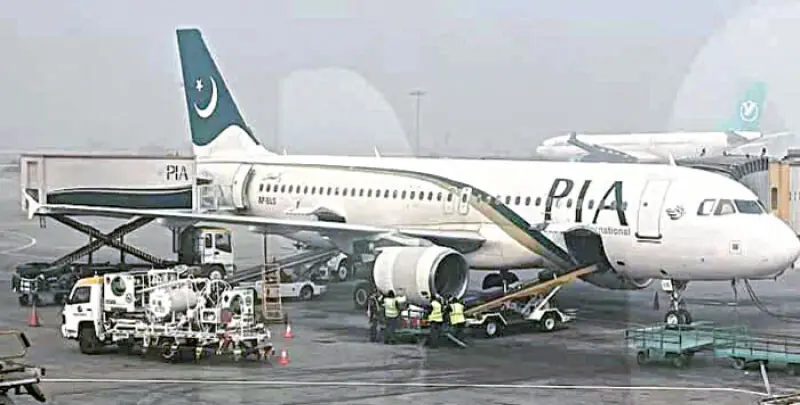
KARACHI: Arif Habib, chairman of the Arif Habib Consortium, which owns Pakistan International Airlines (PIA), has said that the national flag carrier currently has 30 aircraft, of which 18 are operational, and five to six require repair and maintenance.
Speaking to industrialists at the Korangi Association of Trade and Industry (KATI) on Thursday, he said the airline is working to make these aircraft operational, and adding them back to the fleet will bring the total to 26. The long-term target is to expand the fleet to 60 aircraft.
Pakistan, he said, had become more economically stable, and that this fiscal year’s figures showed the government had increased revenue, met all expenditure and paid interest on debt. However, he stressed the need to reduce production costs to boost economic growth.
He said electricity tariffs remained high because of capacity charges and low consumption. If the available transmission system, with a capacity of more than 22,000 megawatts, were fully utilised, the per-unit cost could be reduced by Rs10 to Rs12. He said this could only happen if electricity consumption increased.

Arif Habib says high electricity tariffs hurting industry

Mr Habib said that if the business community remains united, the government will pay attention to their demands. He added that information technology, agriculture and mining were key sectors that could quickly help Pakistan overcome its problems and move towards growth.
Association of Builders and Developers (ABAD) Chairman Hasan Bakhshi urged the business community to unite and form a consortium to acquire and operate loss-making government institutions, including the Karachi Water and Sewerage Board, the Karachi Metropolitan Corporation and the Sindh Building Control Authority. The business community can run these institutions profitably and more efficiently, he added.

Kati President Muhammad Ikram Rajput said that in the past decisions were made in Washington, but now they are being made in Islamabad, as Pakistan has emerged as an important stakeholder in global politics, which was hard for its adversaries to digest.
Kati Deputy Patron-in-Chief Zubair Chhaya, while expressing concern over the state of the economy and the investment climate, said that both foreign and local investment in the country was almost negligible, mainly due to bureaucratic hurdles and policy inconsistency. He said that whenever a good policy was introduced, it did not last long, which hurt investor confidence.
Korangi Industrial Trading Estate Ltd Chairman Zahid Saeed said that despite government claims of industrial development, practical steps were almost non-existent, leaving Karachi’s industrial issues unresolved. Despite an announcement by the Sindh chief minister in December 2025 to develop industrial infrastructure, no formal budget had yet been released for the purpose.
United Business Group (UBG) Chairman Khalid Tawab said that after the war with India, Pakistan’s name had risen on the global stage, and that Pakistan’s role in securing a ceasefire during the recent US-Iran tension had also enhanced the country’s reputation.
He demanded that Karachi Airport be rebuilt and modernised so the city could once again become a major economic hub in the region.
Published in Dawn, April 10th, 2026