Pakistan’s mediation offer reflects growing diplomatic confidence, Capitol Hill symposium told

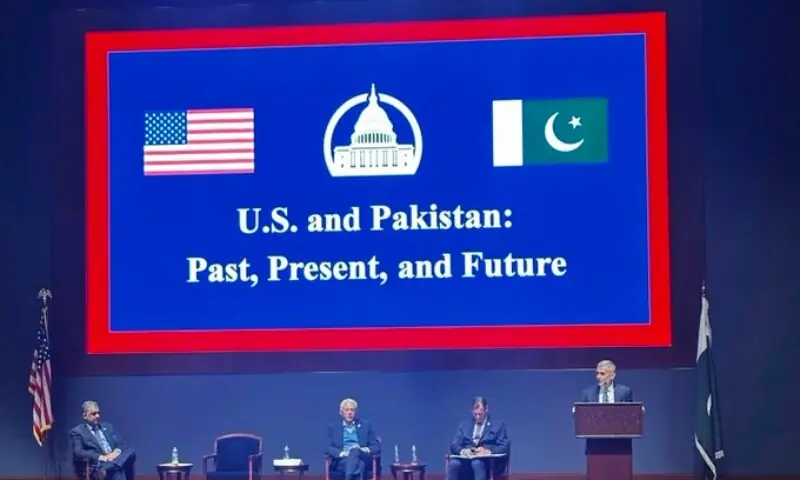

WASHINGTON: Speakers at an hours-long symposium on Capitol Hill on Tuesday noted that Pakistan’s gesture to mediate peace between the United States and Iran, amid the recent escalation of hostilities between Washington and Tehran, reflects growing confidence in Islamabad’s diplomatic role in regional disputes.
Referring to the recent US–Iran military confrontation — which included direct strikes and retaliatory actions that heightened tensions across the Gulf — participants observed that Pakistan’s outreach underscored its desire to play a stabilising role in a region already burdened by multiple conflicts.
Speakers argued that Pakistan, a developing country of more than 250 million people situated in a strategically sensitive region bordering Afghanistan, Iran, India and close to the Gulf, must be viewed beyond a narrow security lens. They noted that the country has a large diaspora in the United States, a growing and educated middle class, significant natural resources, and nuclear capability — factors that make it an important regional player.
They noted that geography has consistently shaped Islamabad’s strategic choices and constrained its economic potential, as developments in neighbouring states directly affect its security and growth prospects.

The symposium, titled “US and Pakistan: Past, Present, and Future,” was organised by the Congressional Pakistan Caucus and held under the Chatham House Rule. The nearly four-hour session was chaired by Caucus co-chairs Tom Suozzi and Jack Bergman in collaboration with the Embassy of Pakistan.

In a social media post, Congressman Tom Suozzi said experts were brought together “to review the history, security and economic dimensions of Pakistan–US bilateral relations and to help build a better future.”
The US State Department welcomed the holding of the symposium. In a separate post, Assistant Secretary of State for South and Central Asia Paul Kapur noted that positive developments in Pakistan–US ties during President Donald Trump’s tenure helped promote mutually beneficial partnerships in economic sectors, including minerals.
Pakistan’s Ambassador to the United States, Rizwan Saeed Sheikh, said Pakistan’s unique geostrategic location gives it importance at both regional and global levels. He noted that Pakistan has played a frontline role in the fight against terrorism and has made significant sacrifices for regional and global peace. He added that Pakistan remains ready to continue playing a full role in promoting international peace and stability.
Discussions on the history of bilateral ties noted that US–Pakistan relations have evolved in cycles — periods of close cooperation often followed by phases of mistrust or disappointment. Participants observed that engagement has frequently been shaped by third-country considerations, particularly developments involving India, Afghanistan and China, which complicated efforts to build a steady, long-term partnership.
There was broad agreement that the relationship had at times become overly transactional, driven by immediate geopolitical needs rather than institutionalised cooperation. Speakers stressed that both countries would benefit from clearer expectations and a framework that goes beyond crisis-driven security coordination.
Security discussions focused on Pakistan’s current threat environment. Participants noted that militant groups have become more fragmented and technologically capable, operating across borders and posing challenges not only to border regions but potentially to major urban centres.
They emphasised that while military operations remain important, sustainable counterterrorism requires stronger civilian law enforcement institutions and rule of law.
Tensions between India and Pakistan were described as a continuing source of regional risk. Even with ceasefire understandings in place, participants cautioned that a major terrorist incident could trigger another crisis between the two nuclear-armed neighbours.
Some warned that both sides risk focusing excessively on military preparedness rather than investing in crisis-prevention mechanisms.
The discussion also examined Pakistan’s relationship with China. While military cooperation between Beijing and Islamabad remains strong, economic cooperation has produced mixed results. High expectations surrounding the China–Pakistan Economic Corridor have not always translated into consistent outcomes, and security threats to foreign personnel have created additional complications.
Participants noted that Pakistan does not seek exclusive dependence on any one partner and continues to value engagement with the United States.
Economic cooperation emerged as a central theme of the symposium. Participants argued that the future of US–Pakistan relations must move from aid-based interaction toward trade and investment. Pakistan was described as having significant potential in critical minerals, renewable energy, information technology and digital services.
However, investors were said to remain cautious due to policy unpredictability, taxation concerns, bureaucratic hurdles and weak dispute resolution mechanisms. Participants stressed that foreign investors require regulatory stability, reliable infrastructure, prepared and bankable projects, and confidence that contracts will be enforced fairly and efficiently.
Examples were cited of US interest in Pakistan’s mineral sector, with participants noting that local communities often respond positively when projects adhere to clear international standards. At the same time, they underlined that attracting sustained foreign capital would require structural reforms, reduced corruption, stronger arbitration frameworks and greater legal certainty.
Between panels, the event also highlighted efforts to address bonded labour in Pakistan’s brick kiln industry. Reference was made to families trapped in generational debt bondage and to recent legislative and administrative measures aimed at reform and modernisation. Participants emphasised that cooperation between government institutions, civil society and international partners is essential to eliminate exploitative labour practices.
In closing discussions, speakers said cooperation between the United States and Pakistan is not optional given the size, population and geopolitical roles of both countries. They stressed that while security cooperation remains necessary, the relationship must expand to include trade, investment, education and institutional development.
Speakers concluded by identifying three recurring themes: the importance of counterterrorism cooperation and regional stability; Pakistan’s central role in regional dynamics involving China, India, Afghanistan and Iran; and the need to deepen economic engagement.
Participants expressed cautious optimism that a more stable and productive partnership could emerge if both sides maintain sustained engagement, adopt realistic expectations and pursue practical reforms. There was broad agreement that similar dialogues should continue in order to strengthen a relationship described as complex, consequential and evolving.