


ISLAMABAD: As global temperatures continue to rise due to the burning of fossil fuels, Pakistan is projected to see a net increase in mortality of 51 deaths per 100,000 people by 2050, with low- and middle-income countries accounting for 90 per cent of these premature deaths due to climate change.
According to a study, these are the first projections of rising temperatures’ impact on mortality to target adaptation planning, which are compiled by the Climate Impact Lab at the University of Chicago, using “highly-localised data from around the world”.
“Ten times more people are projected to die each year in lower-income countries (about 391,000 people) than in higher-income countries (about 39,000 people) due to shifting temperatures, despite being expected to have roughly equal populations,” the study noted, while highlighting the disproportionate impact of heatwaves on the Global South.
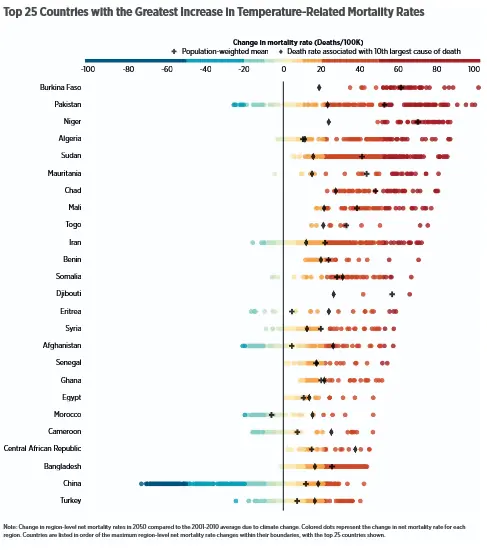
Pakistan and Burkina Faso will be the hardest-hit countries, as per these projections. Pakistani cities fare even worse due to the warming climate.

“While warm, wealthier cities like Phoenix and Madrid are projected to lose an additional 600 and 525 lives each year, respectively, due to a warming climate, Faisalabad, Pakistan, will lose an additional 9,400 lives,” the study revealed.

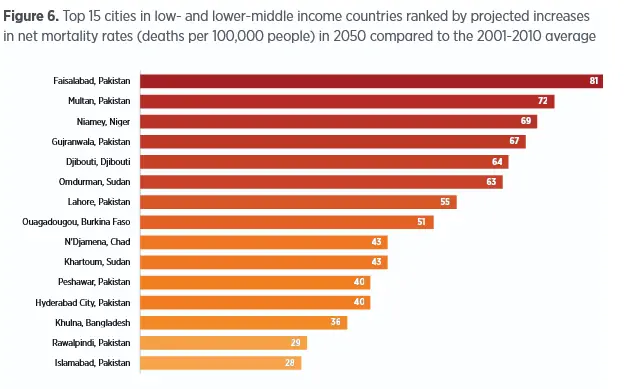
Eight Pakistani cities — Faisalabad, Multan, Gujranwala, Lahore, Peshawar, Hyderabad, Rawalpindi and Islamabad — are among 15 urban centres in low- and middle-income cities ranked by projected increases in net mortality rates in 2050 compared to the 2001-2010 average. With the exception of Khulna in Bangladesh, other cities in the list are from Africa.
The heat-related deaths in Pakistan are projected to exceed “today’s rates associated with tuberculosis, chronic obstructive pulmonary disease (COPD), and stroke”.

“When considering the 301 cities across the globe that we project to see a net increase in temperature-related deaths in 2050, more than 100,000 additional lives will be lost annually and approximately one in three of those deaths will occur in Pakistani cities,” the study warned.
These deaths will occur because Pakistani cities do not have adaptation finance available to adapt to rising temperatures.
The FY25-26 budget only set aside Rs85 billion for adaptation, and a large chunk of adaptation subsidies was focused on agriculture.
CIL projections indicated that 95 cities across Asia would experience an increase in temperature-related mortality of at least 10 deaths per 100,000 with 56 of them residing in China. “Other countries with multiple cities that exceed the 10 deaths per 100,000 threshold include Pakistan (nine), Japan (four), Iran (four), Bangladesh (three), and Saudi Arabia (three),” it added.
According to the study, the population-weighted mean of the change in the net mortality rate of the low-income group increases by approximately eight deaths per 100,000 people, while that of the high-income groups decreases by about four deaths per 100,000 people.
“While lower income (i.e. low- and lower middle-income) and higher income (i.e. upper middle- and high-income) countries will have approximately equal populations in 2050 (52 per cent and 48pc of global population, respectively), 10 times more people are projected to die each year in lower-income countries due to a warmer climate than in higher income countries (approximately 391,000 and 39,000 people, respectively).”
Similarly, 16 of the top 20 countries with the largest net increases are relatively poor, while 18 countries with the largest net decreases in deaths are relatively wealthy.
The research showed that the heat-related deaths were an “inequitable threat” to human well- being, which could be effectively prevented with additional resources and policies. In this regard, adaptation finance plays a crucial role in helping the low-income countries reduce vulnerabilities.
For instance, the projected income growth will reduce climate change’s global impact on mortality by about nine deaths per 100,000 people, about equal to “eliminating suicides across the globe”, it said.
“In other words, without economic growth, there would be seven times more temperature-related deaths globally,” the study noted.
Stressing the importance of adaptation, it said the climate will continue to warm for at least the next few decades even if all the climate goals are met, and net-zero is achieved.
“Efforts to mitigate climate change must therefore be coupled with concerted action to help society adapt to the warming that is already underway to prevent its worst impacts,” it added.
Tamma Carleton, faculty head of Research for the Climate Impact Lab (CIL) and an assistant professor at the University of California, Berkeley, said, “The stakes are too high for the past to be the prologue. Correctly choosing where to spend limited dollars on adaptations could have massive impacts on who lives and who dies.”
Dr Mariam Saleh Khan, a climate scientist at the Weather and Climate Services think-tank in Islamabad, said multiple scientific studies have projected that humid heat in parts of the country is expected to exceed physiological limits of human survivability, impacting also the productivity and physical and mental health.
“Keeping in mind that Pakistan is one of the fastest urbanising countries in South Asia, the current projections of CIL should still be considered lower estimates,” she said, adding that Pakistan did not have a “well-equipped” plan to deal with this looming disaster.
“After the 2022 heatwaves, the government did focus on initiatives like preparing a couple of heat action plans at city and provincial scale, but none of those is based on robust scientific knowledge, rather are kind of simple heat-advisories,” she said, while also criticising the National Adaptation Plan 2023.
“Even in the very celebrated NAP, wet-bulb temperature (an indicator used to measure humid heat) is mentioned only once, and that also with a wrong scientific definition/perception,” she claimed, adding that this CIL report was alarming for the economy, particularly agriculture and construction sectors that rely on outdoor labour. She also regretted that there was no mechanism for recording heat-related mortalities.
‘Mitigation to act as shield’
Ammara Aslam, a climate change researcher at Policy Research Institute for Equitable Development, said the adaptation cost would continue to rise without effective mitigation measures to act as a “shield” against global warming.
“According to UNEP’s latest adaptation gap report (2025), the annual adaptation finance requirement for the developing world is $365bn … and these costs would continue to rise at an exponentially unsustainable rate in a continuously warming world,” she said, adding that these requirements could rise to $500bn.
In the absence of mitigation measures, the warming world will need more and more money to adapt to extreme weather. This financial burden will only increase if inflation and devaluation are added to the mix.
Despite these factors, the adaptation finance is decreasing: it went down from $28bn in 2022 to $26bn in 2023, Aslam said, adding that Pakistan alone needed $152bn by 2030 for its adaptation measures.
At COP30, there was hardly any progress on adaptation, as it failed to triple the adaptation finance to $120bn by 2030 and instead set a new deadline of 2035 without setting a baseline target.
“Every delay in cutting greenhouse emissions today compounds the interest on a debt of resilience that the developing and vulnerable countries cannot shoulder even now,” she said.
According to the World Bank, Pakistan requires $196bn for “deep decarbonisation” by 2030, and, if implemented strategically, it could significantly reduce the country’s adaptation costs, she opined.