



Pakistan on Wednesday urged the United Nations Security Council (UNSC) to move swiftly to designate the Balochistan Liberation Army (BLA) as a terrorist organisation under its sanctions regime, saying the listing request was already under consideration by the council.
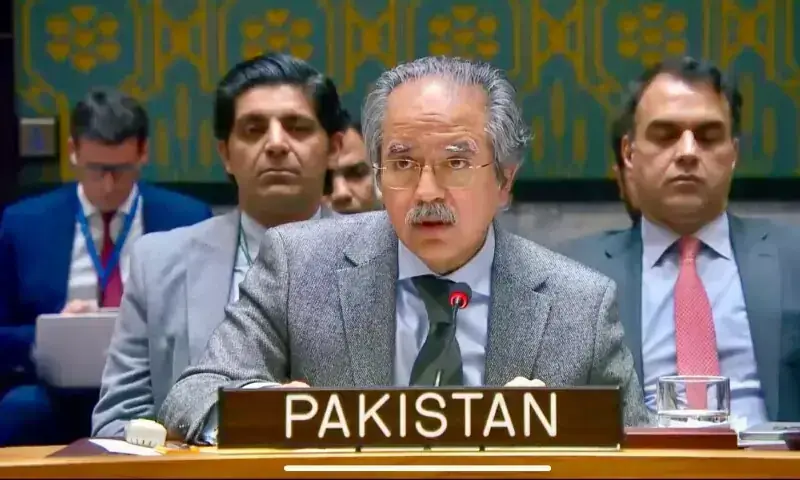
“We hope the council will act swiftly to designate BLA under the 1267 sanctions regime, acceding to the listing request that is currently under consideration,” Pakistan’s Permanent Representative to the United Nations, Ambassador Asim Iftikhar Ahmad, told a UNSC briefing on ‘Threats to International Peace and Security caused by Terrorist Acts’.
In his remarks, the envoy thanked UNSC members for issuing a press statement condemning the recent attacks in Balochistan and expressed appreciation for what he described as an international “outpouring of support and solidarity with Pakistan”.

“We remain resolute in eliminating this externally sponsored scourge from our soil and exposing the sponsors, financiers, aiders and abettors sitting across our borders,” Ambassador Ahmad said.
Ambassador Ahmad said Pakistan had paid a heavy price in the global fight against terrorism.
“As a frontline state in the global counterterrorism effort, we have sacrificed blood and treasure — with more than 90,000 casualties and staggering economic losses over the years,” he said.
Recalling Pakistan’s role in earlier counterterrorism efforts, he said the Al Qaeda “core” was “largely decimated in Afghanistan due to Pakistan’s instrumental efforts,” adding that Pakistan had also played a leading role in combating the militant Islamic State group’s regional affiliate.
However, Ambassador Ahmad warned that the security situation had deteriorated in recent years, particularly after the Taliban takeover of Kabul.
“Externally sponsored and foreign-funded proxy terrorist groups such as Fitna al Khawarij TTP (Tehreek-i-Taliban Pakistan) and Fitna al Hindustan BLA (Baloch Liberation Army) and its Majeed Brigade have got a new lease of life,” he said.
“Operating with virtual impunity from Afghan soil and with the active support of our eastern neighbour, these groups are responsible for heinous terrorist attacks inside Pakistan.”
Referring to the latest violence in Balochistan, he said the BLA had claimed responsibility for coordinated attacks across multiple locations.
“Just this weekend, BLA claimed responsibility for a series of terrorist attacks across multiple locations in Balochistan Province that resulted in the martyrdom of 48 innocent civilians, including five women and three children,” he said, adding that “145 BLA terrorists were neutralised during the effective riposte by our valiant security forces”.
It is worth mentioning that last year in August, the US State Department added BLA and its alias, the Majeed Brigade, to its Foreign Terrorist Organisation list.
In his remarks, Ambassador Ahmad also raised concerns about the evolving regional threat emanating from Afghanistan, citing findings by the UN’s Analytical Support and Sanctions Monitoring Team.
“These terrorist groups pose a threat not only to Pakistan, but to the entire region and beyond,” he warned, pointing to recent attacks in Central Asia near the Afghan border as validation of earlier concerns.
He also cautioned against the proliferation of advanced weapons left behind after the withdrawal of foreign forces from Afghanistan.
“It has become imperative to prevent the billions of dollars of sophisticated weapons and equipment left behind by foreign forces in Afghanistan from falling into the hands of terrorists,” he said, calling for accountability of “external destabilising actors who support, finance and arm these groups, including their proxies in Afghanistan”.
He urged the international community to respond collectively, without double standards.
“The international community must address the contemporary terrorist threat through a collective, comprehensive and coordinated response, including through the balanced implementation of the Global Counter-Terrorism Strategy,” he said.
Ambassador Ahmad also criticised what he described as selective approaches to counterterrorism, arguing that “counterterrorism policies have so far singled out only the adherents of one religion”.
“There must be zero tolerance for state terrorism,” he said, referring to the situation in Indian-occupied Jammu and Kashmir, and called for recognition of “legitimate struggles of peoples against foreign occupation” in line with UN resolutions.
He said the upcoming ninth review of the Global Counterterrorism Strategy later this year provided an opportunity to “renew our collective resolve” and address existing gaps.
“Pakistan will continue to support multilateral efforts aimed at devising comprehensive and holistic strategies to combat and eradicate this menace through collective endeavours and cooperation,” he added.