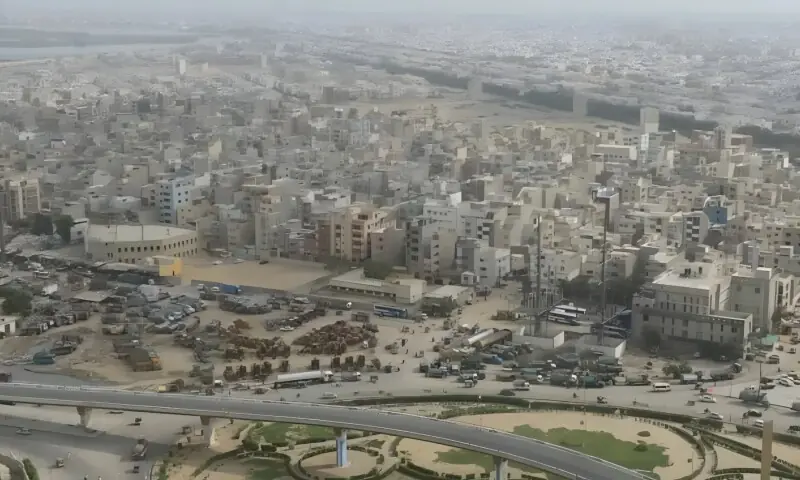

Population growth and the struggle to build a stable, productive economy in Pakistan are fundamentally a story of how demographic pressures collide with limited resources, weak institutions, and low human development.
Pakistan’s population now exceeds 241 million, growing at a rate still above 2 per cent per year, creating an ongoing mismatch between the pace of population expansion and the country’s ability to provide jobs, services, and infrastructure.
While total economic output (termed Gross National Product) has increased over time, rapid population growth continually erodes per capita gains, leaving people trapped in low-income cycles and limiting the state’s fiscal space to invest in development.
The demographic structure, with a noticeable decline in youth dependency from around 90 in 1990 to 70 in 2018-19, offers a potential demographic dividend. Yet, Pakistan has to struggle to translate this into economic productivity.

Millions of young people enter the labour market each year, but employment creation remains insufficient, resulting in high unemployment, underemployment, and a labour force dominated by low-skilled, informal work.

According to the Labour Force Survey 2020-21, 16 per cent of graduates remain unemployed, with a larger proportion of women.
Such high unemployment among university graduates, particularly women, highlights a dual dilemma—an economy too weak to generate high-skilled jobs, and labour markets still shaped by gender discrimination that restricts women’s entry even where skills exist.
Despite women making up nearly half the population, female labour force participation in Pakistan remains among the lowest in the world, hovering around 22-24 per cent.
High fertility, limited mobility, low education levels, and weak workplace protections all contribute to keeping women out of productive employment.
When women withdraw from the labour market due to childbearing or household responsibilities, the economy loses substantial human capital. This reduces household income, lowers national productivity, and further tightens the resource constraints that large families face.
The opportunity cost of excluding women from the labour market is enormous; no country has achieved sustained economic growth without fully integrating women into its workforce.
Even more troubling is the fact that 37pc of Pakistani youth, aged between 15 to 24 years, are neither employed nor participating in education or training (NEET), reflecting a significant loss of potential talent.
The pressure on households is equally intense. Large family sizes create resource dilution within the family, where parental time, income, nutrition, and attention are spread thinly across many children. As a result, each child receives fewer resources, weakening educational attainment, cognitive development, and health outcomes.
This dilution is visible in Pakistan’s alarming levels of child malnutrition, where more than 40pc of children under the age of five are stunted and around 17pc are wasted, contributing to statistics which are some of the highest rates in South Asia.
Stunting represents irreversible cognitive and physical harm, significantly reducing future productivity and earnings potential. A population with such compromised human capital cannot sustain long-term economic growth. Moreover, when children enter the labour force early, often due to economic pressures, Pakistan loses another generation of potential skilled workers, perpetuating poverty and limiting economic innovation.
The pressure of rapid population growth is visible not only in labour markets but across all public systems. Fiscal resources are stretched thin as the state attempts to provide schools, hospitals, roads, and energy to a growing population.
Per capita public expenditure on health and education remains extremely low. With more children competing for limited school spaces, learning outcomes suffer.
Pakistan already faces one of the world’s highest numbers of out-of-school children, over 23 million.
Similarly, health systems struggle with overcrowded facilities, inadequate immunisation coverage, and poor maternal health outcomes.
Environmental stress amplifies these challenges. Pakistan is among the top ten countries most vulnerable to climate change. Rapid population growth increases demand for water, food, and land at a time when climate shocks such as floods, droughts, and heatwaves are intensifying.
Water scarcity is becoming a structural threat as per capita water availability falls below international scarcity thresholds. Agricultural land is under growing pressure, and climate-induced crop failures threaten both livelihoods and food security.
Housing is another dimension where population pressures are acute. Pakistan faces a housing deficit estimated between 4.3 and 10m units—an estimate that varies across researchers but consistently signals a severe and widening gap.
Rapid urbanisation, driven by rising populations in both rural and urban areas, has led to overcrowded cities where informal settlements expand faster than planned infrastructure. Urban services, such as water, sanitation, transport, and energy, are unable to keep pace with demand. High population density without adequate planning leads to congestion, rising rents, slum proliferation, and environmental stress.
Without addressing housing needs, Pakistan will not be able to build healthy, productive urban centres capable of supporting economic transformation.
Provincial disparities further complicate the population–economy dynamic. According to the World Bank report 2025, Punjab has the lowest poverty rate at around 16.3pc. Yet, because of its sheer population size, it still contains about 40pc of all people living in poverty in Pakistan.
Three Punjab districts—Muzaffargarh, Rahim Yar Khan, and Dera Ghazi Khan—each have more than one million poor individuals. Sindh’s poverty rate stands at 24.1pc, and Khyber Pakhtunkhwa’s at about 29.5pc, while Balochistan contains seven of the country’s ten poorest districts.
These patterns show that high population density and limited resource management can produce pockets of extreme poverty even within more developed provinces.
Pakistan’s fertility story is also unique within South Asia. While neighbouring countries have achieved replacement-level fertility, Pakistan’s decline stalled after an initial drop from 6.2 children per woman in the 1980s to 4.8 by 2000.
Despite strong community outreach programmes, such as the Lady Health Workers initiative and social marketing campaigns, fertility remained high, at around 3.6 births per woman in 2018.
This stagnation is surprising because surveys consistently show that men and women desire fewer children than they actually have. The fertility-related health needs remain especially high in poorer regions, where unmet demand for family planning is widespread.
Persistent governance failures, stock-outs of contraceptives, and limited-service delivery have contributed to weak program implementation.
After the 2017 Census showed a 2.4pc annual population growth rate, the Supreme Court intervened, leading to the Council of Common Interests adopting the National Action Plan on Population in 2018.
The plan aims to reduce fertility to 2.8 by 2025 and 2.1 by 2030, with corresponding population growth declines to 1.5pc and then 1.2pc. These targets are achievable if Pakistan strengthens family planning, expands women’s education, improves service delivery, and prioritises demographic management at both federal and provincial levels.
Without these efforts, population growth will continue to dilute economic gains, weaken human capital, strain public finances, and limit the country’s ability to shift toward a stable, resilient, and productive future.
Header Image: A photo of Karachi’s skyline. — Fahim Siddiqi/ White Star