BY approving a US-sponsored resolution, the UN Security Council handed an international mandate to President Donald Trump’s 20-point ‘peace plan’ for Gaza. But it did this without any input from Palestinians. Hamas rejected the resolution saying it fails to meet Palestinian rights and demands and “imposes a mechanism to achieve the [Israeli] occupation’s objectives”.
The resolution can only be implemented if Hamas signs up to it. This means complex negotiations lie ahead if the plan is to progress beyond the present ceasefire, which is being violated daily by Israeli forces, who have also been crossing the ‘yellow line’. This has taken the Palestinian death toll to almost 70,000 in the two-year genocidal war imposed by Israel.
The UNSC resolution is short on specifics and ambiguous in key areas. It ignores all previous resolutions on Palestine. It authorises the creation of a vaguely defined transitional governance body, the Board of Peace, chaired by Trump and members decided by him, to oversee a Palestinian “technocratic” committee responsible for day-to-day running of Gaza. It also authorises the BoP to establish a temporary multinational international stabilisation force (ISF) “to deploy under unified command acceptable to the BoP”.
This will not be a UN peacekeeping mission nor be overseen by the UN. Its mandate is unclear and details are lacking on its scope and structure. It is however tasked to “demilitarise the Gaza Strip” and carry out “permanent decommissioning of weapons from non-state armed groups”, including Hamas.

The original US draft made no reference to Palestinian statehood. But at the insistence of Muslim countries, the final resolution mentions a “credible pathway to Palestinian self-determination and statehood”. But this is wrapped in so many conditions that it denudes it of real meaning. Weak Arab negotiators failed to get a firm commitment to a Palestinian state in the resolution. Meanwhile, Israeli Prime Minister Benjamin Netanyahu remains firmly opposed to any Palestinian state.

The UNSC resolution was welcomed across the world as a step towards peace despite concerns of many countries and Council members, including Pakistan, about its lack of clarity in core areas. China and Russia, who abstained on the vote, both voiced concern about the vague nature of key elements, lack of Palestinian participation and absence of commitment to a two-state solution.
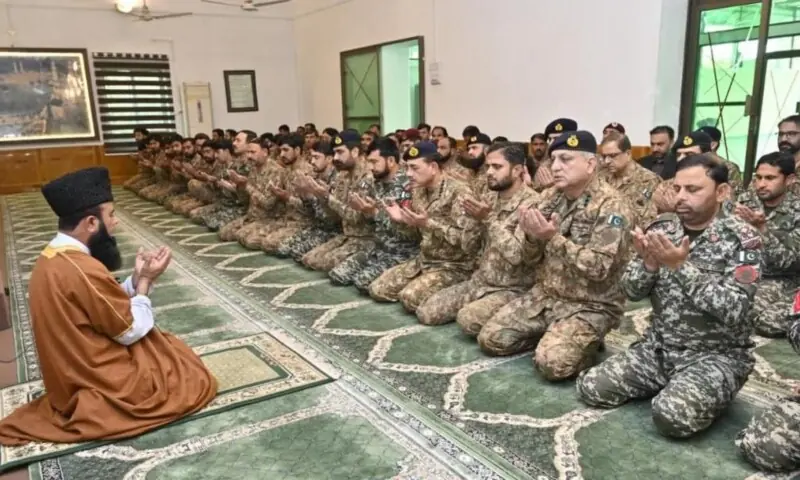
It would be a mistake for Pakistan to send troops for the stabilisation force in Gaza.

China’s ambassador to the UN, Fu Cong, said the resolution “does not [reflect] the fundamental principle of Palestinians governing Palestine”. Russia’s UN envoy, Vassily Nebenzia, described the stabilisation force as “reminiscent of colonial practices”. In a scathing critique, the UN special Rapporteur for Palestine said, “Rather than charting a pathway towards ending the occupation and ensuring Palestinian protection, the resolution risks entrenching external control over Gaza’s governance, borders, security, and reconstruction. The resolution betrays the people it claims to protect.”
In Gaza itself, the UNSC resolution’s main provisions were viewed with great scepticism, according to Al Jazeera reporters on the ground. One resident told the news outlet “Our people … are able to rule ourselves. We don’t need forces from Arab or foreign countries to rule us”. The transitional governing arrangement is seen as outsiders deciding the fate of Palestinians. The international stabilisation force is viewed with deep suspicion — “not as a guarantee of protection but rather a foreign security arrangement imposed without their consent”.
Of course, it is the stance of Hamas and other Palestinian factions that is consequential for the resolution’s enforcement. Hamas still controls Gaza up to the ‘yellow line’ held by Israel. Its popularity has risen since the ceasefire, according to the latest poll by the West Bank-based Palestinian Centre for Policy and Survey Research. Hamas has rejected the UN resolution on a number of grounds. It said the resolution “imposes an international guardianship mechanism on the Gaza Strip”. Assigning the international force to disarm groups resisting the occupation “strips it of its neutrality, and turns it into a party to the conflict in favour of the occupation”.
Hamas has argued that any international force, if established, “must be deployed only at the borders to separate forces, monitor the ceasefire, and be fully under UN supervision”. “It must also operate exclusively in coordination with official Palestinian institutions.” “Resisting the occupation by all means is a legitimate right guaranteed by international laws and conventions.” Hamas also said disarmament is an “internal matter” linked to the end of occupation and creation of a Palestinian state.
It is possible Hamas may be prepared to disarm in exchange for total Israeli withdrawal from Gaza, which would end its occupation. But that can only be tested in serious negotiations that have to take place if the UN-endorsed Trump plan is not to collapse.
The expectation from the stabilisation force to demilitarise Gaza and disarm resistance groups is likely to deter several Muslim countries from joining it. Some of them are engaged in talks to contribute to the force. Israel has to approve countries that can be part of the force. So far it has rejected Turkiye’s participation. The international force will be answerable to the BoP and is intended to work with Egypt and Israel to demilitarise the Gaza Strip. That means it can get caught in a shooting war and act like an enforcement force rather than a peacekeeping one. Its task will also be to secure the borders and train the Palestinian police.
There are at least three reasons why Pakistan should not join ISF. One, it should not be part of a force whose key task is to police Hamas, not protect Palestinians. The implications for Pakistan, for example, of any clash between its troops and Palestinians would be serious. Two, deployment would involve close cooperation with Israel and arguably lure Pakistan into a trap to recognise Israel and join the Abraham Accords. Moreover, Israel’s continuing ceasefire violations and occupation of over half of Gaza pose major obstacles to Trump’s plan. In these circumstances, Hamas will not disarm. Walking into such a quagmire would therefore be a mistake for Pakistan.
The challenges facing implementation of the Gaza peace plan are formidable. At this inflection point for the plan, it is uncertain whether it will be able to deliver peace or meet the same fate as so many failed plans for Palestine have in the past.
The writer is a former ambassador to the US, UK and UN.
Published in Dawn, November 24th, 2025