Net-metering changes are about ‘fair pricing, not anti-solar’, says power minister in NA

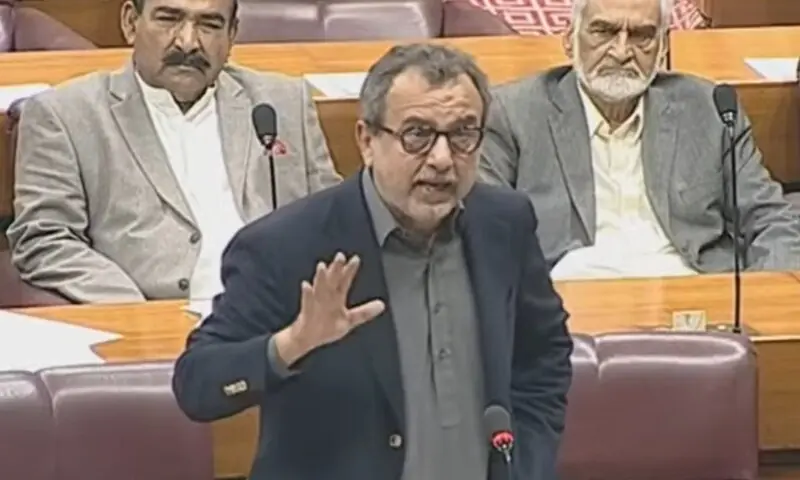

Tensions flared in the National Assembly as the house debated recent changes regarding net-metering, with Power Minister Sardar Awais Leghari maintaining that the issue was about “fair pricing, not being anti-solar”.
The power regulator on Monday changed the terms of contracts for all existing and future net-metered solar consumers — known as prosumers — to contain rising solar energy penetration and protect an expensive and inefficient state-owned power network. The notification effectively terminated the existing net-metering regime and replaced it with net-billing for all.
A day earlier, Prime Minister Shehbaz Sharif directed the Power Division to file a review appeal against it after the action drew much criticism.
In response to a call to attention notice — regarding prosumer regulations — raised by PPP’s Sharmila Faruqui during today’s session, Leghari spoke in defence of the move. He began his address by presenting “some key facts”.

He recalled that the issue had been under discussion for the “past 9-10 months”, adding that when the matter was forwarded to the federal cabinet, Prime Minister Shehbaz Sharif “told us to engage in further deliberations”.

The minister said that the total distributed solar generation in the country was estimated to be between 20,000 MW and 22,000 MW, out of which, “only 6,000-7,000MW of solar systems were on net-metering”.
He continued: “Out of these, only 2,200MW are used by industrial units, while the number for commercial and domestic consumers stood at 4,800MW.”

“Out of these, only 456,000 consumers use net-metering,” the minister said, stressing that given the limited number of consumers, it was “false to say that the general public will suffer due to the move”.
He maintained that only 8-10 per cent of the total solar consumers used the net-metering system. The minister stressed that the issue was not about “being anti-solar, but about fair pricing”.
The minister added that the proposed regulation had maintained the purchase rate for existing users at Rs27 due to “contractual obligations”; however, he noted that “this sparked another debate”.
He said that the net-metering users complained, “if you buy it from us at Rs27, and then give it to us at the rates of Rs45-65. How is this fair?”
“I will tell you how it is fair, this is fair [..] because with all the hydel, solar, wind, nuclear, gas, and coal sources combined, the average price is Rs8.31, then how can you justify the rate of Rs27,” the minister said.
He said that despite the “concessions”, PM Shehbaz has directed the Power Division to “file a review petition to the regulator and limit the move”.
The minister said that if the government were to continue with the policy, “these 456,000 investors, their profit will go down from 50pc to 37pc per year. Is that so bad?”
He stressed that “no one was going to incur any losses”.
“If the electricity cost goes down by Rs1-1.5 for the general consumers and you still get a 37pc profit, then, how can you say that the policy does not serve public interest?” he said.
“Yet, the prime minister has directed us to wait until the NEPRA hearing,” he added.
The minister said that the prime minister further directed the Power Division to develop a strategy to “lessen the burden on others caused by net-metering solar consumers”.
MNA Sharmila Faruqui terms action ‘daylight robbery’
Faruqui, in response to the minister’s remarks, objected to the minister for “shifting the blame to net-metering users for burdening the national grid”.
“These consumers are the ones who followed the government’s clean energy policy,” she said, stressing that the government had taken a “U-turn on their policies”.
“Now they are justifying it by blaming people who were at the forefront of your policy,” she said.
She maintained that the Power Division was “compensating for the cost incurred from line losses and transmission losses, their own inefficiency, inconsistency, corruption, line losses, capacity payments from the people”.
She termed the action “broad daylight robbery”.